Spišská Belá · under the Belianske TatrySpišská Belá · pod Belianskymi Tatrami
Culture in Spišská BeláKultúra v Spišskej Belej
A Spiš town with a bell tower it built to show off, a museum of photography in the house where the lens designer was born, and a Renaissance manor on its southern edge that belongs to the national gallery.Spišské mesto so zvonicou postavenou na obdiv, s múzeom fotografie v rodnom dome konštruktéra objektívu a s renesančným kaštieľom na južnom okraji, ktorý patrí národnej galérii.
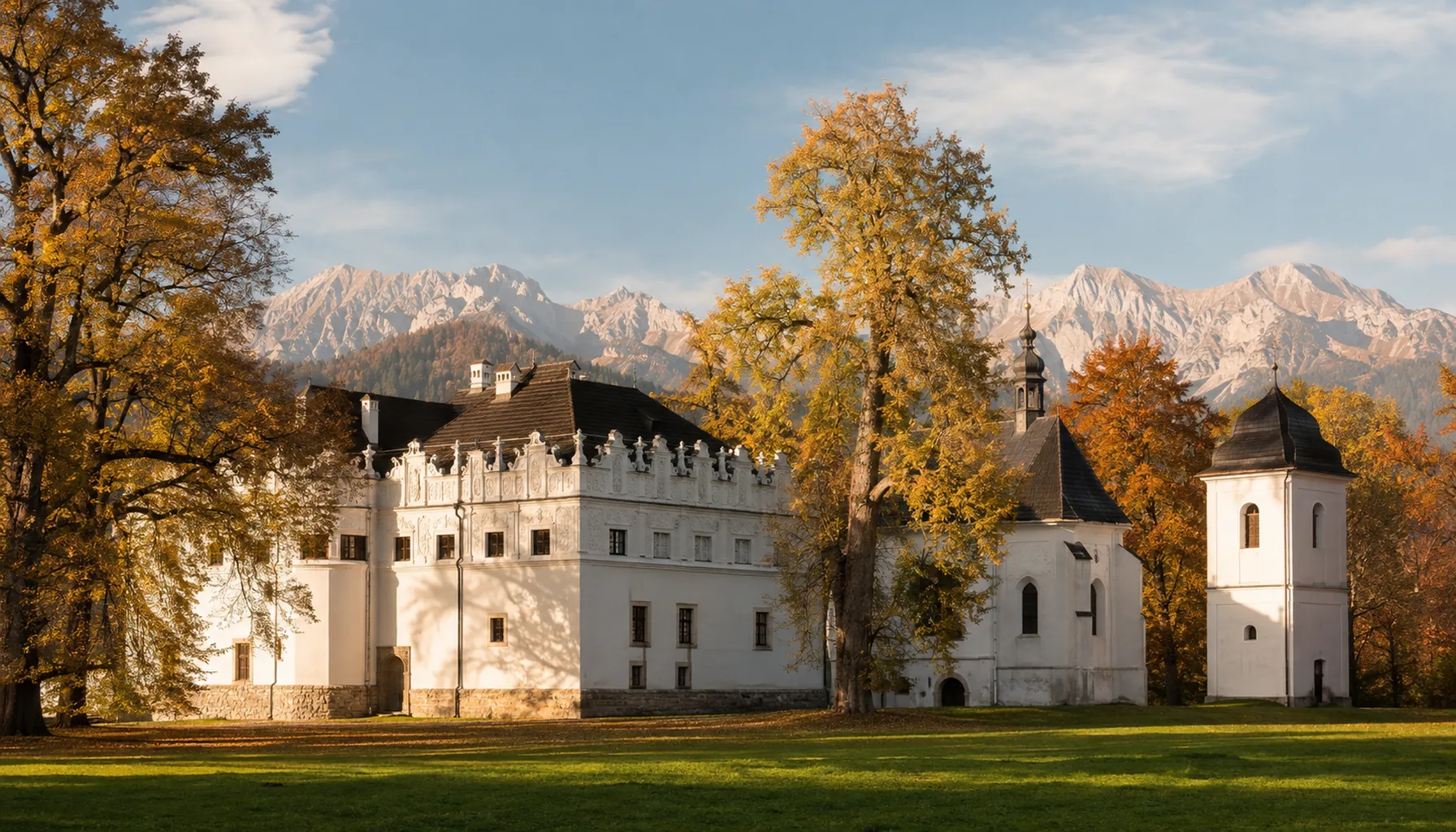
The Renaissance manor of Strážky on the edge of Spišská Belá, with its church, bell tower and park of old trees under the Belianske Tatry.Renesančný kaštieľ Strážky na okraji Spišskej Belej s kostolom, zvonicou a parkom starých stromov pod Belianskymi Tatrami.
The year in Spišská BeláRok v Spišskej Belej
This is a small town whose year is set less by festivals than by seasons and opening times. The road north through Ždiar to the Polish crossing at Lysá Poľana runs through it, and the traffic is heaviest in the ski months and in high summer; tourism passes through Spišská Belá rather than stopping in it. The two things that do hold people — the Petzval museum and the manor at Strážky — keep museum hours, and those hours are the practical shape of a visit.Je to malé mesto, ktorého rok neurčujú ani tak festivaly, ako skôr sezóny a otváracie hodiny. Prechádza ním cesta na sever cez Ždiar k poľskému priechodu na Lysej Poľane a najhustejšia je v lyžiarskych mesiacoch a vo vrcholnom lete; turizmus Spišskou Belou skôr prechádza, než by sa v nej zastavil. Dve veci, ktoré ľudí zdržia — Petzvalovo múzeum a kaštieľ v Strážkach — majú múzejné hodiny a práve tie určujú, ako bude návšteva vyzerať.
For the rest, the calendar is the ordinary one of a Spiš market town: the church year, a town day, a market. We name no individual event, because in a town of this size a festival can run for five years and then stop, and a page that promises one is worse than a page that does not. The town's own listings are the place to check, and the gallery at Strážky publishes its own programme.Inak je kalendár taký, aký má spišské trhové mesto: cirkevný rok, mestské dni, trh. Konkrétne podujatia tu nemenujeme, lebo v meste tejto veľkosti môže festival bežať päť rokov a potom prestať a stránka, ktorá ho sľubuje, je horšia než stránka, ktorá mlčí. Overiť si to treba v mestských oznamoch a galéria v Strážkach zverejňuje vlastný program.
Where culture livesKde žije kultúra
Strážky is the reason a good many people come at all. The Renaissance manor on the southern edge of the town, with its church, its bell tower and a park of old trees, belonged in turn to the Horváth-Stansith and Mednyánszky families and now belongs to the Slovak National Gallery, which keeps a permanent display there with the painter Ladislav Mednyánszky at its centre. He was brought to Strážky as a boy and worked there for long stretches of his life, so the pictures hang in the rooms they came out of. Strážky was a separate village until 1 January 1972.Strážky sú dôvodom, prečo sem mnohí vôbec prídu. Renesančný kaštieľ na južnom okraji mesta, s kostolom, zvonicou a parkom starých stromov, patril postupne rodinám Horváth-Stansith a Mednyánszky a dnes patrí Slovenskej národnej galérii, ktorá tu má stálu expozíciu s maliarom Ladislavom Mednyánszkym v strede. Do Strážok ho priviedli ako chlapca a pracoval tu veľké časti svojho života, takže obrazy visia v miestnostiach, z ktorých vzišli. Strážky boli samostatnou obcou do 1. januára 1972.
In the town itself, the house where Jozef Maximilián Petzval was born is a museum of photography — the right subject in the right building, for reasons set out below. Beyond those two the pattern is the standing one: a cultural centre, a library, a school of art for children, amateur singing and folk groups, none of them named here because premises and programmes change faster than this page does. The larger institutions are in Kežmarok and Poprad, a few minutes down the valley.V samotnom meste je rodný dom Jozefa Maximiliána Petzvala múzeom fotografie — správna téma v správnej budove, z dôvodov uvedených nižšie. Okrem týchto dvoch platí obvyklá schéma: kultúrne stredisko, knižnica, základná umelecká škola, amatérsky spev a folklórne skupiny, pričom žiadnu z nich tu nemenujeme, lebo priestory a programy sa menia rýchlejšie než táto stránka. Väčšie inštitúcie sú v Kežmarku a v Poprade, pár minút dole dolinou.
The buildings that carry itBudovy, ktoré ju nesú
The Gothic church of St Anthony the Abbot and the free-standing Renaissance bell tower beside it are the centre of the town. The tower, with its decorated attic storey, is one of the better examples of a type built all over the Spiš in the sixteenth and seventeenth centuries: towns put their bells in a separate structure rather than on the church, partly for practical reasons and mostly as a boast. The tower was what the town could afford, and it was the town — not a lord, not a bishop — that paid for it.Gotický kostol svätého Antona Pustovníka a samostatne stojaca renesančná zvonica vedľa neho tvoria stred mesta. Zvonica s ozdobnou atikou patrí k lepším príkladom typu, ktorý sa v šestnástom a sedemnástom storočí staval po celom Spiši: mestá dávali zvony do samostatnej stavby a nie na kostol, sčasti z praktických dôvodov a najmä na obdiv. Zvonica bola tým, na čo malo mesto peniaze — a platilo ju mesto, nie zemepán a nie biskup.
That is the key to the whole place. Spišská Belá is first named in writing in 1263 and had town rights by 1271, the year King Stephen V confirmed the Spiš Saxons as one self-governing province with its own elected count. Rights in writing meant a market, a court of your own and dealings with the king rather than with a landlord, which is why this corner of Slovakia is full of small towns instead of large estates. The town was founded by German settlers and was German-speaking for much of its history; that community ended with the Second World War. At Strážky a different tradition ran alongside: the Horváth-Stansith family held the manor from 1556 and ran a Latin humanist school there from 1584.V tom je kľúč k celému mestu. Spišská Belá sa písomne prvý raz spomína v roku 1263 a mestské práva mala v roku 1271, teda v tom istom roku, keď kráľ Štefan V. potvrdil spišských Sasov ako jednu samosprávnu provinciu s vlastným voleným grófom. Práva na papieri znamenali trh, vlastný súd a jednanie priamo s kráľom namiesto so zemepánom — preto je tento kút Slovenska plný malých miest namiesto veľkých panstiev. Mesto založili nemeckí osadníci a veľkú časť dejín bolo nemecky hovoriace; táto komunita sa skončila s druhou svetovou vojnou. V Strážkach bežala popri tom iná tradícia: rodina Horváth-Stansith držala kaštieľ od roku 1556 a od roku 1584 tam viedla latinskú humanistickú školu.
Two men who measured thingsDvaja muži, ktorí merali
Jozef Maximilián Petzval was born here on 6 January 1807, taught mathematics in Pest and then for forty years in Vienna, and in 1840 calculated by hand a photographic lens far faster than anything then in use. It let through roughly sixteen times more light and cut the time a sitter had to hold still from as much as half an hour to under a minute. That single calculation turned photography from a laboratory experiment into a trade, and portrait studios opened across Europe within a few years. He died in Vienna in 1891, and the house he was born in holds the museum.Jozef Maximilián Petzval sa tu narodil 6. januára 1807, učil matematiku v Pešti a potom štyridsať rokov vo Viedni a v roku 1840 na papieri vypočítal fotografický objektív oveľa svetelnejší než čokoľvek vtedy používané. Prepúšťal asi šestnásťkrát viac svetla a skrátil čas, počas ktorého musel portrétovaný vydržať bez pohnutia, z takmer polhodiny na menej než minútu. Tento jediný výpočet premenil fotografiu z laboratórneho pokusu na remeslo a portrétne ateliéry sa o pár rokov otvárali po celej Európe. Zomrel vo Viedni v roku 1891 a v jeho rodnom dome je dnes múzeum.
The second name belongs to the mountains above the town. Ľudovít Greiner, a forester in the service of the estates here, established by measurement in the 1830s that Gerlachovský štít and not Lomnický štít is the highest peak of the Tatras — a correction that stuck. He spent his working life in this district and is commemorated in the town. The Belianske Tatry themselves are almost entirely closed to walkers for nature protection, with only a few signed exceptions; the show cave at Tatranská Kotlina, a short drive west, is how most people see the inside of this end of the range.Druhé meno patrí horám nad mestom. Ľudovít Greiner, lesník v službách tunajších panstiev, v tridsiatych rokoch devätnásteho storočia meraním dokázal, že najvyšším štítom Tatier je Gerlachovský štít a nie Lomnický — oprava, ktorá platí dodnes. Prežil tu celý pracovný život a mesto si ho pripomína. Belianske Tatry sú pre turistov takmer celé zatvorené z dôvodu ochrany prírody, s pár vyznačenými výnimkami; sprístupnená jaskyňa v Tatranskej Kotline, kúsok na západ, je spôsob, akým väčšina ľudí uvidí vnútro tohto konca pohoria.