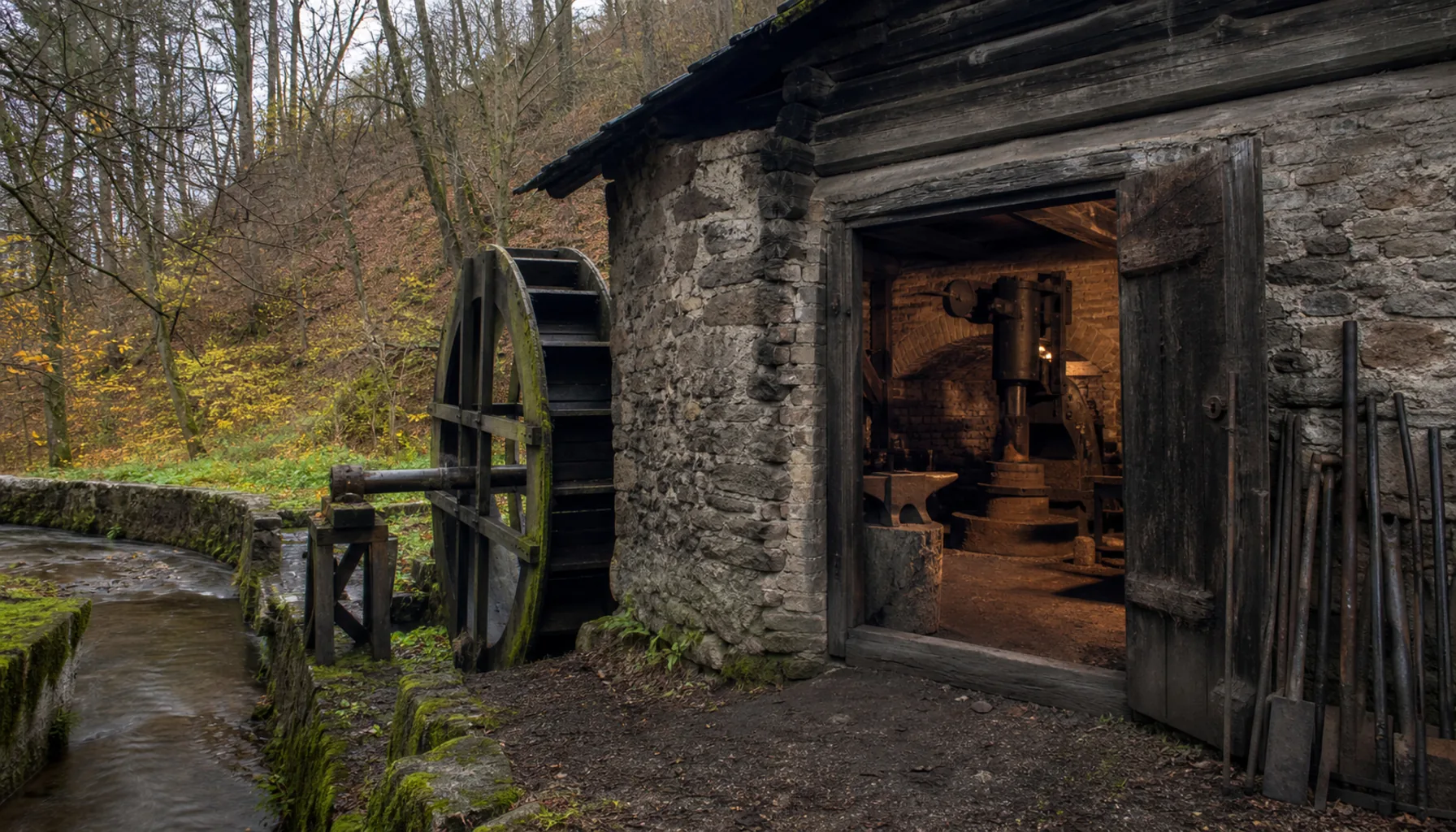
The hammer-forge town of the Bodva valley: a German-speaking settlement whose water-driven forges beat out hoes, spades and picks for the whole of Upper Hungary, and several of which still stand on the stream.Hámorné mesto v doline Bodvy: nemecky hovoriaca osada, ktorej vodou poháňané hámre vyklepávali motyky, rýle a čakany pre celé Horné Uhorsko — a niekoľko z nich stojí pri potoku dodnes.
A water-driven hammer forge on the Bodva at MedzevVodou poháňaný hámor na Bodve v Medzeve
Where it standsKde leží
Medzev lies in the upper Bodva valley on the southern edge of the Volovské vrchy, about thirty kilometres west of Košice and a little above Moldava nad Bodvou, where the valley opens towards the Slovak Karst. The hills around it are forested and full of running water, which is the whole point of the town.Medzev leží v hornej doline Bodvy na južnom okraji Volovských vrchov, asi tridsať kilometrov západne od Košíc a kúsok nad Moldavou nad Bodvou, kde sa dolina otvára smerom k Slovenskému krasu. Okolité kopce sú zalesnené a plné tečúcej vody — a práve v tom je celý zmysel mesta.
Vyšný Medzev, a separate village, continues up the same valley. The two were twin centres of one trade and are usually spoken of together.Vyšný Medzev, samostatná obec, pokračuje tou istou dolinou vyššie. Obe boli dvojicou stredísk jedného remesla a hovorí sa o nich zvyčajne spolu.
The storyHistória
German settlers were brought into these valleys during the medieval mining colonisation of the Ore Mountains, and their descendants in Medzev were known as Mantáci — a community with a dialect of its own, distinct both from the Zipser Germans of Spiš and from the Gründler miners of the Hnilec valley.Nemeckých osadníkov priviedli do týchto dolín pri stredovekej banskej kolonizácii Rudohoria a ich potomkov v Medzeve nazývali Mantáci — spoločenstvo s vlastným nárečím, odlišné od spišských Nemcov aj od gründlerských baníkov z Hnileckej doliny.
Their trade was not mining but hammering. The Bodva and its side streams were led into races that drove tilt hammers, and the forges — hámre — turned bar iron into tools: hoes, spades, shovels, mattocks, picks and axes. Scores of them worked along the water at the height of the trade in the nineteenth century, and Medzev tools were sold across the Kingdom of Hungary and traded south into the Balkans.Ich remeslom nebolo baníctvo, ale kovanie. Bodvu a jej prítoky zviedli do náhonov, ktoré poháňali bucharové kladivá, a hámre menili tyčové železo na náradie: motyky, rýle, lopaty, krompáče, čakany a sekery. Vo vrcholnom období v 19. storočí ich pri vode pracovali desiatky a medzevské náradie sa predávalo po celom Uhorsku a obchodovalo sa s ním až na Balkán.
The trade collapsed when factory-made tools took the market, and the community that had carried it was broken after 1945, when most of the German-speaking population was evacuated, deported or expelled. A small number stayed; the dialect survives now among a few older speakers and in the work of the local German cultural association.Remeslo sa zrútilo, keď trh prevzalo továrensky vyrábané náradie, a spoločenstvo, ktoré ho nieslo, sa po roku 1945 rozpadlo, keď väčšinu nemecky hovoriaceho obyvateľstva evakuovali, odvliekli alebo vysídlili. Malá časť zostala; nárečie dnes žije u niekoľkých starších ľudí a v práci miestneho nemeckého kultúrneho spolku.
What to seeČo vidieť
The forges are the reason to come. Several survive along the Bodva as protected technical monuments — a timber and stone shed over a wheel race, with the hammer, the hearth and the bellows still in place — and at least one is kept in working order and fired for visitors. Access depends on whoever holds the key rather than on posted hours, so arrange it in advance.Hámre sú dôvodom, prečo sem prísť. Niekoľko ich pozdĺž Bodvy prežilo ako chránené technické pamiatky — drevená a kamenná kolňa nad náhonom, v nej kladivo, vyhňa a mechy na svojom mieste — a aspoň jeden sa udržiava v prevádzkyschopnom stave a pre návštevníkov ho rozkúria. Prístup závisí skôr od toho, kto má kľúč, než od vyvesených hodín, preto si návštevu dohodnite vopred.
The town itself is a long street of low houses with the Roman Catholic church on it and a cemetery whose German inscriptions are a plain record of who lived here. It reads as a valley settlement rather than as a market town, because that is what it was.Samotné mesto je dlhá ulica nízkych domov s rímskokatolíckym kostolom a cintorínom, ktorého nemecké nápisy sú prostým záznamom o tom, kto tu žil. Pôsobí ako dolinová osada, nie ako trhové mesto — a presne tým aj bolo.
Two places nearby are worth a whole day. Jasov, a few kilometres south-east, has a Premonstratensian monastery with a Baroque church and a frescoed library, and a dripstone cave listed as World Heritage with the other caves of the Slovak Karst. Štós, up in the forest to the north-west, has a climatic spa that has treated respiratory illness since the nineteenth century; check that it is open before making the trip.Dve miesta v okolí stoja za celý deň. Jasov pár kilometrov na juhovýchod má premonštrátsky kláštor s barokovým kostolom a freskovou knižnicou a kvapľovú jaskyňu zapísanú do svetového dedičstva spolu s ostatnými jaskyňami Slovenského krasu. Štós hore v lese na severozápade má klimatické kúpele, ktoré od 19. storočia liečia dýchacie choroby; pred cestou si overte, či sú v prevádzke.
Work and industryPráca a priemysel
Metalworking did not vanish altogether — there is engineering and small manufacturing in and around the town — but most working people commute to Košice, which is close enough for a daily journey. Forestry and wood processing take up much of the rest.Kovospracovanie celkom nezmizlo — v meste a okolí je strojárstvo a drobná výroba —, no väčšina zamestnaných dochádza do Košíc, ktoré sú dosť blízko na každodennú cestu. Zvyšok napĺňa lesníctvo a drevospracovanie.
The forges themselves are heritage now rather than industry, kept up by their owners and by the town and shown as demonstration rather than production. That is an honest description and not a complaint: a working water-driven hammer is a rare thing anywhere in Europe.Samotné hámre sú dnes skôr dedičstvom než priemyslom; udržiavajú ich majitelia a mesto a ukazujú sa ako ukážka, nie ako výroba. Je to poctivý opis, nie sťažnosť: fungujúci vodný hámor je vzácnosťou kdekoľvek v Európe.
Getting thereAko sa tam dostať
Buses from Košice run up the Bodva valley through Jasov to Medzev and Vyšný Medzev, and by car the same road is the direct approach. The nearest railway station is Moldava nad Bodvou, on the Košice to Rožňava line.Autobusy z Košíc idú dolinou Bodvy cez Jasov do Medzeva a Vyšného Medzeva a autom je tá istá cesta najpriamejším príjazdom. Najbližšia železničná stanica je Moldava nad Bodvou na trati Košice – Rožňava.
Explore MedzevObjavujte Medzev
Every part of this place with a page of its own.Každá časť tohto miesta, ktorá má vlastnú stránku.