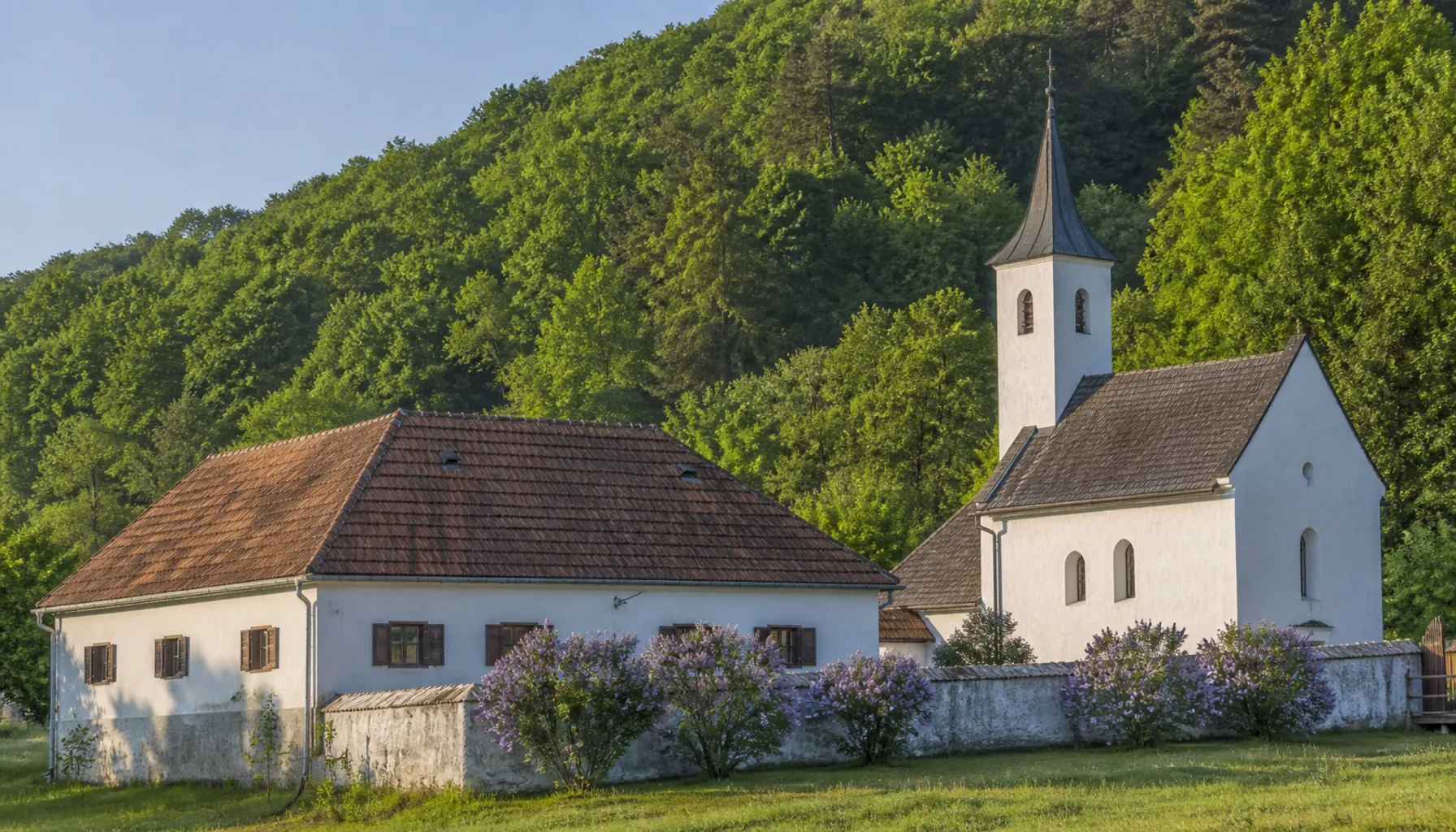
A village in a deep valley of the Myjava hills where, in the summer of 1843, Štúr, Hurban and Hodža sat in the Lutheran parish house and settled what modern written Slovak would be built on.Obec v hlbokej doline Myjavskej pahorkatiny, kde v lete 1843 sedeli Štúr, Hurban a Hodža na evanjelickej fare a dohodli sa, na čom bude postavená moderná spisovná slovenčina.
The Lutheran parish house at Hlboké, where the 1843 agreement was made, with the church beside itEvanjelická fara v Hlbokom, kde vznikla dohoda z roku 1843, a kostol vedľa nej
Where it standsKde leží
Hlboké lies between Senica and Myjava, in the folded hill country where the Little Carpathians run out into the Myjava uplands. The name is a description: the village sits along the floor of a deep, narrow valley, with its fields and its outlying farmsteads on the ridges above.Hlboké leží medzi Senicou a Myjavou, vo zvlnenej pahorkatine, kde Malé Karpaty prechádzajú do Myjavskej pahorkatiny. Názov je opisom: obec sa tiahne dnom hlbokej úzkej doliny a jej polia i samoty ležia na chrbtoch nad ňou.
This is the edge of kopanice country — a settlement pattern of scattered farmsteads on the slopes instead of one compact village — and the hamlets above the valley belong to the municipality as much as the houses along its floor.Sme na okraji kopaníc — sídelného vzorca rozptýlených usadlostí po svahoch namiesto jednej zomknutej dediny — a osady nad dolinou patria k obci rovnako ako domy na jej dne.
Why it is herePrečo práve tu
The origins of the village are unremarkable: a valley settlement of farmers which, after the Reformation took hold across this corner of the country, was a Lutheran one. What made Hlboké matter is that in 1843 its Lutheran pastor was Jozef Miloslav Hurban.Počiatky obce sú nenápadné: roľnícka osada v doline, ktorá sa po tom, ako sa v tomto kúte krajiny presadila reformácia, stala evanjelickou. Dôležitým sa Hlboké stalo tým, že v roku 1843 tu bol evanjelickým farárom Jozef Miloslav Hurban.
In the summer of that year Ľudovít Štúr and Michal Miloslav Hodža came to Hurban's parish house here, and the three of them settled that a common written Slovak would be built on the central dialects — not on the western ones Bernolák had used, and not on the Czech that Lutherans had written in for generations. From Hlboké they went on to Dobrá Voda to put the plan to the old poet Ján Hollý. Štúr's grammar followed in 1846.V lete toho roku prišli na tunajšiu Hurbanovu faru Ľudovít Štúr a Michal Miloslav Hodža a všetci traja sa dohodli, že spoločná spisovná slovenčina bude postavená na stredoslovenských nárečiach — nie na západoslovenských, ktoré použil Bernolák, a nie na češtine, ktorou evanjelici písali po generácie. Z Hlbokého šli do Dobrej Vody predložiť zámer starému básnikovi Jánovi Hollému. Štúrova gramatika vyšla v roku 1846.
Hurban stayed. He was pastor here for the rest of his life, wrote and published from the village through the revolution of 1848 and the decades of Magyarization that followed it, and is buried here. His life has its own place on this site; what belongs on this page is that it was lived in this valley.Hurban ostal. Bol tu farárom do konca života, z obce písal a vydával počas revolučného roku 1848 aj v desaťročiach maďarizácie, ktoré nasledovali, a je tu aj pochovaný. Jeho životopis má na tomto webe vlastné miesto; sem patrí to, že sa odohral práve v tejto doline.
What you actually seeČo naozaj uvidíte
The parish house is a plain single-storey building of the kind every Lutheran parish in this country once had, and the plainness is the point: the agreement was made in a working pastor's home, not at an institution. Part of it is kept as a memorial to Hurban and to what was decided in 1843.Fara je jednoduchá prízemná budova, akú kedysi mala každá evanjelická farnosť v tejto krajine, a práve tá jednoduchosť je podstatná: dohoda vznikla v domácnosti fungujúceho farára, nie v inštitúcii. Časť budovy je zachovaná ako pamätník Hurbana a toho, na čom sa tu v roku 1843 dohodli.
The Lutheran church stands beside it, and Hurban's grave is in the churchyard, marked by a memorial that later generations put up. Between those two buildings and the slope behind them, the historic part of the village is a five-minute walk.Vedľa nej stojí evanjelický kostol a na cintoríne je Hurbanov hrob s pomníkom, ktorý postavili neskoršie generácie. Historická časť obce je medzi týmito dvoma budovami a svahom za nimi — prejdete ju za päť minút.
The rest of the reward is the valley itself: lanes climbing to the kopanice, old orchards, and long views over the Myjava hills from the tops.Zvyšok odmeny je samotná dolina: cesty stúpajúce ku kopaniciam, staré sady a z hrebeňov dlhé výhľady na Myjavskú pahorkatinu.
Living village, not a museumŽivá obec, nie skanzen
Hlboké is a small working village, not a memorial site with a car park. The church is a functioning Lutheran church with a congregation, and the parish house is partly lived and worked in. The memorial rooms are not continuously staffed: opening tends to be by arrangement, through the parish or the municipality, and most happens around the July anniversaries, when there are commemorations.Hlboké je malá fungujúca obec, nie pamätné miesto s parkoviskom. Kostol je fungujúcim evanjelickým kostolom s cirkevným zborom a fara sa sčasti obýva a pracuje sa v nej. Pamätné priestory nemajú stály personál: otvára sa spravidla po dohode, cez farský úrad alebo obec, a najviac sa deje okolo júlových výročí, keď sú spomienkové slávnosti.
Anyone who needs to get inside should arrange it first. Anyone who does not can still stand in the yard where it happened, which is most of what there is to feel here.Kto sa potrebuje dostať dnu, nech si to vopred dohodne. Kto nie, môže aj tak stáť na dvore, kde sa to odohralo — a to je väčšina toho, čo tu možno precítiť.
Getting thereAko sa tam dostať
There is no railway in the village. Buses run from Senica and from Myjava, and by car Hlboké is a signposted turn off the road between the two; the nearest stations are in both those towns.Železnica do obce nevedie. Autobusy premávajú zo Senice a z Myjavy a autom je Hlboké značenou odbočkou z cesty medzi nimi; najbližšie stanice sú v oboch týchto mestách.
Explore HlbokéObjavujte Hlboké
Every part of this place with a page of its own.Každá časť tohto miesta, ktorá má vlastnú stránku.