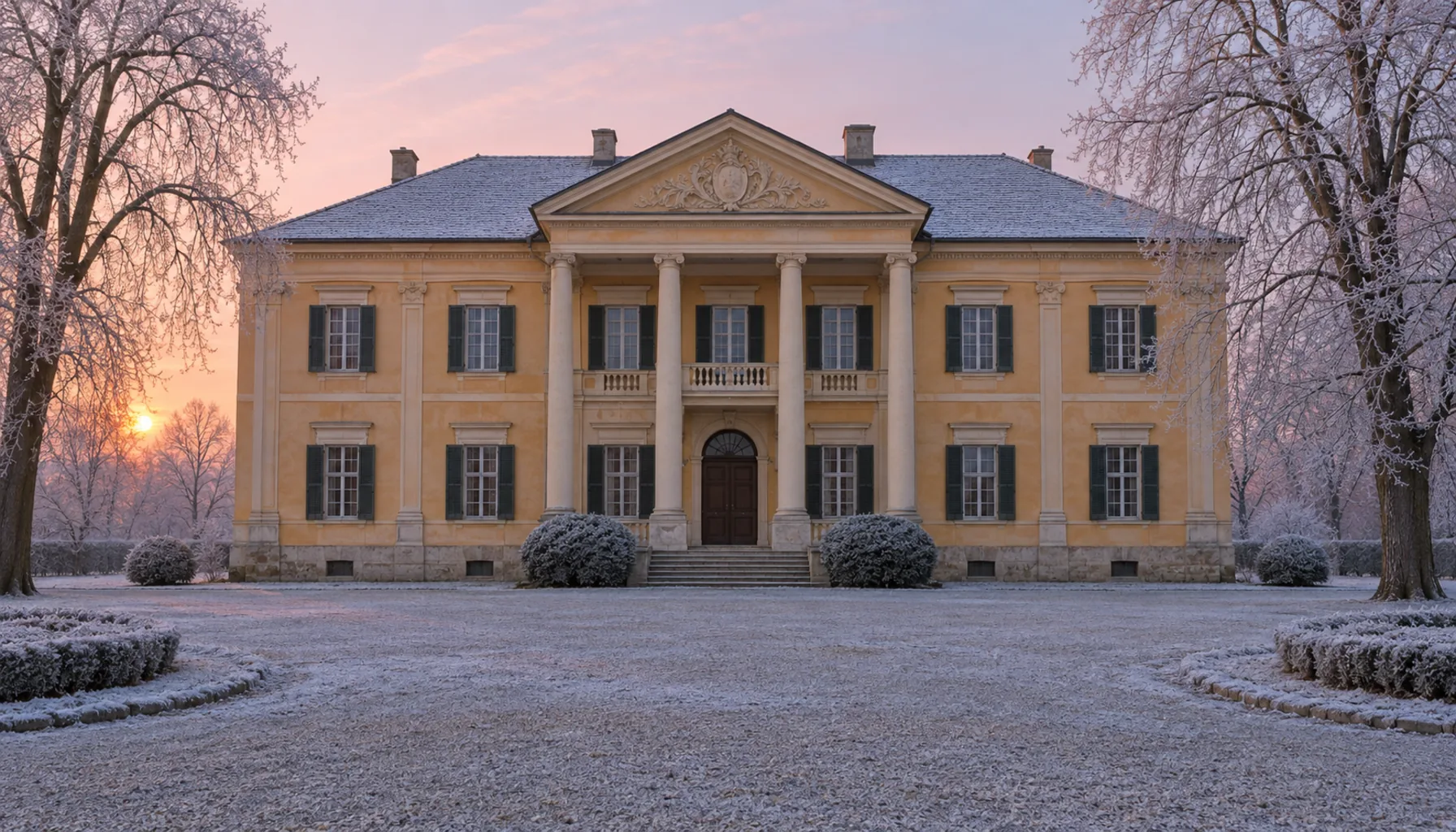
A market town that industry rebuilt into a district seat, keeping a classicist manor house, a gallery of modern Slovak painting and the memory of the corner of the country where written Slovak was settled.Trhové mestečko, ktoré priemysel prestaval na okresné sídlo — s klasicistickým kaštieľom, galériou moderného slovenského maliarstva a pamäťou kraja, kde sa dohodla spisovná slovenčina.
The classicist manor house in Senica, home of the Záhorie Gallery, on a frosty winter morning.Klasicistický kaštieľ v Senici, v ktorom sídli Záhorská galéria, v mrazivé zimné ráno.
The year in SenicaRok v Senici
Senica has held markets by charter since 1396, and King Sigismund confirmed its annual fairs and its exemption from certain tolls in 1419. That is the oldest thing about the town's year and still the plainest: the surrounding villages came here to sell grain and buy iron, and the square is where they did it. What is on today is the calendar of a district seat — a town day, markets, church feasts, school and club events, and a summer that moves out to Kunov reservoir on the northern edge for swimming and fishing. We name no individual festivals, because programmes change faster than a page like this does.Senica má trhové právo od roku 1396 a kráľ Žigmund jej v roku 1419 potvrdil výročné jarmoky a oslobodenie od niektorých mýt. Je to najstaršia vec na mestskom roku a stále aj tá najzrozumiteľnejšia: okolité dediny sem chodili predať obilie a kúpiť železo a robili to na námestí. Dnešný kalendár je kalendárom okresného sídla — dni mesta, trhy, cirkevné sviatky, školské a spolkové podujatia a leto, ktoré sa presúva ku Kunovskej priehrade na severnom okraji za kúpaním a rybačkou. Jednotlivé podujatia tu nemenujeme, lebo programy sa menia rýchlejšie než takáto stránka.
The largest gathering in the district's year does not happen in Senica at all. The Basilica of the Seven Sorrows of the Virgin Mary at Šaštín-Stráže, a short drive south-west, is the national Marian shrine of Slovakia and its principal place of pilgrimage; Pope Francis said Mass there in 2021. Behind the reservoir the marked trails climb into the Myjava hills and the White Carpathians — walking country rather than mountaineering country.Najväčšie zhromaždenie v roku sa v okrese nekoná v Senici. Bazilika Sedembolestnej Panny Márie v Šaštíne-Strážach, kúsok cesty na juhozápad, je národnou mariánskou svätyňou Slovenska a jeho hlavným pútnickým miestom; pápež František tam v roku 2021 slúžil omšu. Za priehradou stúpajú značené chodníky do Myjavskej pahorkatiny a Bielych Karpát — kraj na chodenie, nie na horolezectvo.
Where culture livesKde žije kultúra
The main indoor stop is the manor house, which holds the Záhorie Gallery. It is named after Ján Mudroch, born in the town in 1909, who became one of the central figures of Slovak modern painting, and its collection of twentieth-century Slovak painting is stronger than a town of this size would lead you to expect. It is the one thing here a visitor would travel for: not a castle, not a square, but a regional gallery in a lord's house.Hlavnou zastávkou pod strechou je kaštieľ, v ktorom sídli Záhorská galéria. Nesie meno Jána Mudrocha, ktorý sa v meste narodil v roku 1909 a stal sa jednou z ústredných postáv slovenského moderného maliarstva; jej zbierka slovenskej maľby dvadsiateho storočia je silnejšia, než by ste od mesta tejto veľkosti čakali. Je to jediná vec, za ktorou sa sem oplatí prísť zvlášť: nie hrad, nie námestie, ale krajská galéria v panskom dome.
Everything else is the ordinary infrastructure of a district town, and we describe it as a category rather than naming names: a cultural centre with a hall and a programme, a public library, a school of art for children, amateur choirs and folk groups, and the halls of the secondary schools. Senica has that infrastructure because of a decision taken in 1960, when the administrative map was redrawn and the town became the seat of a district covering a wide stretch of central Záhorie. The hospital, the schools and the offices are here for that reason, and so is the audience that fills a hall on a winter evening.Všetko ostatné je bežná výbava okresného mesta a opisujeme ju radšej ako kategóriu, než by sme menovali: kultúrny dom so sálou a programom, mestská knižnica, základná umelecká škola, ochotnícke zbory a folklórne skupiny a sály stredných škôl. Senica ju má vďaka rozhodnutiu z roku 1960, keď sa prekreslila správna mapa a mesto sa stalo sídlom okresu pre široký pás stredného Záhoria. Preto je nemocnica, školy aj úrady práve tu — a preto je tu aj publikum, ktoré v zimný večer zaplní sálu.
The buildings that carry itBudovy, ktoré ju nesú
Senica has no castle and never had one: the ground is flat sandy Záhorie and offers nothing to build on. The lordly seat here was a fortified house on the level, and what survives is its classicist rebuilding — the manor house that now holds the gallery. The stone castle of the region went up elsewhere: after the Mongol army broke the royal host in 1241, King Béla IV pushed his nobles to build on high ground, and between 1251 and 1261 a lord of the Aba family put up Branč on a hill in the ridges. Senica itself is first written down in 1256, in a charter of that same king.Senica nemá hrad a nikdy ho nemala: podklad je rovné piesočnaté Záhorie a nedáva na čom stavať. Panským sídlom tu bol opevnený dom na rovine a to, čo sa zachovalo, je jeho klasicistická prestavba — kaštieľ, v ktorom je dnes galéria. Kamenný hrad kraja vyrástol inde: keď v roku 1241 mongolské vojsko rozbilo kráľovskú hotovosť, Belo IV. tlačil šľachtu, aby stavala na výšinách, a v rokoch 1251 až 1261 postavil pán z rodu Abovcov hrad Branč na kopci v pahorkatine. Sama Senica je prvý raz spomenutá v roku 1256 v listine toho istého kráľa.
The parish church carries the second story. The Reformation went through Záhorie quickly and Senica, like its landlords, became Lutheran; then the Habsburg court won the country back town by town, and in 1654 the parish church here was returned to the Catholics. Both congregations are in the town today. Nearby stand a monument to those executed in the revolution of 1848 and a liberation memorial unveiled on the square in 1965; the rest of the skyline is the flats, schools and shops that went up around Slovenský hodváb, the fibre works rebuilt after 1948 on the plant opened here in 1920.Druhý príbeh nesie farský kostol. Reformácia prešla Záhorím rýchlo a Senica sa spolu so zemepánmi stala luteránskou; potom si habsburský dvor získaval krajinu späť mesto po meste a v roku 1654 bol tunajší farský kostol vrátený katolíkom. Obe cirkvi sú v meste dodnes. Neďaleko stojí pamätník popraveným v revolúcii roku 1848 a oslobodzovací pamätník odhalený na námestí v roku 1965; zvyšok panorámy tvoria byty, školy a obchody, ktoré vyrástli okolo Slovenského hodvábu, prestavaného po roku 1948 z továrne otvorenej tu v roku 1920.
The corner of the country where Slovak was settledKút krajiny, kde sa dohodla slovenčina
The map of the Slovak national movement of the 1840s is a small one, and Senica sits inside it. In July 1843, at Hlboké a short way from the town, the Lutheran pastor Jozef Miloslav Hurban settled with Ľudovít Štúr and Michal Miloslav Hodža what written Slovak would be built on. Five years later Hurban was one of the leaders of the revolution: a national assembly met at Brezová pod Bradlom on 28 April 1848, and on 19 September the Slovak volunteers proclaimed their national council at Myjava. All of those places are within an hour of Senica.Mapa slovenského národného hnutia štyridsiatych rokov 19. storočia je malá a Senica leží v nej. V júli 1843 sa v Hlbokom kúsok od mesta evanjelický farár Jozef Miloslav Hurban dohodol s Ľudovítom Štúrom a Michalom Miloslavom Hodžom na tom, na čom bude stáť spisovná slovenčina. O päť rokov bol Hurban jedným z vodcov revolúcie: 28. apríla 1848 zasadalo národné zhromaždenie na Brezovej pod Bradlom a 19. septembra vyhlásili slovenskí dobrovoľníci na Myjave svoju národnú radu. Všetky tieto miesta sú do hodiny od Senice.
The reprisals came off the same small map. Vilko Šulek, born at Sobotište just outside Senica, was hanged on 20 October 1848 and his comrade Karol Holuby six days later; the monument in the town remembers them. What followed was two generations of pressure from the other direction — the Slovak grammar schools closed in the 1870s, Matica slovenská shut in 1875, Hungarian required even in village classrooms by 1907 — while the sandy farms failed to feed the families on them and people left for America in numbers. Both halves of that story are why a small Záhorie town takes its own memory seriously.Odveta prišla z tej istej malej mapy. Vilka Šuleka, rodáka zo Sobotišťa hneď za Senicou, obesili 20. októbra 1848 a jeho druha Karola Holubyho o šesť dní neskôr; pamätník v meste na nich pamätá. Nasledovali dve generácie tlaku z opačnej strany — slovenské gymnáziá zatvorili v sedemdesiatych rokoch 19. storočia, Maticu slovenskú zrušili v roku 1875 a od roku 1907 sa maďarčina vyžadovala aj v dedinských triedach — kým piesočnaté polia neuživili rodiny a ľudia hromadne odchádzali do Ameriky. Obe polovice tohto príbehu sú dôvodom, prečo malé záhorské mesto berie svoju pamäť vážne.