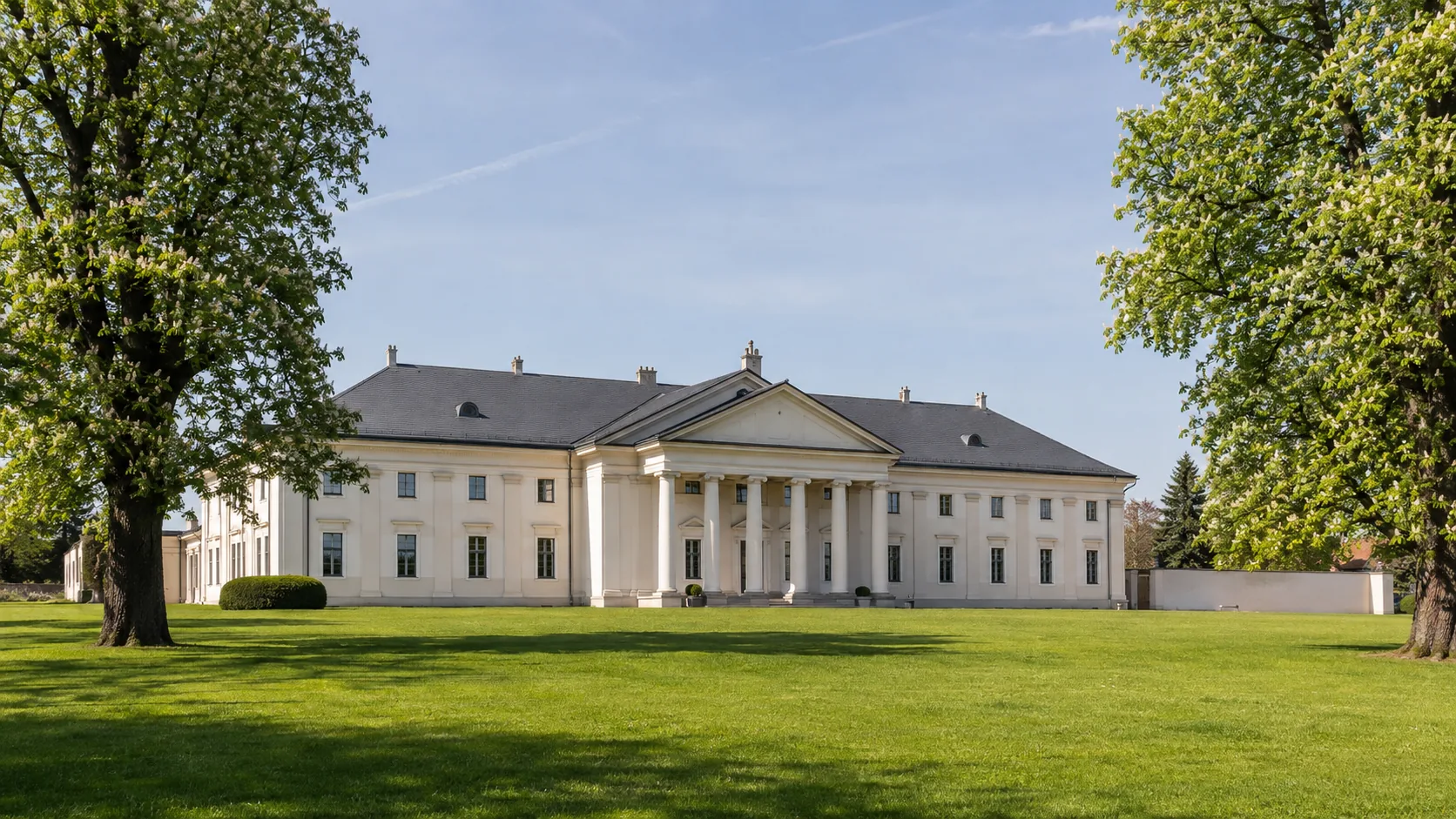
The market town at the centre of Záhorie, on the Myjava river under the White Carpathians — a classicist manor house holding the region's art gallery, a reservoir on its northern edge, and the national Marian shrine of Šaštín a short drive away.Trhové mesto v strede Záhoria, na rieke Myjave pod Bielymi Karpatmi — klasicistický kaštieľ s regionálnou galériou, priehrada na severnom okraji a národná mariánska svätyňa v Šaštíne na skok autom.
The classicist manor house in Senica, home of the Záhorie GalleryKlasicistický kaštieľ v Senici, sídlo Záhorskej galérie
Where it standsKde leží
Senica lies in the middle of the Záhorie plain on the Myjava river, with the White Carpathians and the Myjava hills closing the view to the north-east and pine woods and sandy ground running west towards the Morava. Trnava is about an hour away by road, Bratislava a little more.Senica leží uprostred záhorskej roviny na rieke Myjave, pričom výhľad na severovýchod uzatvárajú Biele Karpaty a myjavské kopce, kým na západ smerom k Morave sa tiahnu borovicové lesy a piesočnatá pôda. Trnava je autom asi hodinu ďaleko, Bratislava o niečo viac.
It is the district seat for a wide stretch of central Záhorie — a country of villages, forest and sand that has always been more thinly settled than the plain on the other side of the Little Carpathians.Je okresným sídlom pre široký pás stredného Záhoria — kraja dedín, lesa a piesku, ktorý bol vždy redšie osídlený než rovina na druhej strane Malých Karpát.
The storyHistória
Senica appears in the records in the thirteenth century and spent most of its history as a market town on the road between Trnava and the Morava crossings. Its lordly seat was a fortified house on the flat rather than a castle on a rock — the ground here offers nothing to build a castle on.Senica sa v písomných prameňoch objavuje v 13. storočí a väčšinu svojich dejín prežila ako trhové mesto na ceste medzi Trnavou a prechodmi cez Moravu. Panským sídlom tu bol opevnený dom na rovine, nie hrad na skale — tunajší terén na hrad neponúka nič.
The manor house that survives is a classicist rebuilding of that seat, and it now holds the Záhorie Gallery, named after the painter Ján Mudroch, who was born in the town in 1909 and became one of the central figures of Slovak modern painting.Zachovaný kaštieľ je klasicistickou prestavbou tohto sídla a dnes v ňom sídli Záhorská galéria pomenovaná po maliarovi Jánovi Mudrochovi, ktorý sa v meste narodil v roku 1909 a stal sa jednou z ústredných postáv slovenského moderného maliarstva.
The twentieth century turned Senica into an industrial town almost overnight. A large chemical-fibre works, Slovenský hodváb — 'Slovak Silk' — was built here after the war and drew workers from the whole district. It did not survive the change of economic system, and the years that followed were spent rebuilding a more varied industrial base out of what was left.Dvadsiate storočie premenilo Senicu na priemyselné mesto takmer zo dňa na deň. Po vojne tu vyrástol veľký závod na chemické vlákna Slovenský hodváb, ktorý pritiahol robotníkov z celého okresu. Zmenu hospodárskeho systému neprežil a nasledujúce roky mesto strávilo budovaním pestrejšieho priemyslu z toho, čo zostalo.
What to seeČo vidieť
The manor house and its gallery are the main indoor stop, with a collection of twentieth-century Slovak painting stronger than a town of this size would suggest.Kaštieľ s galériou je hlavnou zastávkou pod strechou — so zbierkou slovenského maliarstva 20. storočia silnejšou, než by sa v meste tejto veľkosti čakalo.
Kunov reservoir, on the northern edge of the town, is the local water: fishing, a walk round the shore, swimming in summer. Beyond it the marked trails climb into the Myjava hills and the White Carpathians, which are walking country rather than mountaineering country — long ridges, meadows and scattered hamlets.Kunovská priehrada na severnom okraji mesta je miestnou vodou: rybárčenie, okruh po brehu, v lete kúpanie. Za ňou stúpajú značené chodníky do myjavských kopcov a Bielych Karpát, ktoré sú skôr krajinou na pešiu turistiku než na horolezectvo — dlhé hrebene, lúky a roztrúsené kopanice.
The most visited building in the district is not in Senica at all. The Basilica of the Seven Sorrows of the Virgin Mary at Šaštín-Stráže, a short drive south-west, is the national shrine of Slovakia and its principal place of pilgrimage; Pope Francis celebrated Mass there in 2021.Najnavštevovanejšia stavba okresu nestojí v Senici. Bazilika Sedembolestnej Panny Márie v Šaštíne-Strážach, kúsok autom na juhozápad, je národnou svätyňou Slovenska a jeho hlavným pútnickým miestom; v roku 2021 tam slúžil omšu pápež František.
Work and industryPráca a priemysel
After the fibre works closed, employment moved to engineering, plastics, rubber and food processing in the industrial zones around the town, alongside the services a district seat carries — hospital, secondary schools, administration.Po zániku závodu na vlákna sa zamestnanosť presunula do strojárstva, spracovania plastov, gumárenstva a potravinárstva v priemyselných zónach okolo mesta, popri službách, ktoré so sebou nesie okresné sídlo — nemocnica, stredné školy, úrady.
The countryside around it is farmed but not rich. Sandy Záhorie soil suits rye, potatoes, asparagus and pine plantations better than the wheat that the plain east of the Little Carpathians grows, and forestry is a real employer here in a way it is not further south.Okolitá krajina sa obrába, no bohatá nie je. Piesočnatej záhorskej pôde svedčí skôr raž, zemiaky, špargľa a borovicové lesy než pšenica, ktorú rodí rovina východne od Malých Karpát, a lesníctvo je tu skutočným zamestnávateľom, čo sa o juhu kraja povedať nedá.
Getting thereAko sa tam dostať
The railway between Trnava and Kúty runs through Senica, and the main road from Trnava towards Holíč and Skalica passes through the town; the D2 motorway on the Záhorie side is a short drive west. Buses connect it with Bratislava, Trnava and Myjava.Cez Senicu vedie železnica z Trnavy do Kútov a mestom prechádza hlavná cesta z Trnavy smerom na Holíč a Skalicu; diaľnica D2 na záhorskej strane je kúsok autom na západ. Autobusy ju spájajú s Bratislavou, Trnavou a Myjavou.
Explore SenicaObjavujte Senica
Every part of this place with a page of its own.Každá časť tohto miesta, ktorá má vlastnú stránku.