A flat market town that gave its name twice over — once to one of the great families of the Kingdom of Hungary, and once to an orchestral piece played all over the world.Rovinaté trhové mesto, ktoré svoje meno darovalo dvakrát — raz jednej z veľkých uhorských rodín a raz orchestrálnemu dielu, ktoré sa hrá po celom svete.
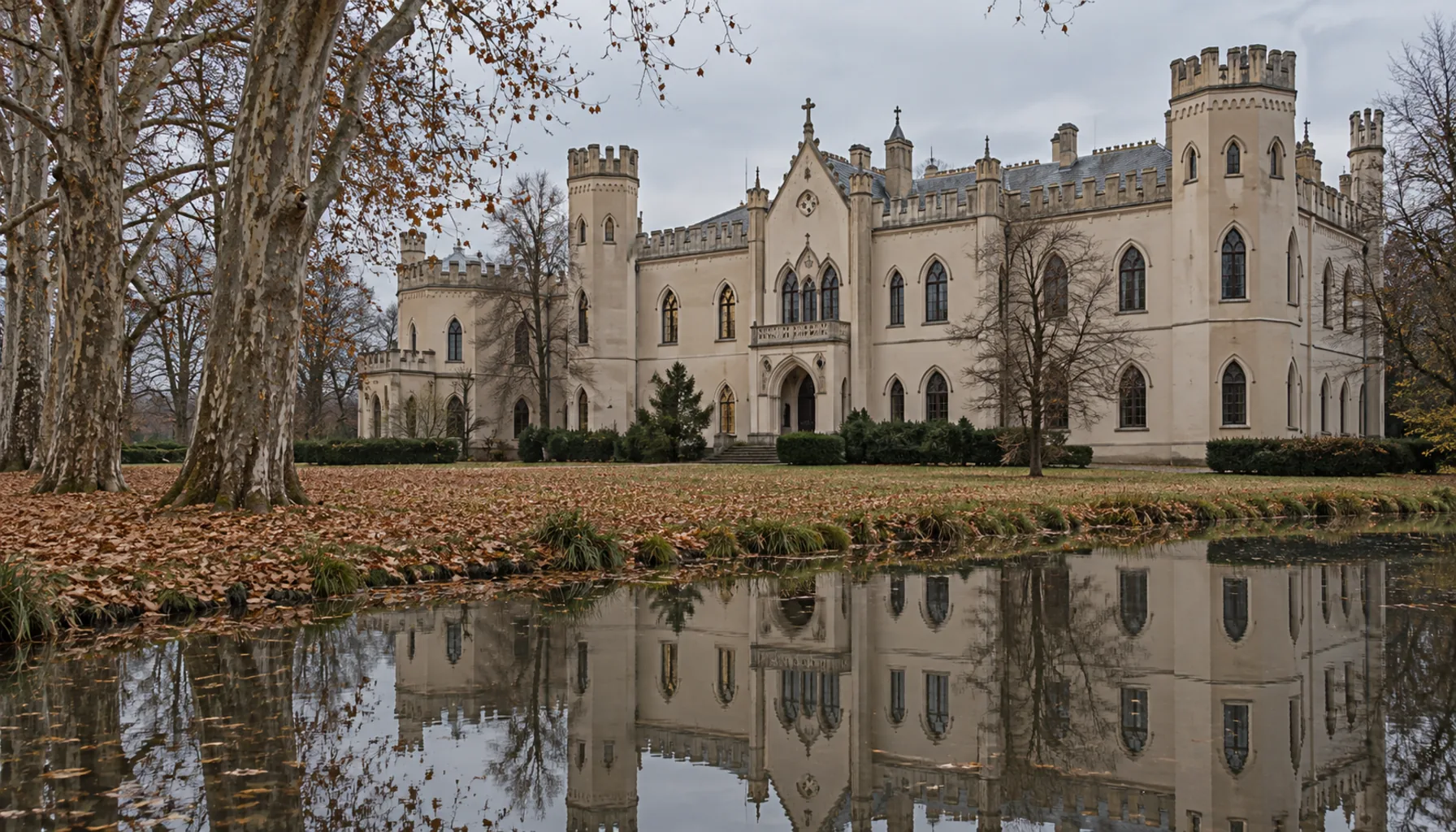
The neo-Gothic Esterházy château in Galanta, seen across its park in November.Neogotický Esterháziovský kaštieľ v Galante pohľadom cez park v novembri.
The year in GalantaRok v Galante
Galanta's year has been organised around fairs for four hundred years. The town was granted the standing of a free market town in 1613 or 1614, and in 1635 Ferdinand II confirmed four annual fairs and a weekly market — in effect, a licence to make money from the road between Turkish-held Buda and the royal capital at Pressburg. In the quiet eighteenth century the crafts organised themselves into guilds that set prices and trained apprentices, and the fairs grew with them. A market town's calendar is a trading calendar first and a festive one second, and that is still the shape of the year here.Rok v Galante je už štyristo rokov usporiadaný okolo jarmokov. Mesto získalo postavenie slobodného trhového mestečka roku 1613 alebo 1614 a roku 1635 potvrdil Ferdinand II. štyri výročné jarmoky a týždenný trh — v podstate povolenie zarábať na ceste medzi tureckým Budínom a kráľovským hlavným mestom Prešporkom. V pokojnom osemnástom storočí sa remeslá zorganizovali do cechov, ktoré určovali ceny a vychovávali učňov, a jarmoky rástli s nimi. Kalendár trhového mesta je najprv obchodný a až potom sviatočný, a taký je tvar roka tu dodnes.
What you will find now is the ordinary calendar of a district town: a town day in the warm months, markets, church feasts, concerts in the house of culture, and the summer season at the thermal park on the edge of town, which is the reason a good many Slovak families know the name Galanta at all. We name no festival and give no dates, because programmes are set year by year and change faster than a page like this does; the town's own listings are the reliable source. Slovak and Hungarian are both everyday languages here, and the Hungarian name of the town is Galánta.Dnes tu nájdete obyčajný kalendár okresného mesta: dni mesta v teplých mesiacoch, trhy, hody, koncerty v dome kultúry a letnú sezónu v termálnom areáli na okraji mesta, vďaka ktorému vôbec pozná meno Galanta množstvo slovenských rodín. Konkrétne názvy ani dátumy tu neuvádzame — programy sa určujú rok po roku a menia sa rýchlejšie než takáto stránka; spoľahlivým zdrojom sú mestské vývesky a webová stránka. Slovenčina aj maďarčina sú tu každodenné jazyky a maďarské meno mesta je Galánta.
Where culture livesKde žije kultúra
More than anywhere else, the town's cultural life is housed in the two Esterházy manor houses. The neo-Gothic one of 1860 and its park are the landmark; the Renaissance house a few streets away has been restored and put to public use after a long interruption. That restoration began in the 1980s and was broken off when the state paying for it ceased to exist, and the building then waited years for a new owner and a new budget. Anyone reading that as a picture of the whole decade would not be far wrong.Kultúrny život mesta je viac než kdekoľvek inde uložený v dvoch esterházyovských kaštieľoch. Novogotický z roku 1860 a jeho park sú dominantou mesta; renesančný kaštieľ o pár ulíc ďalej bol po dlhom prerušení obnovený a sprístupnený verejnosti. Obnova sa začala v osemdesiatych rokoch a zastala, keď prestal existovať štát, ktorý ju platil, takže budova roky čakala na nového vlastníka a nový rozpočet. Kto v tom vidí obraz celého desaťročia, nebude ďaleko od pravdy.
Beyond the houses the institutions are the ordinary ones of a district town: a house of culture with a hall and a programme, a library, a regional museum whose collections are shown in the manor houses rather than in a building of their own, amateur choirs and folk groups, and a school of art for children. We name none of them individually, because premises and programmes move. Galanta is also a practical base for the flat country around it — drainage canals, the backwaters of the Little Danube, and villages that keep the low brick-and-plaster architecture that has largely gone from the bigger towns.Okrem kaštieľov sú inštitúcie tie obvyklé pre okresné mesto: dom kultúry so sálou a programom, knižnica, vlastivedné múzeum, ktorého zbierky sú vystavené v kaštieľoch a nie vo vlastnej budove, amatérske zbory a folklórne skupiny a základná umelecká škola pre deti. Menovite ich neuvádzame, lebo priestory aj programy sa menia. Galanta je zároveň praktickým východiskom do rovinatého okolia — kanálov, ramien Malého Dunaja a dedín, ktoré si zachovali nízku tehlovo-omietkovú architektúru, aká vo väčších mestách takmer zmizla.
The buildings that carry itBudovy, ktoré ju nesú
Two houses, one family, three hundred years. There was never a castle here — you cannot put a castle on flat mud, which is why the wave of stone building that followed the Mongol defeat of the royal army in 1241 passed this lowland by, and the country was ruled from manor houses instead. A Renaissance manor went up around 1600 under Ferenc Esterházy. A second house followed in 1633 under his sons Dániel and Pál, was rebuilt in the baroque taste in 1736, and was made over again in 1860 by József Esterházy into the neo-Gothic building with turrets and pointed windows that people photograph today: a medieval look laid over a seventeenth-century body.Dva kaštiele, jedna rodina, tristo rokov. Hrad tu nikdy nestál — na rovnom blate sa hrad postaviť nedá, a preto vlna kamenného staviteľstva, ktorá prišla po tom, čo Mongoli roku 1241 rozbili kráľovské vojsko, túto rovinu obišla a vládlo sa odtiaľto z kúrií a kaštieľov. Renesančný kaštieľ vyrástol okolo roku 1600 za Ferenca Esterházyho. Druhý dom pribudol roku 1633 za jeho synov Dániela a Pála, roku 1736 bol prestavaný v barokovom vkuse a roku 1860 z neho dal József Esterházy urobiť novogotickú stavbu s vežičkami a lomenými oknami, ktorú dnes všetci fotografujú: stredoveký výzor prehodený cez telo zo sedemnásteho storočia.
The rest of the heritage in the streets is smaller and easy to miss. Cholera swept through in 1873 and the town put up four columns in thanks for surviving it; three of them still stand. The railway station matters as much as any of it. The line from Bratislava to Pest opened through the town in 1850, made Galanta a junction — and it put a stationmaster's family on the platform. The family that carried this town's name across Europe left two houses; the railway left the town its shape.Ostatné pamiatky v uliciach sú menšie a ľahko ich prehliadnuť. Roku 1873 prešla mestom cholera a mesto postavilo štyri stĺpy z vďaky za to, že ju prežilo; tri z nich stoja dodnes. Rovnako dôležitá je železničná stanica. Trať z Bratislavy do Pešti bola cez mesto otvorená roku 1850, urobila z Galanty železničný uzol — a priviedla na perón rodinu prednostu stanice. Rodina, ktorá meno tohto mesta rozniesla po Európe, tu nechala dva kaštiele; železnica dala mestu jeho tvar.
The dances that took the name awayTance, ktoré meno odniesli do sveta
From 1885 the stationmaster's small son listened to the town's bands from that platform. His name was Zoltán Kodály, and in 1933 he turned what he remembered of them into Dances of Galánta, still one of the most played Hungarian orchestral works of the century. It is not folklore collected in a notebook. It is a childhood memory of a particular band in a particular small town, written down by a man who had spent his adult life collecting the real thing and knew exactly what he was doing with it.Od roku 1885 počúval z toho perónu malý syn prednostu stanice mestské kapely. Volal sa Zoltán Kodály a roku 1933 z toho, čo si zapamätal, urobil Galantské tance — dodnes jedno z najhrávanejších maďarských orchestrálnych diel storočia. Nie je to folklór zozbieraný do zápisníka. Je to detská spomienka na konkrétnu kapelu v konkrétnom malom meste, zapísaná človekom, ktorý celý dospelý život zbieral to pravé a presne vedel, čo s ňou robí.
It is worth knowing what that means for a visitor: there is nothing to tour. No house, no plaque circuit, no reconstructed bandstand. What there is is a name read off concert programmes in Vienna, Budapest and Tokyo several times a year, attached to a flat railway town of grain silos and poplar windbreaks. Galanta had already given its name away once before: the Esterházys took the of in their title from this small market village when they acquired the estate in 1421, and carried it across Hungary and into Austria. Twice over, the town's best-known export has been its own name.Pre návštevníka to znamená jedno: nie je čo obchádzať. Niet domu, niet okruhu s tabuľami, niet zrekonštruovaného hudobného pavilónu. Je tu len meno, ktoré niekoľkokrát do roka zaznie z koncertných programov vo Viedni, v Budapešti aj v Tokiu, a patrí rovinatému železničnému mestu obilných síl a topoľových vetrolamov. Galanta pritom svoje meno darovala už raz predtým: Esterházyovci si po získaní panstva roku 1421 vzali z tejto malej trhovej dediny prídomok a odniesli ho cez celé Uhorsko až do Rakúska. Najznámejším vývozným artiklom mesta bolo dvakrát jeho vlastné meno.