A bilingual market town on the lowland between Trnava and the Danube, with two Esterházy châteaux, the childhood streets that Zoltán Kodály later set to music, and a thermal park on its edge.Dvojjazyčné trhové mesto na rovine medzi Trnavou a Dunajom, s dvoma kaštieľmi Esterházyovcov, ulicami Kodályovho detstva, ktoré neskôr vošli do hudby, a termálnym areálom na okraji.
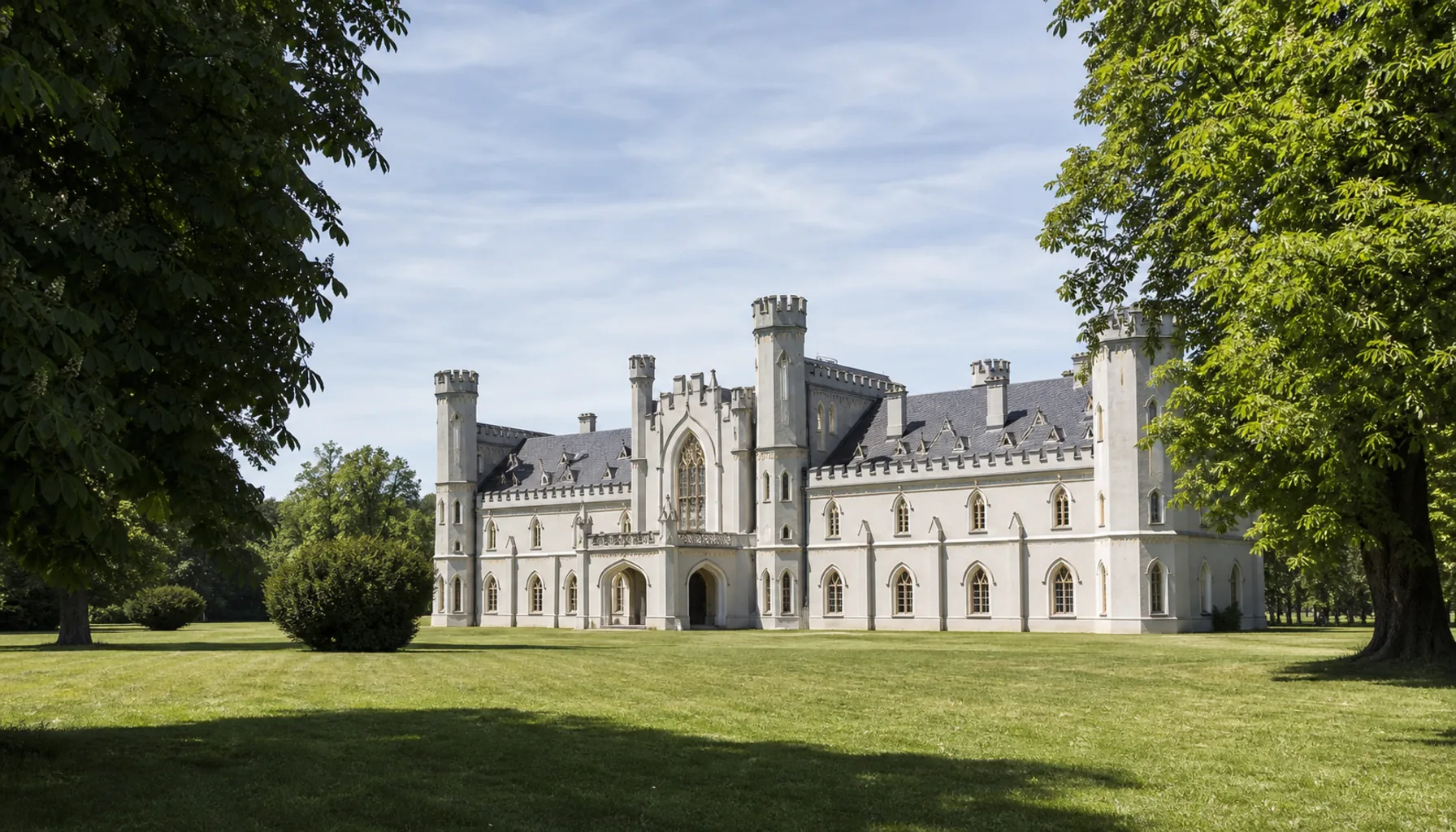
The neo-Gothic Esterházy château in Galanta, seen from its parkNovogotický kaštieľ Esterházyovcov v Galante, pohľad z parku
Where it standsKde leží
Galanta lies on the flat Danubian Lowland about twenty-five kilometres south of Trnava, at the northern edge of the Žitný ostrov country, where the Čierna voda and a web of drainage channels cross fields of wheat and maize. There is no relief in the landscape at all: the horizon is poplar windbreaks and grain silos.Galanta leží na rovine Podunajskej nížiny asi dvadsaťpäť kilometrov južne od Trnavy, na severnom okraji kraja Žitného ostrova, kde polia pšenice a kukurice pretína Čierna voda a sieť odvodňovacích kanálov. Krajina nemá nijaké prevýšenie: horizont tvoria topoľové vetrolamy a obilné silá.
Slovak and Hungarian are both everyday languages here — the Hungarian name of the town is Galánta — and the bilingualism is ordinary rather than remarkable, visible on shopfronts and in the schools.Slovenčina aj maďarčina sú tu bežnou rečou — maďarsky sa mesto volá Galánta — a dvojjazyčnosť je tu samozrejmosťou, nie zvláštnosťou; vidno ju na výkladoch aj v školách.
The storyHistória
Galanta gave its name to one of the great families of the Kingdom of Hungary: the Esterházys of Galánta, who held the estate from the sixteenth century and carried the name in their title wherever else in the kingdom their fortunes took them.Galanta dala meno jednému z veľkých rodov Uhorského kráľovstva: Esterházyovcom z Galanty, ktorí panstvo držali od 16. storočia a meno niesli vo svojom titule všade tam, kam ich v kráľovstve zaviedli ich osudy.
Two of their houses survive in the town and are usually told apart by style — a Renaissance manor house and a nineteenth-century neo-Gothic one. Between them they span three hundred years of the family's taste and standing.V meste sa zachovali dva ich domy a zvyčajne sa rozlišujú podľa slohu — renesančný kaštieľ a novogotický z 19. storočia. Spolu preklenujú tristo rokov vkusu a postavenia rodu.
Zoltán Kodály spent several years of his childhood in Galanta, where his father was the railway stationmaster, and returned to the memory of the town's bands in 1933 with Dances of Galánta, still one of the most played Hungarian orchestral works of the century.Zoltán Kodály prežil v Galante niekoľko rokov detstva — jeho otec tu bol prednostom železničnej stanice — a k spomienke na tunajšie kapely sa vrátil v roku 1933 skladbou Galantské tance, dodnes jedným z najhrávanejších maďarských orchestrálnych diel storočia.
What to seeČo vidieť
The neo-Gothic château and its park are the town's landmark; the Renaissance house nearby has been restored and put to public use. They are best seen as a pair — one family, two very different centuries of building.Novogotický kaštieľ s parkom je dominantou mesta; renesančný dom neďaleko je obnovený a slúži verejnosti. Najlepšie je pozrieť si ich ako dvojicu — jeden rod, dve veľmi odlišné storočia stavania.
Galandia, the thermal complex on the edge of the town, draws on the hot water that lies under the whole southern lowland and is the reason a good many Slovak families know the name Galanta at all.Termálny areál Galandia na okraji mesta čerpá z horúcej vody, ktorá leží pod celou južnou nížinou, a je dôvodom, prečo veľa slovenských rodín názov Galanta vôbec pozná.
The town is a practical starting point for the Žitný ostrov. Flat lanes, drainage canals and the backwaters of the Little Danube make good cycling and canoeing country, and the villages around keep the low brick-and-plaster architecture that has largely gone from the bigger towns.Mesto je praktickým východiskom na Žitný ostrov. Rovinaté cesty, odvodňovacie kanály a ramená Malého Dunaja tvoria dobrý kraj na bicykel aj na kanoe a okolité obce si zachovali nízku tehlovo-omietkovú architektúru, ktorá z väčších miest väčšinou zmizla.
Work and industryPráca a priemysel
Galanta became an electronics town in the early 2000s, when a large consumer-electronics plant opened in its industrial zone and reshaped employment across the district. That industry has since contracted, and engineering, plastics, food processing and logistics along the Bratislava road now carry more of the load.Elektrotechnickým mestom sa Galanta stala začiatkom 21. storočia, keď v jej priemyselnej zóne otvorili veľký závod na spotrebnú elektroniku a zamestnanosť v okrese sa tým prekreslila. Toto odvetvie odvtedy ustúpilo a väčšiu časť bremena dnes nesie strojárstvo, spracovanie plastov, potravinárstvo a logistika pri ceste na Bratislavu.
Agriculture is the constant. This is some of the most productive arable land in Slovakia, farmed in large blocks, and the processing plants, grain traders and machinery dealers that go with it are a real part of the town's economy.Stálicou je poľnohospodárstvo. Ide o jednu z najúrodnejších orných pôd na Slovensku, obrábanú vo veľkých blokoch, a spracovateľské závody, obchodníci s obilím i predajcovia techniky, ktoré k nej patria, sú skutočnou súčasťou hospodárstva mesta.
Getting thereAko sa tam dostať
Galanta is a railway junction: the main line from Bratislava to Nové Zámky and Budapest runs through it, with a branch north through Sereď to Trnava. By road it sits between the D1 motorway and the lowland roads south, and buses run frequently to Trnava, Sereď and Šaľa.Galanta je železničným uzlom: vedie cez ňu hlavná trať z Bratislavy do Nových Zámkov a Budapešti a na sever odbočuje trať cez Sereď do Trnavy. Cestne leží medzi diaľnicou D1 a nížinnými cestami na juh a autobusy premávajú často do Trnavy, Serede a Šale.
Explore GalantaObjavujte Galanta
Every part of this place with a page of its own.Každá časť tohto miesta, ktorá má vlastnú stránku.