A flat farming town on the Danube's gravel island, with the culture of a market village that grew slowly under one family — and a set of lock gates a few kilometres away that draws more visitors than anything in the streets.Rovinaté poľnohospodárske mesto na dunajskom štrkovom ostrove s kultúrou trhovej obce, ktorá pomaly rástla pod jednou rodinou — a s plavebnými komorami pár kilometrov za chotárom, ktoré pritiahnu viac ľudí než čokoľvek v uliciach.
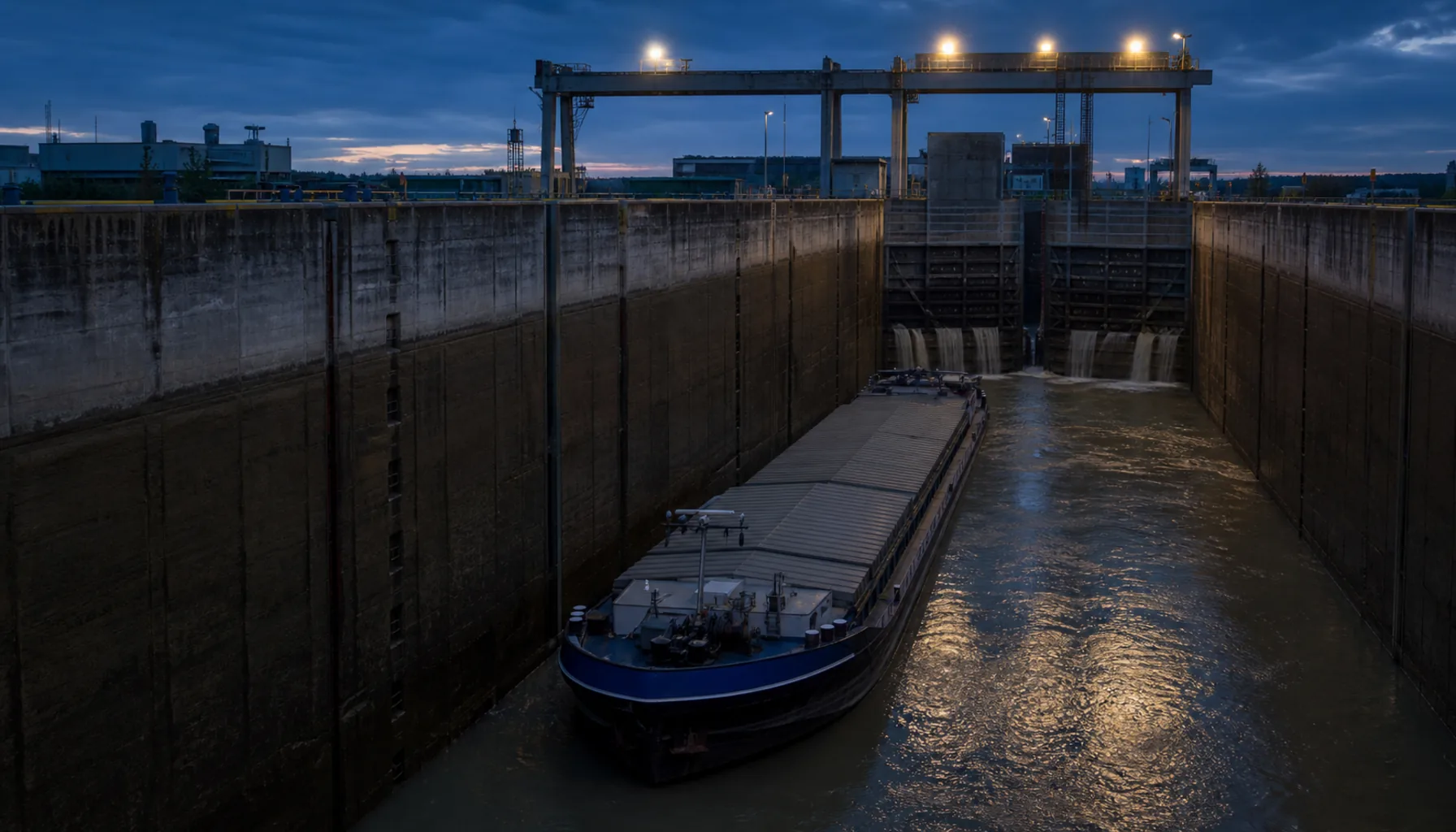
A loaded barge in one of the two lock chambers of the Gabčíkovo barrage on the Danube, at dusk.Naložený čln v jednej z dvoch plavebných komôr gabčíkovského vodného diela na Dunaji, za súmraku.
The year in GabčíkovoRok v Gabčíkove
The town's calendar has one old root. In 1468 King Matthias Corvinus granted Bős — the name the place carried until 1948 — the right to hold a weekly market, and market rights are how ordinary villages in medieval Hungary turned into small towns. The market brought the farmers of the southern half of the island here to sell, and it fixed the wide main street that still runs through the middle of the place. By 1796 a description of the county calls Bős a market town; the charter was restored, after a long interruption, on 1 January 2016.Kalendár mesta má jeden starý koreň. Roku 1468 udelil kráľ Matej Korvín obci Bős — tak sa toto miesto volalo až do roku 1948 — právo konať týždenný trh, a práve trhové právo bolo v stredovekom Uhorsku cestou, ktorou sa z obyčajnej dediny stávalo mestečko. Na trh sem chodili predávať gazdovia z celej južnej polovice ostrova a od neho pochádza aj široká hlavná ulica, ktorá dodnes beží stredom obce. Roku 1796 už opis stolice nazýva Bős trhovým mestečkom; mestské práva sa sem po dlhom prerušení vrátili 1. januára 2016.
Beyond that, keep expectations sober. Gabčíkovo keeps the calendar of a town of its size: patronal feasts at the parish church of St Margaret, a town day in the warm months, events tied to the harvest and the farming year, and the school and cultural-centre concerts that fill the winter. We name no festival here, because programmes of this kind are set year by year and change faster than a page like this does — the town's own noticeboards and website are the reliable source. Summer brings a second, quieter calendar: cyclists on the Danube dyke, and the people who stop to watch a loaded ship rise slowly in the lock.Inak však treba mať triezve očakávania. Gabčíkovo drží kalendár mesta svojej veľkosti: hodové slávnosti pri farskom kostole svätej Margity, dni mesta v teplých mesiacoch, podujatia naviazané na žatvu a na poľnohospodársky rok a zimné koncerty školy a kultúrneho domu. Konkrétne názvy tu neuvádzame — programy tohto druhu sa určujú rok po roku a menia sa rýchlejšie než takáto stránka; spoľahlivým zdrojom sú vývesky a webová stránka mesta. Leto prináša druhý, tichší kalendár: cyklistov na dunajskej hrádzi a ľudí, ktorí zastanú a sledujú, ako sa naložená loď pomaly dvíha v plavebnej komore.
Where culture livesKde žije kultúra
Culture here runs in two everyday languages, Slovak and Hungarian, as it does across the whole island. The institutions are the ordinary ones of a small town: a cultural centre with a hall and a programme, a library, amateur choirs and folk groups, and a school of art for children. We name none of them individually, because premises and programmes change faster than a page like this does.Kultúra tu žije v dvoch každodenných jazykoch, po slovensky a po maďarsky, tak ako na celom ostrove. Inštitúcie sú tie obvyklé pre malé mesto: kultúrny dom so sálou a programom, knižnica, amatérske spevácke zbory a folklórne skupiny a základná umelecká škola pre deti. Menovite ich tu neuvádzame, lebo priestory aj programy sa menia rýchlejšie než takáto stránka
There is no town museum and no gallery, and it would be dishonest to promise either. What Gabčíkovo has instead is a subject that draws people from outside: the waterworks. The two lock chambers lift and lower everything moving between the upper and lower Danube, and watching a loaded ship rise out of one of them holds an audience longer than most exhibitions do. It is a working industrial installation with controlled access, so the reliable public view is from the dyke and the approach road, and organised visits depend on the operator.Mestské múzeum ani galéria tu nie sú a bolo by nečestné ich sľubovať. Gabčíkovo má namiesto toho tému, ktorá sem ťahá ľudí zvonka — vodné dielo. Dve plavebné komory dvíhajú a spúšťajú všetko, čo sa plaví medzi horným a dolným Dunajom, a pohľad na naloženú loď, ktorá sa z komory pomaly dvíha, udrží pozornosť dlhšie než väčšina výstav. Je to však fungujúca priemyselná stavba s riadeným vstupom: spoľahlivý výhľad je z hrádze a z príjazdovej cesty a organizované návštevy závisia od prevádzkovateľa.
The buildings that carry itBudovy, ktoré ju nesú
There is no stone anywhere on this island and no ground higher than a bank of silt, so its lords dug instead of climbing. In 1402 the sources record a fortified manor here with a moat and bastions — a castle made of water, which on the flat was enough to hold off a raiding party until help arrived. The family was the Amades, granted the place in 1264 out of the royal castle estate of Szolgagyőr, and they held it, and the people on it, until serfdom was abolished in 1848.Na tomto ostrove niet kameňa ani zeme vyššej než nános bahna a štrku, a tak tunajší páni namiesto stúpania kopali. Roku 1402 pramene spomínajú opevnené sídlo s vodnou priekopou a baštami — hrad z vody, ktorý na rovine stačil na to, aby zadržal lúpežnú výpravu, kým prišla pomoc. Dedinu aj s ľuďmi na nej držali Amadeovci: dostali ju roku 1264 z majetku kráľovského hradného panstva Szolgagyőr a patrila im až do zrušenia poddanstva roku 1848.
The eighteenth century is what you actually see. In its second half Count Tádé Amade rebuilt the moated house as a baroque manor with towers — the building a family puts up when it no longer expects to be attacked — and the Gothic parish church of St Margaret, standing since the fourteenth century, was given its baroque form in 1770. Around them the town is deliberately plain: a wide main street, low houses with deep gardens, vines over the yards. Nobody comes to Gabčíkovo for its architecture, and the town has never pretended otherwise.To, čo tu naozaj vidno, je osemnáste storočie. V jeho druhej polovici prestaval gróf Tádé Amade staré vodné sídlo na barokový kaštieľ s vežami — teda na stavbu, akú si rodina postaví, keď už neráta s útokom — a gotický farský kostol svätej Margity, stojaci od štrnásteho storočia, dostal roku 1770 barokovú podobu. Okolo nich je mesto zámerne obyčajné: široká hlavná ulica, nízke domy s hlbokými dvormi a záhradami, vinič nad dvorom. Do Gabčíkova nikto nechodí za architektúrou a mesto sa nikdy netvárilo inak.
Water, and the name on the mapVoda a meno na mape
Water is the town's real subject, and it has been a hard one. The Danube took the fields in 1850, 1862, 1876 and 1878; fire took the village itself in 1861 and again in 1867. The regulation of the river in the nineteenth century answered both, and turned a flood plain into the most productive farmland in the country. A sugar factory worked here from 1855 to 1876 and was among the largest in Hungary; then it closed and the place went back to grain. This is a landscape that has been engineered for a century and a half, and the barrage is its latest chapter rather than its first.Skutočnou témou mesta je voda a bola to téma tvrdá. Dunaj vzal polia v rokoch 1850, 1862, 1876 a 1878, oheň vzal samotnú dedinu roku 1861 a znova roku 1867. Regulácia rieky v devätnástom storočí odpovedala na oboje a z povodňovej nivy urobila najúrodnejšiu pôdu v krajine. V rokoch 1855 až 1876 tu pracoval cukrovar, jeden z najväčších v Uhorsku; potom zanikol a obec sa vrátila k obiliu. Táto krajina je inžiniersky prestavaná už poldruha storočia a vodné dielo je jej poslednou kapitolou, nie prvou.
The name is the other thing to understand. The village was Bős until 1948, when it was renamed after Jozef Gabčík, a Slovak soldier of the war years who came from a village near Žilina and had no connection with the island at all. The barrage built under the 1977 treaty then carried that name into the international law reports, and the judgment of the International Court of Justice in 1997 gave neither side a win. The town had very little say in any of it, and the argument is told properly elsewhere on this site. What belongs here is the town's own quiet answer to it: the dyke, the cycle route along the top of it, and the herons and white-tailed eagles in the old river branches south of the fields.Druhá vec, ktorej treba rozumieť, je meno. Obec sa až do roku 1948 volala Bős; vtedy dostala meno po Jozefovi Gabčíkovi, slovenskom vojakovi z vojnových rokov, ktorý pochádzal z obce pri Žiline a s ostrovom nemal nič spoločné. Vodné dielo postavené na základe zmluvy z roku 1977 potom toto meno prenieslo až do medzinárodných súdnych spisov a rozsudok Medzinárodného súdneho dvora z roku 1997 nedal za pravdu ani jednej strane. Mesto do toho mohlo hovoriť len málo a celý spor je na tejto stránke rozpovedaný inde. Sem patrí tichá odpoveď samotného mesta: hrádza, cyklotrasa po jej korune a volavky či orliaky morské v starých ramenách južne od polí.