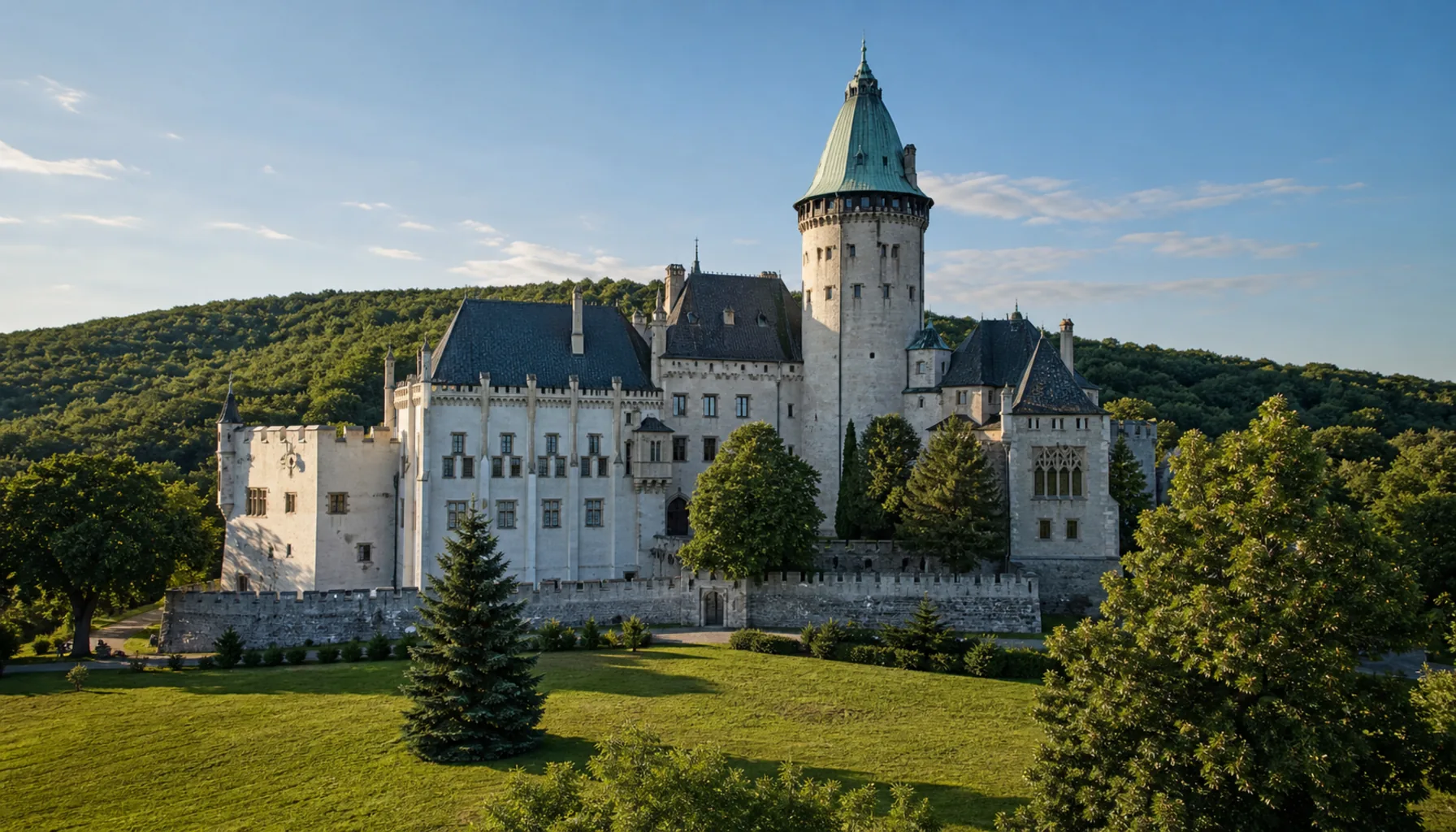
A Castle Built in the Twentieth CenturyZámok postavený v dvadsiatom storočí
There has been a castle on this shoulder of the Little Carpathians since the Middle Ages. It was one of the chain of fortresses guarding the passes over the range, standing where the hills meet the Trnava plain, and it was garrisoned and rebuilt for centuries. Its end came in the early eighteenth century, during the anti-Habsburg uprisings that burned out so many castles in this part of the country. After that, Smolenice was a ruin.Hrad na tomto výbežku Malých Karpát stojí už od stredoveku. Bol jedným z reťaze pevností strážiacich priesmyky cez pohorie, stál tam, kde sa vrchy stretávajú s Trnavskou pahorkatinou, a stáročia sa v ňom striedali posádky a stavebné úpravy. Jeho koniec prišiel na začiatku osemnásteho storočia počas protihabsburských povstaní, ktoré v tejto časti krajiny vypálili toľko hradov. Odvtedy boli Smolenice zrúcaninou.
It stayed one for roughly two hundred years. Then, in the years just before the First World War, Count Jozef Pálffy decided to build himself a residence on the old walls — not a restoration, but a new romantic château in the neo-Gothic taste that had already remade Bojnice: steep roofs, crenellations, a tall round tower with a conical cap. Work began. Then the war came, and the family’s world came apart with it, and the building stopped with its shell up and its interiors unmade.A zostali ňou zhruba dvesto rokov. Potom, v rokoch tesne pred prvou svetovou vojnou, sa gróf Jozef Pálfi rozhodol postaviť si na starých múroch sídlo — nie obnovu, ale nový romantický zámok v neogotickom vkuse, ktorý už predtým pretvoril Bojnice: strmé strechy, cimburie, vysoká okrúhla veža s kužeľovou strieškou. Stavba sa začala. Potom prišla vojna, s ňou sa rozpadol svet rodiny a stavba zastala s hotovým obalom a nedokončeným vnútrom.
The château was only finished decades later, after the Second World War, under the state — and the state gave it a job. It passed to the Slovak Academy of Sciences, which converted it into a conference and congress centre for scientific meetings, a role it still fills. That is the key to understanding Smolenice: it is a working institution that happens to look like a fairy tale, not a museum that happens to hold conferences.Zámok dokončili až o desaťročia neskôr, po druhej svetovej vojne, už za štátu — a štát mu dal úlohu. Prešiel na Slovenskú akadémiu vied, ktorá ho prebudovala na konferenčné a kongresové centrum pre vedecké stretnutia, a túto funkciu plní dodnes. To je kľúč k pochopeniu Smoleníc: je to fungujúca inštitúcia, ktorá náhodou vyzerá ako rozprávka, nie múzeum, ktoré náhodou hostí konferencie.