Stará Turá · The Kopanice and the White CarpathiansStará Turá · Kopanice a Biele Karpaty
Culture in Stará TuráKultúra v Starej Turej
A Lutheran market town under Veľká Javorina whose culture was made on the ridges above it: a summer meeting on the border itself, a tower that is not what it is called, and a writer once read in dozens of languages.Evanjelické trhové mesto pod Veľkou Javorinou, ktorého kultúra vznikla na hrebeňoch nad ním: letné stretnutie priamo na hranici, veža, ktorá nie je tým, ako sa volá, a spisovateľka kedysi čítaná v desiatkach jazykov.
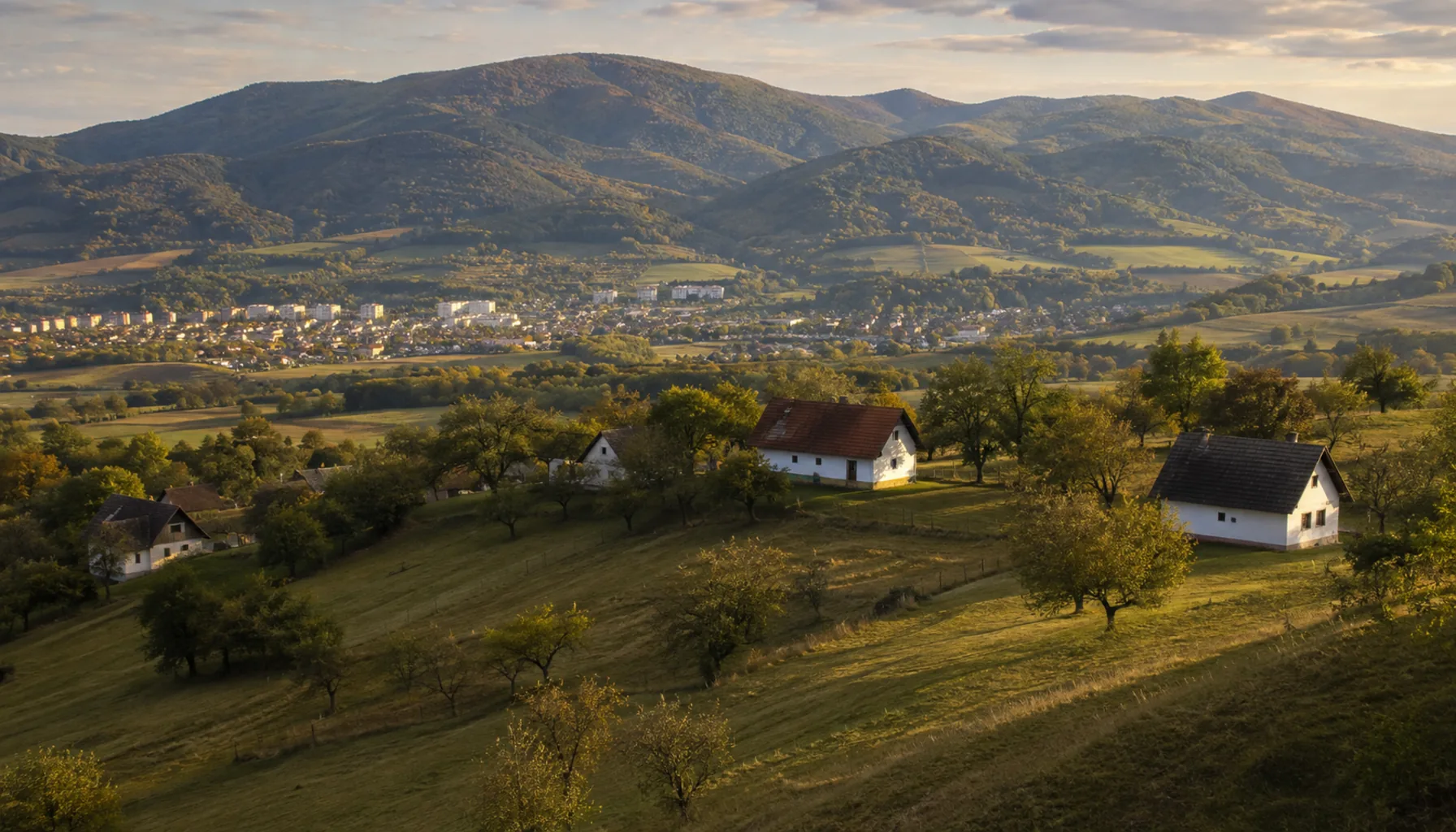
Kopanice farmsteads scattered along the ridges above Stará Turá, with plum orchards and hay meadows between them in late September.Kopaničiarske usadlosti roztrúsené po hrebeňoch nad Starou Turou, medzi nimi slivkové sady a lúky v neskorom septembri.
The year in Stará TuráRok v Starej Turej
The fixed point of the year is up on Veľká Javorina, the 970-metre summit of the White Carpathians above the town, where the border itself runs across the meadow. Gatherings held there since the nineteenth century made the hill the symbol of Czech and Slovak mutuality, and when Czechoslovakia divided on 1 January 1993 the meeting did not stop.Pevným bodom roka je Veľká Javorina, 970 metrov vysoký vrchol Bielych Karpát nad mestom, kde hranica prechádza priamo cez lúku. Stretnutia, ktoré sa tam konajú od devätnásteho storočia, urobili z tohto kopca symbol česko-slovenskej vzájomnosti, a keď sa 1. januára 1993 Československo rozdelilo, stretávanie neprestalo.
It still happens every summer, on a frontier that has been an open one since Slovakia joined the Schengen area in December 2007, so the walk up from either side is now simply a walk. Down in the town the calendar is what a place of this size keeps: a season in the cultural house, town days, a market. Dates are announced locally rather than nationally, so check the town's own listings.Deje sa to každé leto, na hranici, ktorá je od vstupu Slovenska do schengenského priestoru v decembri 2007 otvorená, takže výstup z ktorejkoľvek strany je dnes jednoducho prechádzka. Dole v meste je kalendár taký, aký si drží miesto tejto veľkosti: sezóna v dome kultúry, mestské dni, trh. Termíny sa oznamujú miestne, nie celoštátne, preto si pozrite oznamy mesta.
Where culture livesKde žije kultúra
The organising institution here was never a landlord. Stará Turá belonged to the Čachtice estate from its first written mention in 1392 until serfdom was abolished in 1848, and it never got a castle or a manor house of its own; what organised local life was the Lutheran congregation, and the town is still about two-fifths Lutheran. That is why the cultural inheritance is made so heavily of schooling, temperance work, choirs and print rather than of collections.Inštitúciou, ktorá tu život organizovala, nikdy nebol zemepán. Stará Turá patrila čachtickému panstvu od prvej písomnej zmienky v roku 1392 až do zrušenia poddanstva v roku 1848 a nikdy nedostala vlastný hrad ani kaštieľ; život organizoval evanjelický cirkevný zbor a mesto je dodnes približne z dvoch pätín evanjelické. Preto je kultúrne dedičstvo utkané prevažne zo školstva, abstinenčnej práce, spevokolov a tlače, nie zo zbierok.
What the town keeps today is the ordinary provision — a cultural house with a hall and a programme, a library, a school of art for children, choirs and folk groups — together with the memorials to Kristína Royová. We do not name the institutions one by one, because premises and programmes change faster than a page like this does.Dnes si mesto drží bežnú ponuku — dom kultúry so sálou a programom, knižnicu, základnú umeleckú školu, zbory a folklórne súbory — a k tomu pamätníky Kristíny Royovej. Inštitúcie tu jednotlivo nemenujeme, lebo priestory a programy sa menia rýchlejšie než takáto stránka.
The buildings that carry itBudovy, ktoré ju nesú
The free-standing tower in the cemetery is called the Hussite Tower, and the Hussites had nothing to do with it. Historians have shown it is a seventeenth-century church tower left standing alone after the Church of the Holy Trinity burned in 1770 and was abandoned, and that it doubled as a watchtower for the Čachtice estate. It is the best thing to look at in town and the best warning in town about trusting a name.Voľne stojaca veža na cintoríne sa volá Husitská veža a husiti s ňou nemali nič spoločné. Historici ukázali, že ide o kostolnú vežu zo sedemnásteho storočia, ktorá zostala stáť sama po tom, čo Kostol Najsvätejšej Trojice v roku 1770 zhorel a bol opustený, a že slúžila aj ako strážna veža čachtického panstva. Je to najlepšia vec, na ktorú sa v meste dá pozerať, a najlepšie varovanie pred dôverou v názvy.
The Roman Catholic church of the Assumption was built in 1748 at the initiative of the landlord Juraj Erdödy, on the site the Lutheran congregation had lost in the re-Catholicisation — a confiscated building changed where people could gather, not what they believed. In the cemetery stands a classicist gravestone of 1882 over Ján Pottfay, a municipal official killed in the disturbances of 1848: a broken column, the old symbol for a life cut short. And the kopanice are built heritage in their own right, single farmsteads and small clusters spread along the ridges, three hundred years older than the compact town below them.Rímskokatolícky Kostol Nanebovzatia Panny Márie postavili v roku 1748 z podnetu zemepána Juraja Erdödyho na mieste, o ktoré evanjelický zbor prišiel počas rekatolizácie — zhabaná budova zmenila to, kde sa ľudia mohli schádzať, nie to, čomu verili. Na cintoríne stojí klasicistický náhrobok z roku 1882 nad Jánom Pottfayom, mestským úradníkom zabitým v nepokojoch roku 1848: zlomený stĺp, starý symbol predčasne ukončeného života. A kopanice sú stavebným dedičstvom samy osebe — jednotlivé usadlosti a malé zhluky roztiahnuté po hrebeňoch, o tristo rokov staršie než kompaktné mesto pod nimi.
What this town sent outČo toto mesto poslalo do sveta
Kristína Royová was born here in 1860 and died here in 1936. She wrote Christian fiction that was translated into dozens of languages and made her, for a time, the most widely translated Slovak author there had been — a remarkable thing for a woman from a small Lutheran town who never held any public office. With her sister Mária she started temperance and nursing work in the town, including a home for the sick out of which local health institutions later grew, and the Blue Cross movement in Slovakia began from it.Kristína Royová sa tu narodila v roku 1860 a tu aj v roku 1936 zomrela. Písala kresťanskú prózu, ktorú preložili do desiatok jazykov a ktorá z nej na čas urobila najprekladanejšiu slovenskú autorku, aká dovtedy bola — pozoruhodné pre ženu z malého evanjelického mesta, ktorá nikdy nezastávala verejný úrad. So sestrou Máriou začala v meste abstinenčnú a ošetrovateľskú prácu vrátane domu pre chorých, z ktorého neskôr vyrástli miestne zdravotnícke zariadenia, a odtiaľ sa na Slovensku začalo hnutie Modrého kríža.
Two other natives are read and eaten across the country. Jozef Roháček (1877 to 1962) made the Slovak Bible translation that carries his name and that Slovak Protestants still use. Ján Vagač (1759 to 1835) went off to Detva in central Slovakia and founded what is generally counted the first bryndza dairy in the country — sheep's cheese made on an industrial scale, now the national dish. For a town of eight thousand people on thin soil, that is a considerable export.Ďalší dvaja rodáci sa po celej krajine čítajú a jedia. Jozef Roháček (1877 až 1962) vytvoril slovenský preklad Biblie, ktorý nesie jeho meno a ktorý slovenskí evanjelici používajú dodnes. Ján Vagač (1759 až 1835) odišiel do Detvy na strednom Slovensku a založil to, čo sa vo všeobecnosti považuje za prvú bryndziareň v krajine — ovčí syr vyrábaný priemyselne, dnes národné jedlo. Na mesto s ôsmimi tisíckami obyvateľov na chudobnej pôde je to slušný vývoz.