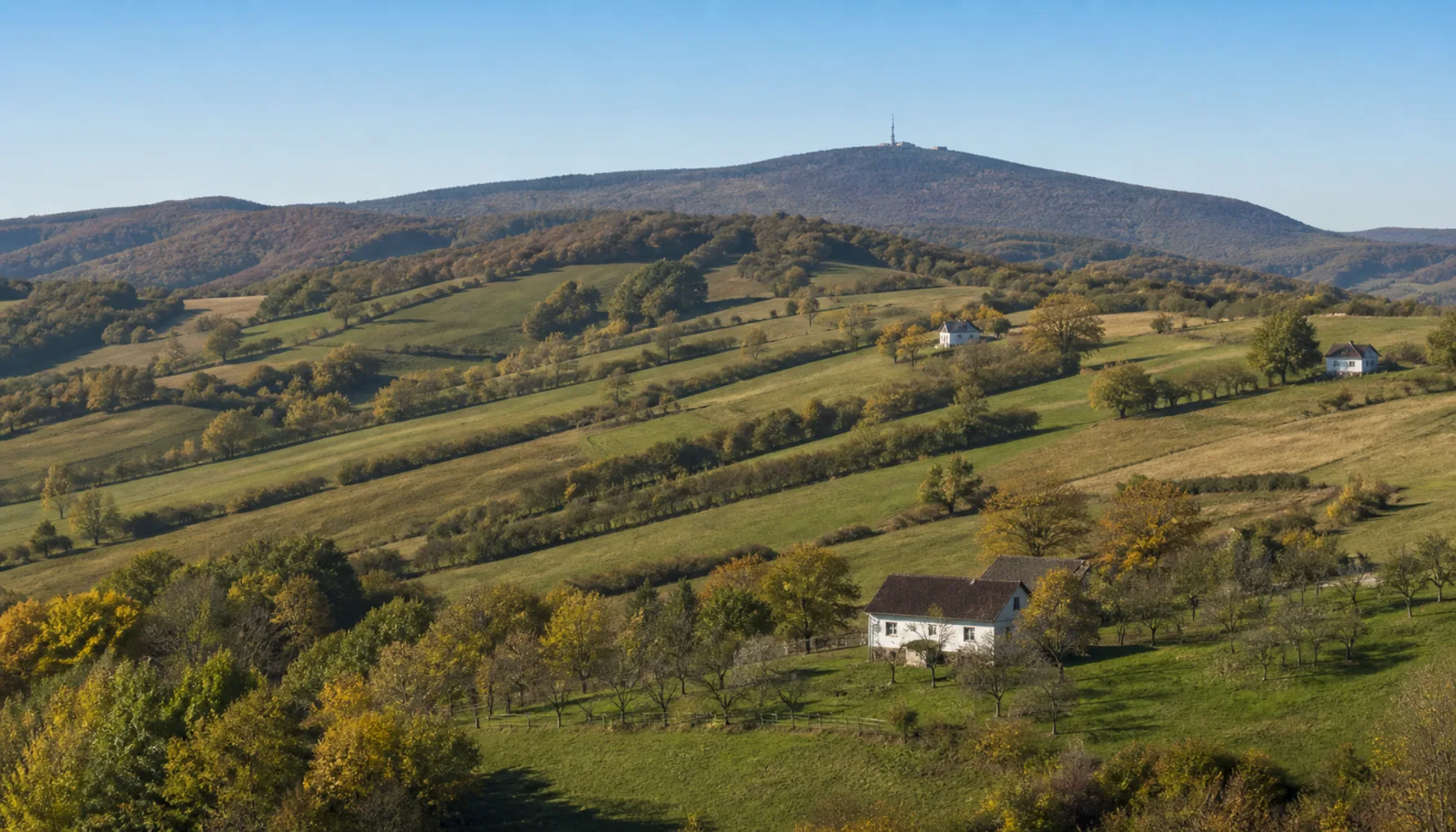
A Kopanice town on the western edge of the region, with scattered farmsteads on the ridges above it and, in the valley below, sixty years of precision manufacturing — dental equipment and water meters made for export from a town of this size.Kopaničiarske mesto na západnom okraji kraja, s roztratenými usadlosťami na chrbtoch nad ním a s presnou výrobou v doline pod nimi: zubná technika a vodomery sa už šesťdesiat rokov vyvážajú z mesta tejto veľkosti.
Kopanice farmsteads on the ridges above Stará Turá, with Veľká Javorina beyondKopaničiarske usadlosti na chrbtoch nad Starou Turou s Veľkou Javorinou v pozadí
Where it standsKde leží
Stará Turá lies in the hills west of the Váh, some fifteen kilometres from Nové Mesto nad Váhom, on the south-eastern edge of the Myjava uplands and under the long ridge of the White Carpathians. Veľká Javorina, the highest summit of that range at 970 metres, stands on the border above the town.Stará Turá leží v kopcoch západne od Váhu, asi pätnásť kilometrov od Nového Mesta nad Váhom, na juhovýchodnom okraji Myjavskej pahorkatiny a pod dlhým hrebeňom Bielych Karpát. Veľká Javorina, s 970 metrami najvyšší vrch tohto pohoria, stojí na hranici nad mestom.
The municipality covers a great deal of ground for its population, because the kopanice belong to it: single farmsteads and small clusters of them spread across the ridges, reached by narrow lanes, some still farmed and many now weekend houses. The compact town in the valley is a twentieth-century thing; the settlement pattern above it is three hundred years older.Mesto má na počet obyvateľov veľký kataster, lebo doň patria aj kopanice: jednotlivé usadlosti a ich malé zhluky roztratené po chrbtoch, dostupné úzkymi cestami, niektoré ešte obrábané a mnohé dnes chalupárske. Kompaktné mesto v doline je vecou 20. storočia; spôsob osídlenia nad ním je o tristo rokov starší.
The storyHistória
Stará Turá is recorded as a settlement in the Middle Ages and grew as a market and craft place for the surrounding hills rather than as the seat of anyone's estate — there is no castle here and no great manor house. Like the whole of the Kopanice country it became solidly Lutheran at the Reformation and stayed that way, with the congregation as the organising institution of local life.Stará Turá sa ako sídlo spomína v stredoveku a rástla skôr ako trhové a remeselnícke miesto pre okolité kopce než ako sídlo niečieho panstva — nie je tu hrad ani veľký kaštieľ. Ako celé kopaničiarske územie sa pri reformácii stala pevne evanjelickou a taká aj zostala, pričom organizujúcou inštitúciou miestneho života bol cirkevný zbor.
The town's best-known figure is Kristína Royová, born here in 1860 and buried here in 1936. She wrote Christian fiction that was translated into dozens of languages and made her for a time the most widely read Slovak author abroad; with her sister Mária she founded temperance and nursing work in the town, including a home for the sick out of which local health institutions grew. The Blue Cross movement in Slovakia began from that work.Najznámejšou postavou mesta je Kristína Royová, ktorá sa tu v roku 1860 narodila a v roku 1936 ju tu aj pochovali. Písala kresťanskú prózu preloženú do desiatok jazykov, ktorá z nej na čas urobila najčítanejšiu slovenskú autorku v zahraničí; so sestrou Máriou tu založila abstinenčnú a ošetrovateľskú prácu vrátane domu pre chorých, z ktorého vyrástli miestne zdravotnícke zariadenia. Práve odtiaľto sa na Slovensku začalo hnutie Modrého kríža.
Industry arrived after the Second World War and changed the town's shape. Precision engineering was placed here — measuring instruments first, then dental and medical equipment from the 1960s — and people came down off the kopanice into new housing beside the factories.Priemysel prišiel po druhej svetovej vojne a zmenil podobu mesta. Umiestnili sem presné strojárstvo — najprv meraciu techniku, od 60. rokov zubnú a zdravotnícku — a ľudia zišli z kopaníc do nových bytov pri závodoch.
What to seeČo vidieť
The town centre is plain and largely modern: the Lutheran church, a square, and the memorials to Kristína Royová. It is not why people come.Centrum mesta je striedme a väčšinou moderné: evanjelický kostol, námestie a pamiatky na Kristínu Royovú. Nie je to dôvod, prečo sem ľudia chodia.
Veľká Javorina is. The summit is a broad meadow on the Czech and Slovak border with views over both countries, reached on foot in a couple of hours from the villages below or by road for most of the way. Gatherings held there since the nineteenth century made it a symbol of Czech and Slovak mutuality, and the tradition continues each summer.Tým je Veľká Javorina. Vrchol tvorí široká lúka na česko-slovenskej hranici s výhľadom na obe strany; dá sa naň vyjsť za pár hodín z obcí pod ním alebo takmer celou cestou autom. Stretnutia, ktoré sa tam konajú od 19. storočia, z nej urobili symbol česko-slovenskej vzájomnosti a tradícia pokračuje každé leto.
The kopanice themselves are the other reason to come: field roads and marked paths link the farmsteads across the ridges, and the country is good for cycling and for cross-country skiing in a hard winter. A small reservoir in the hills near the town is used for fishing and summer swimming.Druhým dôvodom sú samotné kopanice: usadlosti na chrbtoch spájajú poľné cesty a značené chodníky a kraj je dobrý na cyklistiku a v tuhej zime na bežky. Malá vodná nádrž v kopcoch pri meste slúži na rybárčenie a letné kúpanie.
Work and industryPráca a priemysel
For a town of its size Stará Turá manufactures a remarkable amount. Chirana has made dental and medical equipment here since 1967, and the metering works — water and gas meters, now part of an international group trading as Sensus — has a similarly long history. Toolmaking, plastics and automotive components have grown up around them.Na svoju veľkosť vyrába Stará Turá pozoruhodne veľa. Chirana tu od roku 1967 vyrába zubnú a zdravotnícku techniku a podobne dlhú históriu má aj výroba meracej techniky — vodomerov a plynomerov, dnes v medzinárodnej skupine pôsobiacej ako Sensus. Okolo nich vyrástlo nástrojárstvo, plasty a výroba dielov pre automobilový priemysel.
Farming continues on the ridges at a small scale, more grass, sheep and orchards than arable, and a good share of the working population commutes down to Nové Mesto nad Váhom and the Váh valley.Na chrbtoch sa naďalej hospodári v malom — skôr lúky, ovce a sady než orná pôda — a značná časť pracujúcich dochádza dolu do Nového Mesta nad Váhom a do považskej doliny.
Getting thereAko sa tam dostať
The branch railway from Nové Mesto nad Váhom to Myjava and Vrbovce serves the town, but buses from Nové Mesto and Myjava are the more practical connection. By car the road climbs west out of the Váh valley in a few minutes.Mesto obsluhuje odbočná trať z Nového Mesta nad Váhom na Myjavu a do Vrboviec, praktickejším spojením sú však autobusy z Nového Mesta a z Myjavy. Autom sa z považskej doliny vystúpi na západ za pár minút.
Explore Stará TuráObjavujte Stará Turá
Every part of this place with a page of its own.Každá časť tohto miesta, ktorá má vlastnú stránku.