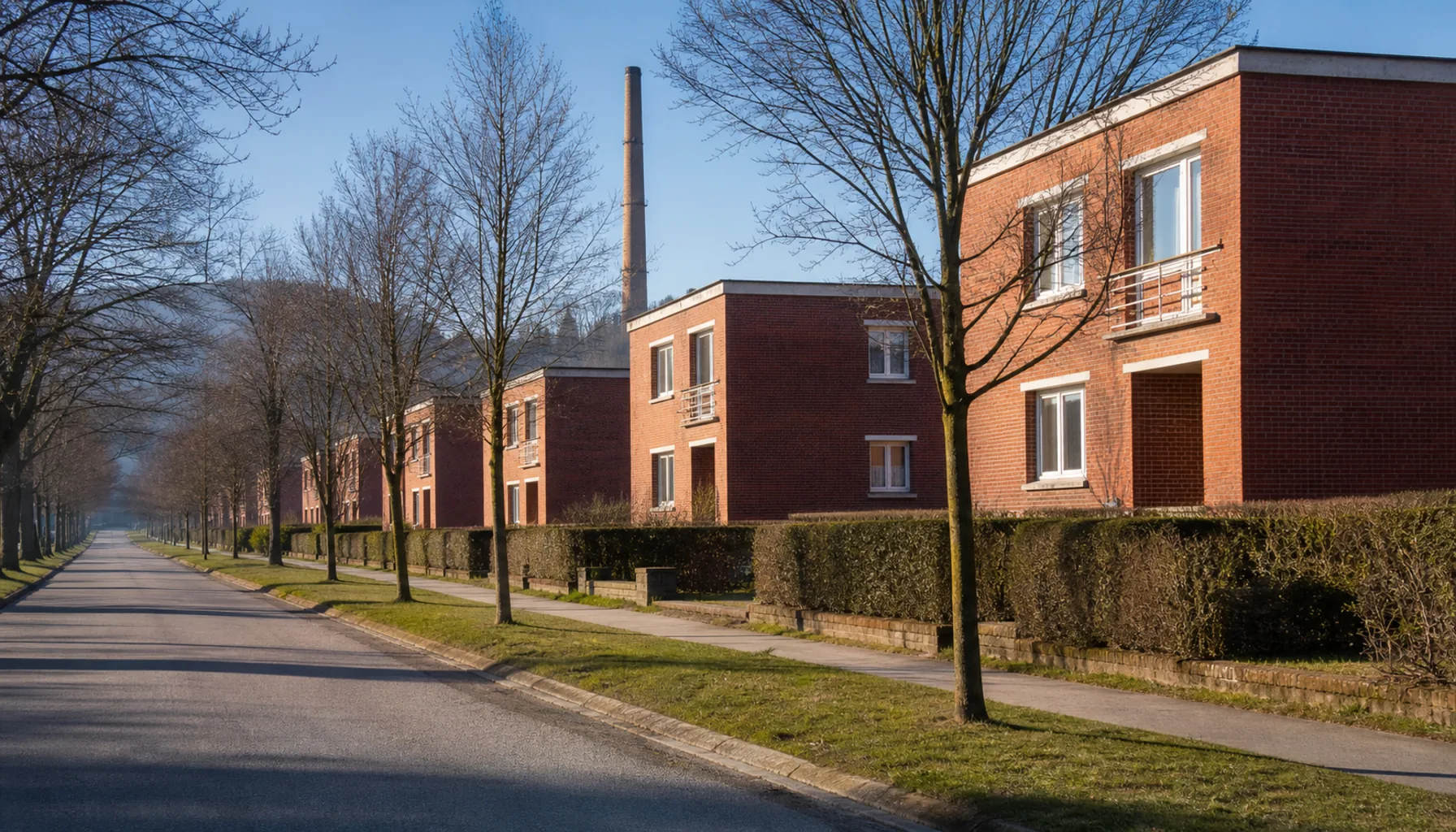
A town drawn on paper and built in one go from 1938 as Baťovany, the Slovak shoe town of the Baťa company — a grid of identical brick houses facing a factory, renamed after the war for the partisans.Mesto navrhnuté na rysovacej doske a postavené naraz od roku 1938 ako Baťovany, slovenské obuvnícke mesto firmy Baťa — mriežka rovnakých tehlových domov oproti továrni, po vojne premenovaná na počesť partizánov.
Rows of standardised red-brick Baťa houses in Partizánske, built as Baťovany from 1938Rady typizovaných červenotehlových baťovských domov v Partizánskom, stavaných od roku 1938 ako Baťovany
Where it standsKde leží
Partizánske stands on the Nitra river in the lower part of the Upper Nitra basin, between Topoľčany downstream and Prievidza upstream, with the Vtáčnik rising to the east and the last hills of the Tribeč to the south-west. The valley floor here is flat and wide, which is exactly why the site was chosen.Partizánske leží na rieke Nitre v dolnej časti hornonitrianskej kotliny, medzi Topoľčanmi po prúde a Prievidzou proti prúdu, s Vtáčnikom na východe a poslednými kopcami Tribeča na juhozápade. Dno doliny je tu rovné a široké — presne preto bolo toto miesto vybrané.
The plan is legible from the first street: the works on one side of the main axis, the housing on the other, laid out on a grid, with the public buildings between them.Plán mesta prečítate hneď na prvej ulici: závod na jednej strane hlavnej osi, bývanie na druhej, všetko v mriežke a medzi tým verejné budovy.
The storyHistória
Construction began in 1938 on fields belonging to the village of Šimonovany. The Baťa company of Zlín needed a shoe plant inside the new Slovak state, and it built not just a factory but a whole town for it, in the company's standard idiom: flat-roofed red brick, standardised family houses in rows, a hotel, a cinema, a school and a community house. The plan was drawn by the architect Jiří Voženílek.Stavba sa začala v roku 1938 na poliach obce Šimonovany. Firma Baťa zo Zlína potrebovala obuvnícky závod vnútri nového slovenského štátu a nepostavila len fabriku, ale rovno celé mesto — v štandardnom firemnom jazyku: červená tehla s plochými strechami, typizované rodinné domy v radoch, hotel, kino, škola a spoločenský dom. Plán navrhol architekt Jiří Voženílek.
The town was called Baťovany until 1949, when it was renamed Partizánske and Šimonovany was absorbed into it. The shoe works, by then state-owned, grew into one of the largest producers in Czechoslovakia and employed most of the town.Mesto sa až do roku 1949 volalo Baťovany; vtedy ho premenovali na Partizánske a Šimonovany sa doň včlenili. Obuvnícky závod, medzitým znárodnený, vyrástol na jedného z najväčších výrobcov v Československu a zamestnával takmer celé mesto.
Mass shoe production did not survive the 1990s, and the town has spent the decades since replacing it — which it has managed better than most single-industry towns of its size.Masová výroba obuvi 90. roky neprežila a mesto odvtedy hľadalo náhradu — a zvládlo to lepšie než väčšina rovnako veľkých miest s jedným priemyslom.
What to seeČo vidieť
The town itself is the sight. Partizánske is one of the most complete pieces of interwar company-town planning in Slovakia, and the way to see it is to walk the grid: the brick terraces, the wide axis, the square, and the scale relationship between housing and works that the whole thing was designed to express.Pamiatkou je samotné mesto. Partizánske je jedným z najucelenejších príkladov medzivojnového plánovania firemného mesta na Slovensku a najlepšie si ho pozriete prechádzkou po mriežke: tehlové radovky, široká os, námestie a ten pomer mierok medzi bývaním a závodom, ktorý mal celý návrh vyjadriť.
The older layer survives at the edge, in what was Šimonovany, with its manor house and the village street the new town was built beside — the contrast between the two is worth the short walk.Staršia vrstva sa zachovala na okraji, v niekdajších Šimonovanoch, s kaštieľom a dedinskou ulicou, vedľa ktorej nové mesto vyrástlo — kontrast oboch stojí za tú krátku prechádzku.
For a day out, the Vtáčnik rises east of the town with marked trails from the villages at its foot, and the Nitra river and its old meanders make easy flat cycling towards Topoľčany.Na celodenný výlet sa ponúka Vtáčnik na východ od mesta so značenými chodníkmi z obcí pod ním a rieka Nitra so starými meandrami, popri ktorej sa pohodlne bicykluje po rovine smerom na Topoľčany.
Work and industryPráca a priemysel
Engineering took the place of shoes. VIPO builds machinery and complete production lines for the rubber and tyre industry, MicroStep-PA makes computer-controlled cutting machines, and FATRA IZOLFA produces waterproofing membranes for roofs and foundations — three quite different specialisms in a town of this size.Namiesto obuvi nastúpilo strojárstvo. VIPO stavia stroje a celé výrobné linky pre gumárenský a pneumatikársky priemysel, MicroStep-PA vyrába počítačom riadené rezacie stroje a FATRA IZOLFA hydroizolačné fólie pre strechy a spodné stavby — tri celkom odlišné špecializácie na mesto tejto veľkosti.
What the shoe works left behind is a workforce used to precise, repetitive manufacturing and a town built to house it, which is a large part of why the replacement industries settled here rather than somewhere else in the basin. Beyond the factories, people commute to Prievidza and Topoľčany, both within half an hour.Po obuvníckom závode zostala pracovná sila zvyknutá na presnú a opakovanú výrobu a mesto postavené na to, aby ju ubytovalo — a to je veľká časť dôvodu, prečo sa náhradné odvetvia usadili práve tu a nie inde v kotline. Okrem tunajších závodov ľudia dochádzajú do Prievidze a Topoľčian, oboje do pol hodiny.
Getting thereAko sa tam dostať
Partizánske is on the railway up the Nitra valley between Topoľčany and Prievidza, and buses run to Prievidza, Topoľčany, Bánovce nad Bebravou and Nitra. By road it is on the main route from Nitra into Upper Nitra.Partizánske leží na železnici dolinou Nitry medzi Topoľčanmi a Prievidzou a autobusy premávajú do Prievidze, Topoľčian, Bánoviec nad Bebravou a Nitry. Cestne leží na hlavnej trase z Nitry na Hornú Nitru.
Explore PartizánskeObjavujte Partizánske
Every part of this place with a page of its own.Každá časť tohto miesta, ktorá má vlastnú stránku.