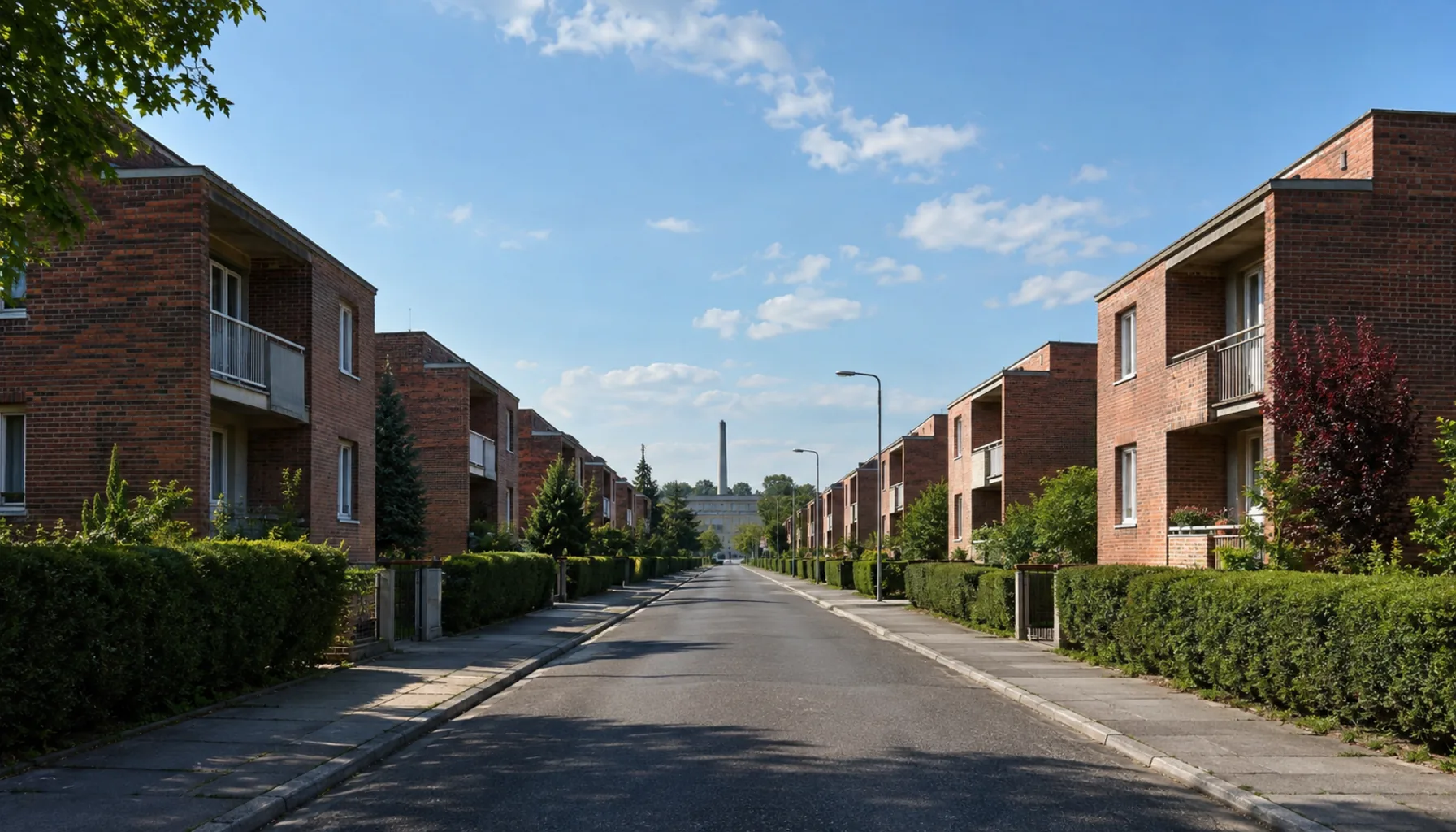
A town drawn on paper before it was built, with its school, its cinema and its community house on the plan from the first day — which is why the architecture is the first cultural fact about the place.Mesto nakreslené na papieri skôr, než ho postavili, so školou, kinom a spoločenským domom v pláne od prvého dňa — a práve preto je architektúra prvým kultúrnym faktom o tomto mieste.
A street of standardised red-brick Baťa houses in Partizánske, built from 1938 on the grid of the company town then called Baťovany.Ulica typizovaných tehlových baťovských domov v Partizánskom, stavaných od roku 1938 v pravidelnej sieti firemného mesta Baťovany.
The year in PartizánskeRok v Partizánskom
The calendar here is the calendar of any Slovak town of this size — a season in the cultural centre, town days in summer, markets on the square, a Christmas programme. One date belongs to Partizánske more than to most places: the anniversary of the Slovak National Uprising, which began on 29 August 1944. The town joined it, took its present name from the partisans in February 1949, and the nationalised shoe works then carried the date itself in its name for forty years.Kalendár je tu kalendárom ktoréhokoľvek slovenského mesta tejto veľkosti — sezóna v kultúrnom dome, mestské dni v lete, trhy na námestí, vianočný program. Jeden dátum však patrí Partizánskemu viac než väčšine miest: výročie Slovenského národného povstania, ktoré sa začalo 29. augusta 1944. Mesto sa doň zapojilo, vo februári 1949 dostalo po partizánoch svoje dnešné meno a znárodnené obuvnícke závody potom niesli ten dátum v názve štyridsať rokov.
Beyond that fixed point, programmes are announced locally rather than nationally and change from year to year, so check the town's own listings before travelling for a particular weekend. The Vtáčnik rises to the east with marked trails from the villages at its foot, and the Nitra and its old meanders make easy flat cycling towards Topoľčany — which is where a good part of the town's outdoor year actually happens.Okrem tohto pevného bodu sa programy oznamujú miestne, nie celoštátne, a rok od roka sa menia — pred cestou za konkrétnym víkendom si teda overte oznamy mesta. Na východe sa dvíha Vtáčnik so značkovanými chodníkmi z obcí pod ním a Nitra so svojimi starými meandrami ponúka pohodlné rovinaté bicyklovanie smerom na Topoľčany — a práve tam sa odohráva dobrá časť mestského roka pod holým nebom.
Where culture livesKde žije kultúra
Culture was built in with the housing. Between the rows of family houses and the factory gate the plan put a school, a hotel, a cinema and a community house, because a workforce brought in young from villages all over Upper Nitra had to be given somewhere to go in the evening. That is unusual: in most Slovak towns of this size the public buildings accumulated over centuries, while here they arrived with the streets, from 1938 onwards.Kultúra sa tu stavala spolu s bývaním. Medzi rady rodinných domov a bránu továrne plán umiestnil školu, hotel, kino a spoločenský dom, pretože mladá pracovná sila privezená z dedín celej hornej Nitry musela mať kam večer ísť. To je nezvyčajné: vo väčšine slovenských miest tejto veľkosti sa verejné budovy hromadili po stáročia, tu prišli spolu s ulicami, od roku 1938.
What operates in them now is the ordinary provision of a district town — a cultural centre with a hall and a programme, a library, a school of art for children, clubs, choirs and folk groups. We name none of them individually, because premises and programmes change faster than a page like this does. The town's own noticeboards are the reliable source.To, čo v nich dnes funguje, je bežná ponuka okresného mesta — kultúrne centrum so sálou a programom, knižnica, základná umelecká škola, kluby, zbory a folklórne súbory. Jednotlivo ich tu nemenujeme, lebo priestory a programy sa menia rýchlejšie než takáto stránka. Spoľahlivým zdrojom sú oznamy samotného mesta.
The buildings that carry itBudovy, ktoré ju nesú
The town itself is the monument. Flat-roofed red brick on a concrete frame, standardised family houses in rows, the works on one side of the main axis and the housing on the other: a company idiom brought from Zlín, usually credited to the architect Jiří Voženílek, while the town credits Vladimír Karfík, who ran the building department the plan came out of. The first spade went into the fields of Šimonovany on 8 August 1938, and within weeks the state it was being built in began to come apart.Pamiatkou je samotné mesto. Červená tehla s plochou strechou na betónovom skelete, typizované rodinné domy v radoch, závod na jednej strane hlavnej osi a bývanie na druhej: firemný rukopis prinesený zo Zlína, ktorý sa zvyčajne pripisuje architektovi Jiřímu Voženílkovi, kým mesto uvádza Vladimíra Karfíka, ktorý viedol stavebné oddelenie, z ktorého plán vzišiel. Prvý výkop na šimonovianskych poliach sa začal 8. augusta 1938 a o pár týždňov sa štát, v ktorom sa mesto stavalo, začal rozpadať.
The older layer survives at the edge. Šimonovany is first named in writing in 1260, its manor house still stands, and papal tithe registers of 1332 to 1337 record a parish church here dedicated to the Virgin Mary. A tax survey of 1436 counted eleven porty in the village; in 1601 it had a mill, thirty-eight houses and ten small noble curias, and by 1828 seventy-four houses. Walking out of that village street into the grid is the shortest lesson available in what happened to this valley.Staršia vrstva prežíva na okraji. Šimonovany sú prvýkrát písomne doložené v roku 1260, ich kaštieľ stále stojí a pápežské desiatkové registre z rokov 1332 až 1337 tu zaznamenávajú farský kostol zasvätený Panne Márii. Daňový súpis z roku 1436 napočítal v dedine jedenásť port; v roku 1601 mala mlyn, tridsaťosem domov a desať drobných zemianskych kúrií a do roku 1828 sedemdesiatštyri domov. Prejsť z tejto dedinskej ulice do pravidelnej siete ulíc je najkratšou lekciou o tom, čo sa v tomto údolí stalo.
The shoe town's own memoryPamäť obuvníckeho mesta
By the late 1980s the works employed about sixteen thousand people and turned out more than thirty-two million pairs of shoes a year, and practically the whole town either worked there or supplied it. Mass production did not survive the opening of the market after 1989: cheap imports arrived, the eastern export markets vanished, and for a town where nearly everybody had the same employer that was the hardest possible landing. The memory of it is still the common ground here, more than any monument is.Koncom osemdesiatych rokov závod zamestnával asi šestnásťtisíc ľudí a vyrábal vyše tridsaťdva miliónov párov topánok ročne — prakticky celé mesto v ňom buď pracovalo, alebo mu dodávalo. Masová výroba neprežila otvorenie trhu po roku 1989: prišli lacné dovozy, východné odbytiská zmizli a pre mesto, kde mal takmer každý toho istého zamestnávateľa, to bolo najtvrdšie možné pristátie. Spomienka na to je tu dodnes spoločnou pôdou viac než ktorákoľvek pamiatka.
What is left is not nostalgia but a plan that is now read as architecture rather than obeyed as a company rule. Partizánske is one of the most complete pieces of interwar company-town planning in Central Europe, and the way to see it is on foot: the brick terraces, the wide axis, the square, and the deliberate scale relationship between where people lived and where they worked. It was designed to be legible, and it still is.Nezostala nostalgia, ale plán, ktorý sa dnes číta ako architektúra, namiesto toho, aby sa dodržiaval ako firemný predpis. Partizánske je jedným z najucelenejších príkladov medzivojnového plánovania firemného mesta v strednej Európe a vidieť sa dá najlepšie pešo: tehlové radovky, široká os, námestie a zámerný vzťah mierky medzi tým, kde ľudia bývali, a tým, kde pracovali. Bolo navrhnuté tak, aby sa dalo čítať — a stále sa dá.