Nemšová · The Vlára valleyNemšová · Vlárska dolina
Culture in NemšováKultúra v Nemšovej
A glassworks town at the mouth of the Vlára valley, with a pilgrimage chapel on the ridge above it and the oldest pilgrimage site in Slovakia a few kilometres downstream.Sklárske mesto pri ústí Vlárskej doliny, s pútnickou kaplnkou na hrebeni nad ním a s najstarším pútnickým miestom Slovenska pár kilometrov po prúde.
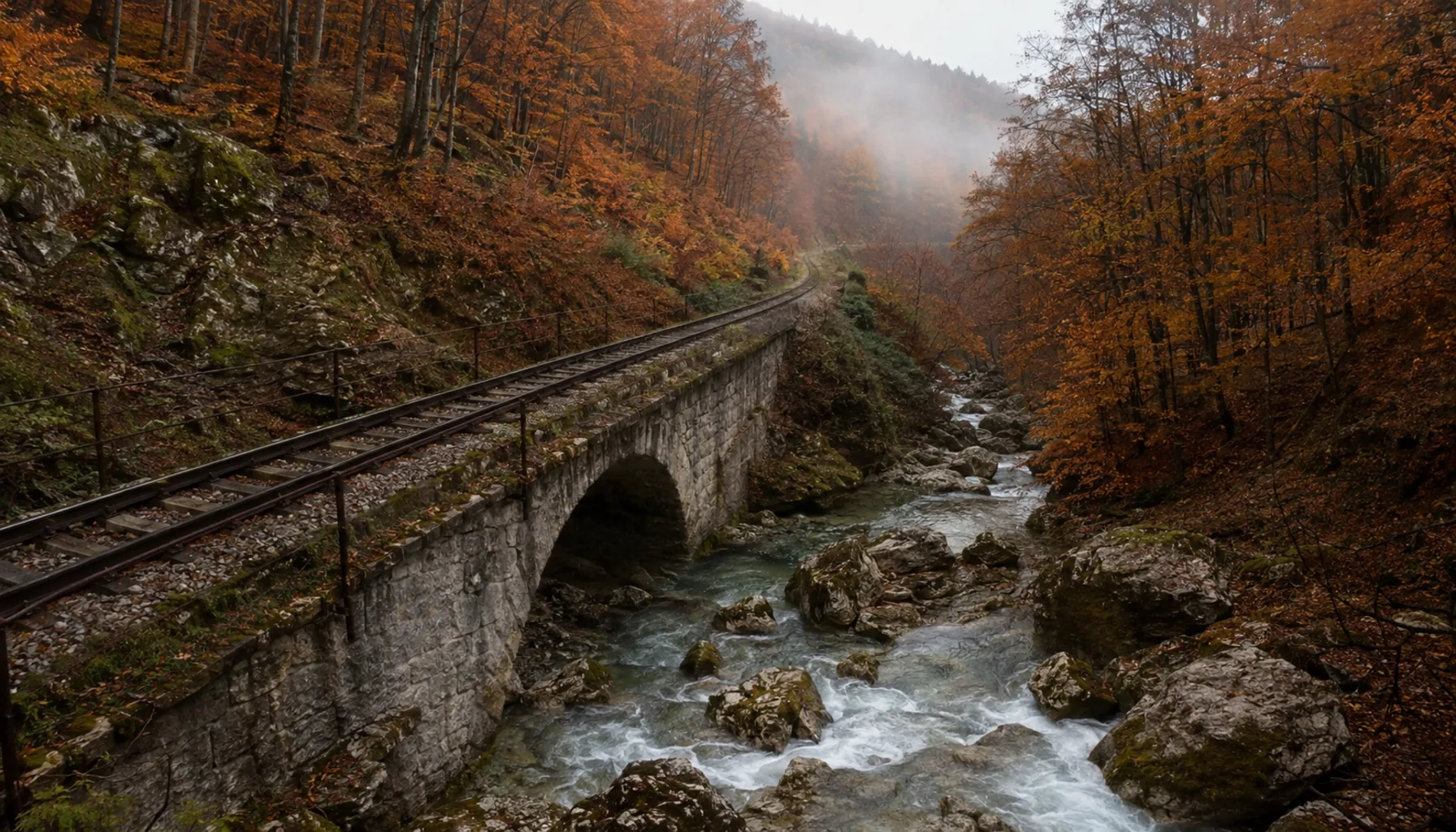
The railway climbing the wooded Vlára valley above Nemšová towards the pass into Moravia, on a misty November morning.Železnica stúpajúca zalesnenou Vlárskou dolinou nad Nemšovou k priesmyku na Moravu, v hmlisté novembrové ráno.
The year in NemšováRok v Nemšovej
The oldest date in this town's year is not in the town. A few kilometres downstream at Skalka nad Váhom, on a rock above the river, the hermit Benedict lived in the early eleventh century, the pupil of Svorad who had come to the abbey on Zobor above Nitra; their lives were written down a generation later and their cult was confirmed in 1083. Skalka is counted as the oldest pilgrimage place in Slovakia, and the July pilgrimage still fills the rock, nine hundred years on.Najstarší dátum v roku tohto mesta nie je v meste. Pár kilometrov po prúde, na Skalke nad Váhom, žil na skale nad riekou začiatkom jedenásteho storočia pustovník Benedikt, žiak Svorada, ktorý prišiel do opátstva na Zobore nad Nitrou; ich životy zapísali o generáciu neskôr a ich kult potvrdili v roku 1083. Skalka sa pokladá za najstaršie pútnické miesto na Slovensku a júlová púť skalu napĺňa dodnes, deväťsto rokov nato.
Higher up, at Trenčianska Závada, the chapel of Our Lady of Fatima built in 1949 is a pilgrimage chapel still, with services each May and October. Between those, the town's year is what a town of six thousand in four parts keeps: municipal events, school and club seasons, and the village calendars each of the four parts holds on to. Look in the town's own listings; we name nothing here that could be out of date by the time you read it.Vyššie, v Trenčianskej Závade, je kaplnka Panny Márie Fatimskej z roku 1949 stále pútnickou kaplnkou s bohoslužbami v máji a v októbri. Medzi tým je rok mesta taký, aký si drží šesťtisícové mesto v štyroch častiach: mestské podujatia, školské a záujmové sezóny a dedinské kalendáre, ktorých sa každá zo štyroch častí drží. Hľadajte v mestskom prehľade podujatí; nič tu nemenujeme, čo by mohlo byť neaktuálne skôr, než to prečítate.
Where culture livesKde žije kultúra
Nemšová has no museum and does not pretend to. What it keeps is the ordinary provision — a cultural centre with a hall and a programme, a library, a school of art for children, choirs and folk groups — and in a sense it keeps it four times over, because Ľuborča, Kľúčové and Trenčianska Závada are boroughs of the town rather than separate places, and each of them still looks and feels like a village with a life of its own. That distinction is worth keeping straight.Nemšová nemá múzeum a netvári sa, že má. Čo má, je obvyklé vybavenie — kultúrne stredisko so sálou a programom, knižnicu, základnú umeleckú školu, spevokoly a folklórne skupiny — a v istom zmysle ho má štyri razy, lebo Ľuborča, Kľúčové a Trenčianska Závada sú mestskými časťami, nie samostatnými obcami, a každá stále vyzerá a žije ako dedina s vlastným životom. Ten rozdiel sa oplatí držať v hlave.
The other thing shaping public life here is the works. Container glass is made continuously, day and night, because a glass furnace cannot be switched off, and a town on shifts organises its evenings differently from a town on office hours. The glassworks has been the largest employer for miles around for generations, and since 2002 it has belonged to the Swiss Vetropack group.Druhou vecou, ktorá formuje verejný život, je sklárňa. Obalové sklo sa vyrába nepretržite, vo dne v noci, lebo sklárska pec sa nedá vypnúť, a mesto na zmeny si organizuje večery inak než mesto na úradné hodiny. Sklárňa je po generácie najväčším zamestnávateľom v okolí a od roku 2002 patrí švajčiarskej skupine Vetropack.
The buildings that carry itBudovy, ktoré ju nesú
The parish church of St Michael the Archangel, built in 1766, is the oldest building in the town. It went up in the decades when the Habsburg monarchy was rebuilding parishes and schools across the country after the last of the uprisings, and it fixed in stone a patron the village had already been using for eighty years. Around it Nemšová stayed exactly what it was: a farming village on the road along the Váh, first written down in 1242, the year the Mongol armies withdrew from the kingdom, with carts climbing the Vlára pass to Moravia above it.Najstaršou budovou v meste je farský kostol svätého Michala Archanjela z roku 1766. Postavili ho v desaťročiach, keď habsburská monarchia po posledných povstaniach obnovovala fary a školy po celej krajine, a zafixoval v kameni patróna, ktorého dedina používala už osemdesiat rokov. Okolo neho zostala Nemšová presne tým, čím bola: poľnohospodárskou dedinou na ceste popri Váhu, prvý raz zapísanou v roku 1242, v roku, keď mongolské vojská odišli z kráľovstva, s vozmi stúpajúcimi nad ňou cez Vlársky priesmyk na Moravu.
The other structures that made the town are transport and industry. On 28 October 1888 the railway through the Vlára pass opened between Uherský Brod and Trenčianska Teplá with a station here — at that moment one of only three rail links between the Kingdom of Hungary and Moravia. Up on the ridge, Trenčianska Závada was founded at the end of the fifteenth century during the Wallachian colonisation, the slow movement of shepherding communities westward along the Carpathian ridges, which is why a town on the river also owns a village at 320 metres. Nemšová itself became a town only on 1 January 1989.Ostatné stavby, ktoré mesto urobili, sú doprava a priemysel. 28. októbra 1888 otvorili železnicu cez Vlársky priesmyk medzi Uherským Brodom a Trenčianskou Teplou so stanicou tu — vtedy jedno z troch železničných spojení medzi Uhorskom a Moravou. Hore na hrebeni vznikla Trenčianska Závada koncom pätnásteho storočia počas valaskej kolonizácie, pomalého posunu pastierskych spoločenstiev po karpatských hrebeňoch na západ, a preto mesto pri rieke vlastní aj dedinu v 320 metroch. Samotná Nemšová sa stala mestom až 1. januára 1989.
St Michael with the scalesSvätý Michal s váhami
The oldest known seal of Nemšová is dated 1688. In the middle of it stands St Michael the Archangel in the dress of a Roman soldier, a sword in his right hand and a pair of scales in his left, weighing souls. A seal mattered: it meant the community could authenticate its own documents, and the picture on it was an identity the village chose and then kept.Najstaršia známa pečať Nemšovej je z roku 1688. V jej strede stojí svätý Michal Archanjel v odeve rímskeho vojaka, v pravej ruke meč a v ľavej váhy, na ktorých váži duše. Pečať znamenala veľa: obec si mohla overovať vlastné listiny a obraz na nej bol identitou, ktorú si dedina vybrala a potom si ju držala.
It kept it. St Michael with sword and scales is on the town's coat of arms today, three hundred and forty years later, and the parish church built in 1766 carries the same dedication. Very little else in Nemšová is that old. A town whose visible fabric is mostly twentieth-century and whose emblem is seventeenth-century is telling you something true about how continuity actually works in Slovak places: it survives in paper and in a patron saint more often than in stone.A držala si ju. Svätý Michal s mečom a váhami je dodnes v mestskom erbe, tristoštyridsať rokov neskôr, a farský kostol z roku 1766 nesie to isté zasvätenie. Málo čo iné v Nemšovej je také staré. Mesto, ktorého viditeľná zástavba je väčšinou z dvadsiateho storočia a ktorého znak je zo sedemnásteho, hovorí niečo pravdivé o tom, ako kontinuita na slovenských sídlach naozaj funguje: prežíva častejšie na papieri a v mene patróna než v kameni.