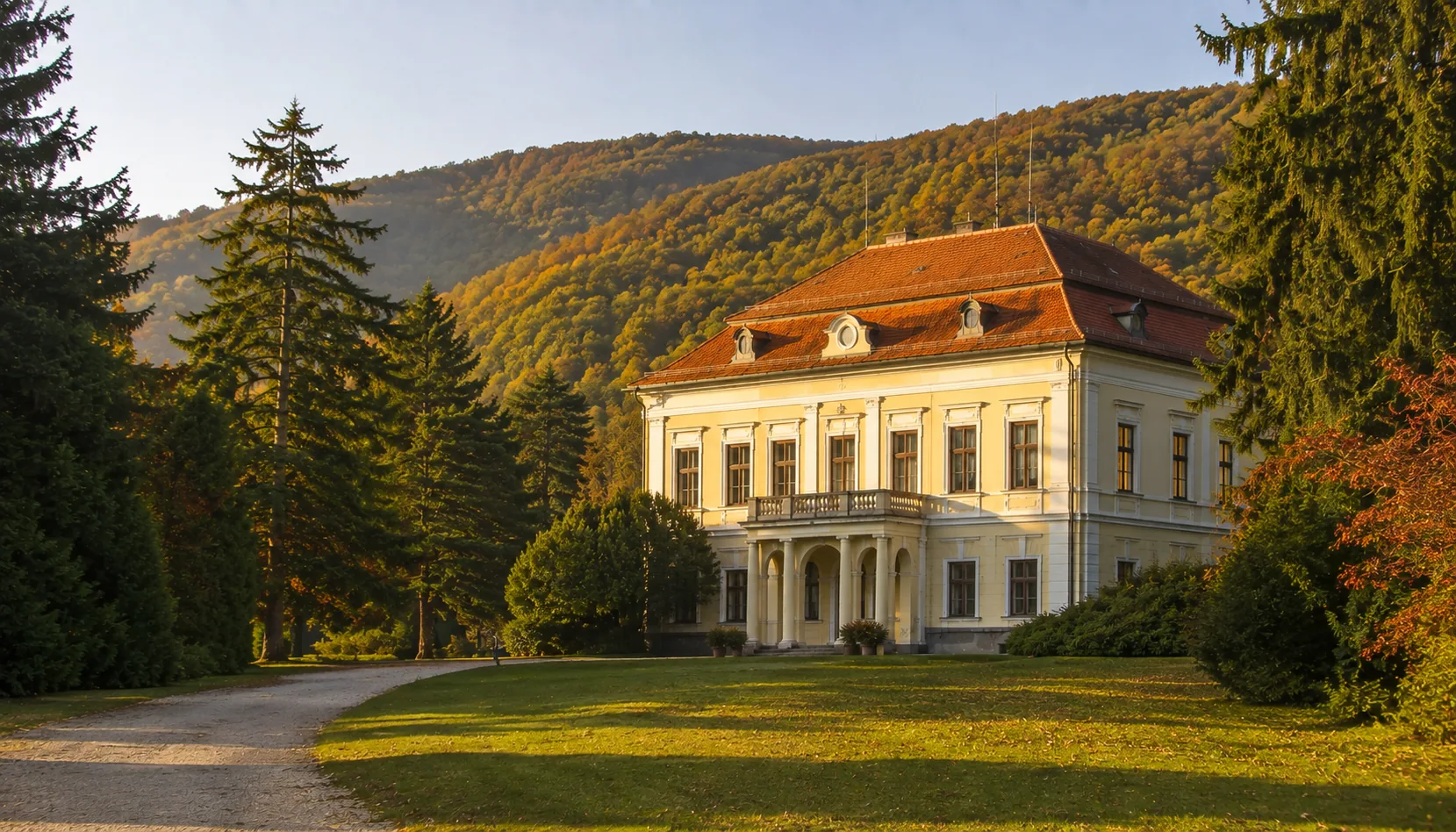
A glassmaking village on the Váh below Púchov, where drinking glass has been made since 1892: the Slovak glass museum occupies its manor house, and the ruin of Lednica castle stands on a crag a few kilometres up the valley behind it.Sklárska obec na Považí pod Púchovom, kde sa nápojové sklo vyrába od roku 1892: v tunajšom kaštieli sídli slovenské múzeum skla a pár kilometrov hore dolinou za ním stojí na brale zrúcanina Lednického hradu.
The manor house at Lednické Rovne, home of the Slovak glass museum, in its parkKaštieľ v Lednických Rovniach so slovenským múzeom skla, uprostred parku
Where it standsKde leží
Lednické Rovne lie on the western side of the Váh valley between Ilava and Púchov, on flat ground at the foot of the White Carpathians where the Lednica stream comes out of the hills. They are a village, not a town — but a village with a factory known well beyond Slovakia, which is why they belong in a list of the region's towns.Lednické Rovne ležia na západnej strane považskej doliny medzi Ilavou a Púchovom, na rovine pod Bielymi Karpatmi, kde z kopcov vyteká Lednický potok. Sú obcou, nie mestom — no obcou so závodom známym ďaleko za hranicami Slovenska, a preto patria do zoznamu miest kraja.
The valley behind the village climbs north-west into the White Carpathians towards Lednica, and the crags of that range — the klippen belt, white limestone standing out of wooded slopes — begin immediately above.Dolina za obcou stúpa na severozápad do Bielych Karpát smerom na Lednicu a bralá tohto pohoria — bradlové pásmo, biely vápenec vystupujúci zo zalesnených svahov — sa začínajú hneď nad ňou.
The storyHistória
The village belonged to the Lednica estate, whose castle stands on a rock up the valley; the manor house on the flat below was the estate's later and more comfortable seat. That building is now the centre of the village's public life rather than of anyone's private one.Obec patrila k lednickému panstvu, ktorého hrad stojí na skale hore dolinou; kaštieľ na rovine pod ním bol neskorším a pohodlnejším sídlom panstva. Tá budova je dnes strediskom verejného života obce, nie niečieho súkromného.
In 1892 Jozef Schreiber, of a glassmaking family from Moravia trading as Schreiber & Neffen, bought the estate and built a glassworks here. He built more than that: workers' housing, a school and the infrastructure of a company village, and the works drew in glassmakers and their families from Bohemia, Moravia and Austria. The village as it now stands is essentially his.V roku 1892 kúpil panstvo Jozef Schreiber, príslušník sklárskej rodiny z Moravy podnikajúcej pod menom Schreiber & Neffen, a postavil tu sklárne. Postavil však aj viac: robotnícke domy, školu a celú infraštruktúru továrenskej obce, a závod pritiahol sklárov s rodinami z Čiech, Moravy i Rakúska. Obec v dnešnej podobe je v podstate jeho dielom.
Nationalised after the war, the works made pressed and blown glass for export through the socialist decades, and since the 1990s it has traded as RONA — one of the larger European producers of lead-free crystal stemware, supplying restaurants and the hotel trade across the continent.Po vojne znárodnené sklárne vyrábali počas socialistických desaťročí lisované a fúkané sklo na vývoz a od 90. rokov podnikajú ako RONA — jeden z väčších európskych výrobcov bezolovnatého krištáľového nápojového skla pre reštaurácie a hotelierstvo na celom kontinente.
What to seeČo vidieť
The glass museum in the manor house is the point of a visit: the history of glassmaking here, the technology of it, and a collection of Slovak glass from the nineteenth century to the present, shown in the rooms of the house the glassmakers bought. Check opening times before travelling — a village museum does not keep city hours.Zmyslom návštevy je múzeum skla v kaštieli: dejiny tunajšieho sklárstva, jeho technológia a zbierka slovenského skla od 19. storočia po súčasnosť, vystavená v priestoroch domu, ktorý si sklári kúpili. Otváracie hodiny si pred cestou overte — dedinské múzeum nemá mestský režim.
The park around the manor house is large, old and planted with exotic trees, and serves as the village's public green space. Lednica castle, a few kilometres up the valley, is the other reason to come: a ruin grown into and onto a limestone crag above the village of the same name, reached on foot from below in half an hour, freely accessible, and one of the most striking castle sites in western Slovakia.Park okolo kaštieľa je rozľahlý, starý a vysadený cudzokrajnými drevinami a slúži ako verejná zeleň obce. Druhým dôvodom na návštevu je Lednický hrad pár kilometrov hore dolinou: zrúcanina vrastená do vápencového brala nad rovnomennou obcou, pešo zdola za polhodinu, voľne prístupná a jedna z najpôsobivejších hradných polôh na západnom Slovensku.
Beyond that the White Carpathians open up — Vršatec and its crags to the south, ridge paths towards the Czech border, and the flat cycling of the Váh valley below.Ďalej sa otvárajú Biele Karpaty — Vršatec s bralami na juh, hrebeňové chodníky k českej hranici a rovinatá cyklistika v považskej doline pod nimi.
Work and industryPráca a priemysel
The glassworks is the village's economy, and an unusual one: part of the range is still blown and finished by hand, so the plant employs glassmakers, cutters and decorators alongside furnace and machine crews, and the skills are handed on locally. Mould-making, packing and haulage have grown up around it.Sklárne sú hospodárstvom obce a hospodárstvom netypickým: časť sortimentu sa stále fúka a dokončuje ručne, takže závod zamestnáva sklárov, brusičov a maliarov skla popri obsluhe pecí a strojov a remeslo sa odovzdáva na mieste. Okolo neho vyrástla výroba foriem, baliarne a doprava.
The rest of the working population commutes along the valley — to the tyre plant at Púchov, the engineering works at Dubnica nad Váhom and the cement works at Ladce.Zvyšok pracujúcich dochádza dolinou — do púchovskej gumárne, do dubnických strojární a do ladeckej cementárne.
Getting thereAko sa tam dostať
The village lies just off the main Bratislava–Žilina railway and the D1 motorway; the nearest stations are Púchov and Ilava, and buses run from Púchov through the village and on up the valley to Lednica. By car it is a short turn west off the valley road.Obec leží kúsok od hlavnej trate Bratislava – Žilina a od diaľnice D1; najbližšie stanice sú Púchov a Ilava a autobusy premávajú z Púchova cez obec a ďalej dolinou do Lednice. Autom je to krátka odbočka na západ z dolinovej cesty.
Explore Lednické RovneObjavujte Lednické Rovne
Every part of this place with a page of its own.Každá časť tohto miesta, ktorá má vlastnú stránku.