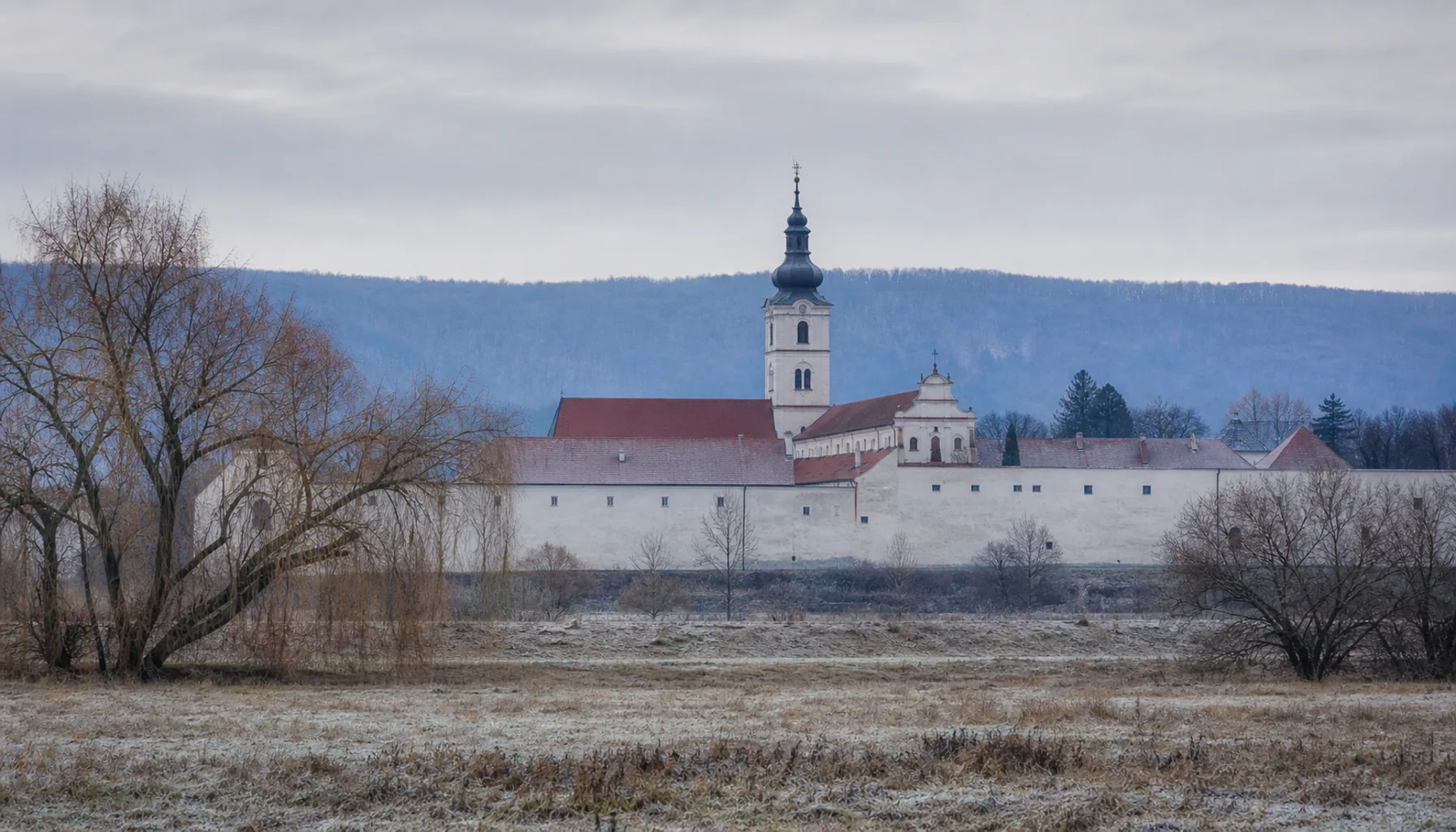
A small town on the Váh whose castle is a prison: a medieval stronghold that became a Trinitarian monastery, then barracks, and has held prisoners since the middle of the nineteenth century.Malé mesto na Váhu, ktorého hrad je väznicou: stredoveká pevnosť sa stala trinitárskym kláštorom, potom kasárňami a od polovice 19. storočia v nej sedia väzni.
The whitewashed walls and church tower of the former Trinitarian monastery at Ilava, now a prisonObielené múry a veža kostola bývalého trinitárskeho kláštora v Ilave, dnes väznice
Where it standsKde leží
Ilava lies on the Váh between Dubnica nad Váhom and Púchov, with the White Carpathians across the river to the west and the Strážov Hills behind it to the east. It is the seat of its district, although Dubnica nad Váhom next door is the larger town.Ilava leží na Váhu medzi Dubnicou nad Váhom a Púchovom, s Bielymi Karpatmi za riekou na západe a Strážovskými vrchmi za chrbtom na východe. Je sídlom okresu, hoci susedná Dubnica nad Váhom je väčším mestom.
Everything on this stretch of the valley is within a few kilometres of everything else: the engineering works at Dubnica, the cement works at Ladce, and the crags of Vršatec on the far side of the river.Na tomto úseku doliny je všetko od všetkého na pár kilometrov: strojárske závody v Dubnici, cementáreň v Ladcoch a vršatecké bralá na druhej strane rieky.
The storyHistória
A castle stood here from the Middle Ages — a lowland stronghold by the river rather than a crag fortress, guarding the road and the crossing. It changed hands among the noble families of the Váh for centuries.Od stredoveku tu stál hrad — nížinná pevnosť pri rieke, nie hradisko na brale, ktorá strážila cestu a brod. Po stáročia sa striedal v rukách považských šľachtických rodov.
At the turn of the eighteenth century the buildings were given to the Trinitarian order, which rebuilt them as a monastery with a church. Joseph II dissolved the order, and the complex went on to serve as barracks and a manufactory before becoming a prison in the 1850s. It has been one ever since.Na prelome 17. a 18. storočia budovy pripadli rádu trinitárov, ktorý ich prestaval na kláštor s kostolom. Jozef II. rád zrušil a areál potom slúžil ako kasárne a manufaktúra, kým sa v 50. rokoch 19. storočia nestal väznicou. Je ňou dodnes.
Its twentieth century belongs to Slovak political history. Between 1939 and 1945 the wartime Slovak State ran a detention camp here for its political opponents, and the communist period used the prison for the same purpose. The name Ilava carried that meaning in ordinary speech for decades.Jej dvadsiate storočie patrí do slovenských politických dejín. V rokoch 1939 až 1945 tu vojnový Slovenský štát viedol zaisťovací tábor pre svojich politických odporcov a komunistické obdobie väznicu využívalo na ten istý účel. Meno Ilava malo tento význam v bežnej reči desaťročia.
What to seeČo vidieť
Be clear about what can be seen: the historic core is a working prison and is not open to visitors. What a passer-by gets is the outside — long whitewashed walls with the monastery church tower rising over them in the middle of a small town, which is an odd and memorable town centre.Povedzme si rovno, čo sa dá vidieť: historické jadro je fungujúca väznica a pre návštevníkov nie je prístupné. Okoloidúci uvidí vonkajšok — dlhé obielené múry s vežou kláštorného kostola nad nimi uprostred malého mesta, čo je zvláštne a nezabudnuteľné centrum.
The surroundings carry the rest. Ladce, a few kilometres north, has Slovakia's oldest cement works, founded in 1889 and still supplied by the Butkov quarry above the village; terraces cut into that quarry have been turned into a hilltop sanctuary that now draws pilgrims and walkers for the view over the valley.Zvyšok ponúka okolie. Ladce pár kilometrov na sever majú najstaršiu cementáreň na Slovensku, založenú v roku 1889 a dodnes zásobovanú lomom Butkov nad obcou; z terás vylámaných v tom lome sa stalo vrcholové sanktuárium, ktoré dnes priťahuje pútnikov aj turistov kvôli výhľadu do doliny.
Across the river, Vršatec is the best walking in this part of the White Carpathians — a line of white limestone crags with a castle ruin on one of them, reached on foot from the villages below, with views the length of the Váh valley.Za riekou je Vršatec najlepšou turistikou v tejto časti Bielych Karpát — rad bielych vápencových brál so zrúcaninou hradu na jednom z nich, dostupný pešo z obcí pod ním, s výhľadmi po celej dĺžke považskej doliny.
Work and industryPráca a priemysel
The prison is one of the town's larger employers, which is an unusual thing to be able to say about a district seat. Beyond it, most people work along the valley: at the engineering and armaments plants of Dubnica nad Váhom, at the Ladce cement works, or at the tyre plant in Púchov.Väznica patrí k väčším zamestnávateľom v meste, čo sa o okresnom sídle povie len málokedy. Inak väčšina ľudí pracuje pozdĺž doliny: v strojárskych a zbrojárskych závodoch Dubnice nad Váhom, v ladeckej cementárni alebo v púchovskej gumárni.
Getting thereAko sa tam dostať
Ilava is on the main Bratislava–Žilina railway and beside the D1 motorway; buses run up and down the valley and across the river to the villages under Vršatec.Ilava leží na hlavnej trati Bratislava – Žilina a pri diaľnici D1; autobusy premávajú dolinou hore aj dole a cez rieku do obcí pod Vršatcom.
Explore IlavaObjavujte Ilava
Every part of this place with a page of its own.Každá časť tohto miesta, ktorá má vlastnú stránku.