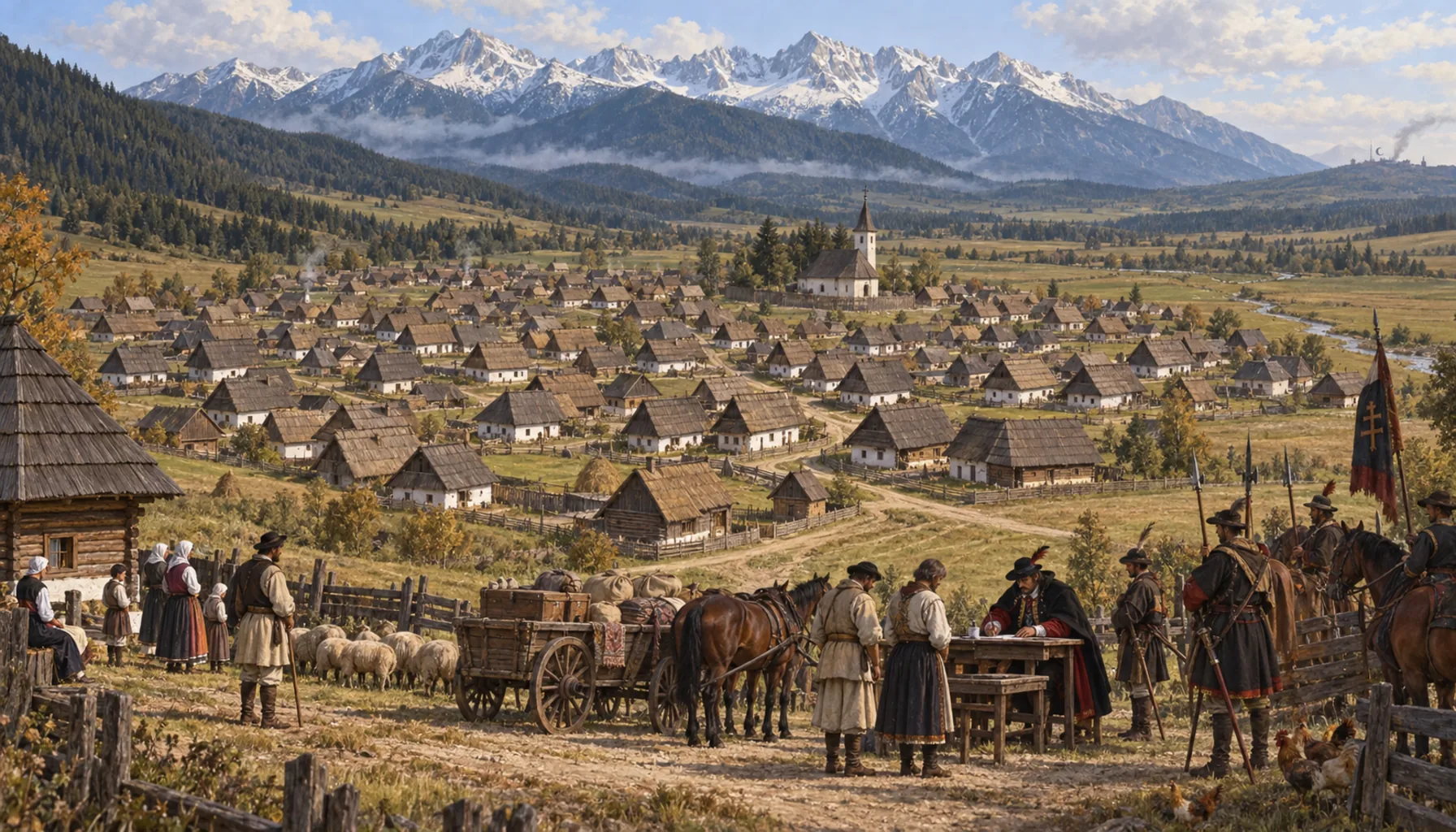
The Ottoman wars that shaped southern Slovakia never reached this valley — the frontier fortresses were well over a hundred kilometres away — but the kingdom's wars were paid for everywhere, in taxes and in levies. What the records show here instead is growth. By 1600 Važec had a manor farm (a majer, the landlord's own home farm worked by the villagers' labour) and 72 houses with roughly 900 people, which for an upland village is a substantial place. Across Liptov most parishes turned Lutheran during the Reformation of this century, and Važec kept both confessions side by side afterwards — which is why, three hundred years later, it would build a second church.Osmanské vojny, ktoré formovali južné Slovensko, sa do tejto doliny nikdy nedostali — pohraničné pevnosti boli hodne vyše sto kilometrov ďaleko — no kráľovstvo si svoje vojny platilo všade, daňami a odvodmi. Záznamy odtiaľto ukazujú niečo iné: rast. Roku 1600 mal Važec majer (panský dvor, ktorý obrábali poddaní) a 72 domov s približne 900 obyvateľmi, čo je na hornatú dedinu poriadna obec. V Liptove prešla väčšina farností počas reformácie tohto storočia k evanjelikom a vo Važci potom obe konfesie žili vedľa seba — a práve preto tu o tristo rokov neskôr postavili druhý kostol.