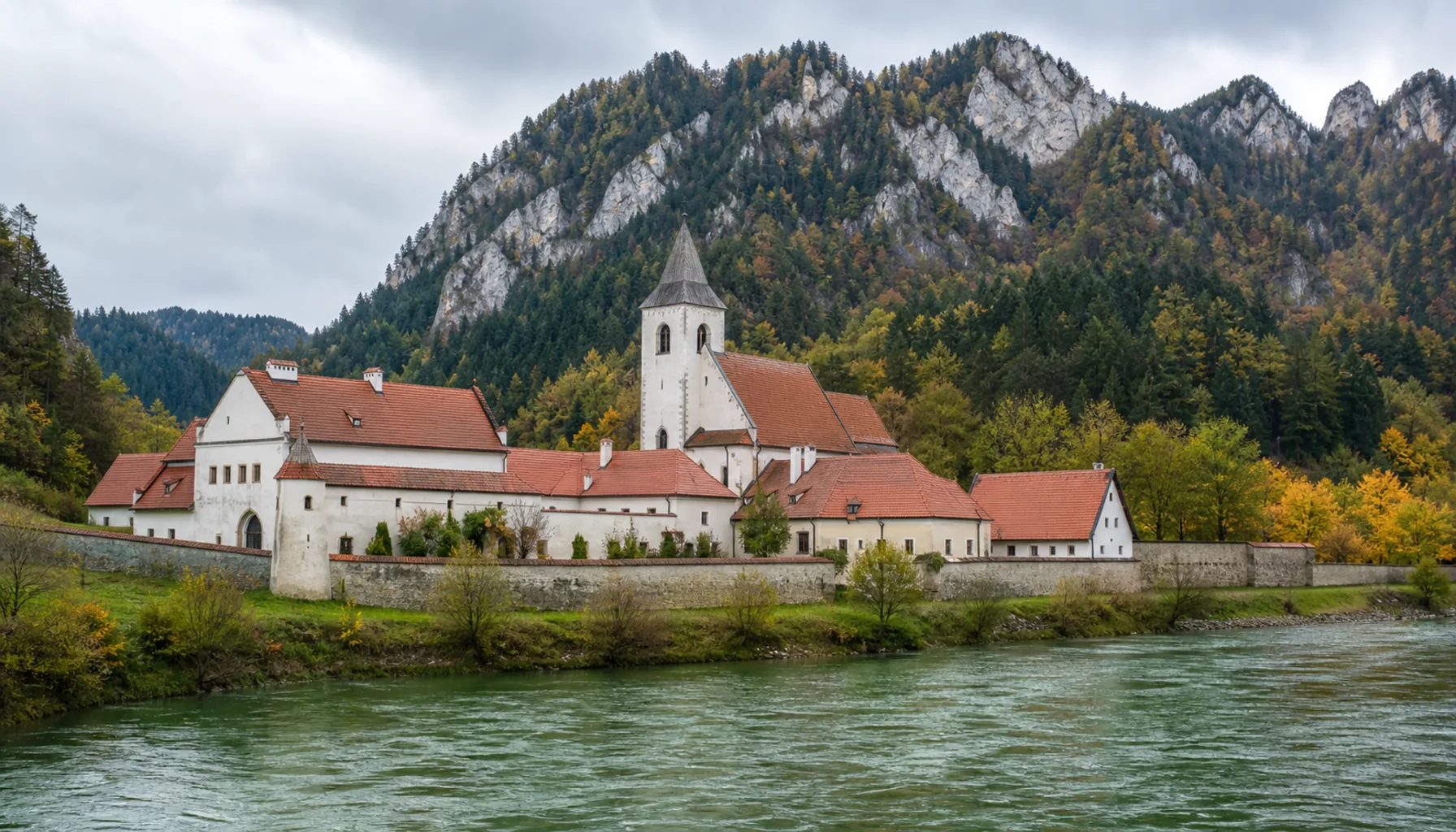
A monastery at the mouth of the Dunajec gorge — Carthusian first, then Camaldolese, dissolved under Joseph II and now a museum — with the raft trip down the Polish border setting off from the bank below it.Kláštor pri ústí prielomu Dunajca — najprv kartuziánsky, potom kamaldulský, zrušený za Jozefa II. a dnes múzeum — a od brehu pod ním vyráža splav po poľskej hranici.
The walled monastery of Červený Kláštor above the Dunajec, the Pieniny behindOpevnený areál Červeného Kláštora nad Dunajcom, v pozadí Pieniny
Where it standsKde leží
The village stands on the Slovak bank of the Dunajec at the point where the river turns into its limestone gorge, at the eastern end of Zamagurie beneath the cliffs of the Pieniny. The far bank is Poland, and downstream the water saws through the rock for about ten kilometres to Lesnica. Everything here faces that one geography: the monastery on the flat by the water, the road along the river, the border running down the middle of the current.Obec stojí na slovenskom brehu Dunajca práve tam, kde rieka vchádza do svojho vápencového prielomu, na východnom konci Zamaguria pod pieninskými stenami. Druhý breh je už Poľsko. Po prúde sa voda prerezáva skalou asi desať kilometrov až k Lesnici. Všetko sa tu obracia k tejto jedinej geografii: kláštor na rovine pri vode, cesta popri rieke, hranica vedúca stredom prúdu.
Why it is herePrečo práve tu
The monastery came first and the village grew round it. A Carthusian house was founded here in the early fourteenth century on the endowment of a Spiš landowner, in a spot that suited the order exactly — enclosed, remote and hard to reach. The Carthusians were gone by the later sixteenth century, in the unrest of the Reformation era.Najprv bol kláštor a obec vyrástla okolo neho. Kartuziánsky dom tu založili na začiatku 14. storočia z nadácie spišského zemepána, na mieste, ktoré rádu presne vyhovovalo — uzavretom, odľahlom a ťažko prístupnom. Kartuziáni odtiaľ odišli do konca 16. storočia, počas nepokojov reformačnej doby.
In the early eighteenth century the Camaldolese took the site over, rebuilt it and stayed until Joseph II dissolved the house in the 1780s. After that it slid a long way towards ruin; the restoration that turned it into a museum has run in stages over decades.Na začiatku 18. storočia areál prevzali kamalduli, prestavali ho a zostali, kým Jozef II. kláštor v 80. rokoch 18. storočia nezrušil. Potom klesol poriadny kus cesty k zrúcanine; obnova, ktorá z neho urobila múzeum, prebiehala v etapách celé desaťročia.
Its best-known figure is Brother Cyprián, an eighteenth-century Camaldolese lay brother who served as the house's physician and apothecary and compiled a herbarium of several hundred pressed plants that survives to this day. He treated people from the villages around, which is why he is remembered at all. Local tradition later gave him a flying machine and a leap from the cliffs above the Dunajec; the herbarium is the documented part.Jeho najznámejšou postavou je brat Cyprián, kamaldulský laický brat z 18. storočia, ktorý v kláštore pôsobil ako lekár a lekárnik a zostavil herbár s niekoľkými stovkami lisovaných rastlín, ktorý sa zachoval dodnes. Liečil ľudí z okolitých dedín, a práve preto sa naňho vôbec spomína. Ľudová tradícia mu neskôr pripísala lietajúci stroj a skok zo skál nad Dunajcom; doloženou časťou je herbár.
What you actually seeČo naozaj uvidíte
The complex is a walled quadrangle, plainer outside than in. Inside are the Gothic church, the cloister, the ranges of monks' cells with their own small walled gardens — the Carthusian plan, kept when the Camaldolese moved in because their life suited it too — a refectory and the apothecary. Displays cover the two orders, the pharmacy and Cyprián's herbarium. It is a state museum with seasonal opening and set hours, worth checking before you travel rather than after.Areál je opevnený štvorcový celok, zvonku strohejší než zvnútra. Vnútri je gotický kostol, krížová chodba, rady mníšskych ciel s vlastnými malými ohradenými záhradkami — kartuziánska schéma, ktorú kamalduli zachovali, lebo aj ich spôsobu života vyhovovala —, refektár a lekáreň. Expozície sa venujú obom rádom, lekárni a Cypriánovmu herbáru. Je to štátne múzeum so sezónnym otváraním a pevnými hodinami, ktoré sa oplatí overiť pred cestou, nie po nej.
The other thing here is the river. The plte — flat wooden rafts poled by Goral raftsmen — set off from the bank below the monastery and run the gorge down to Lesnica, seasonally and weather permitting. A riverside path and cycle route follow the Slovak bank the whole way, and a foot-and-cycle bridge crosses to the Polish side.Druhou vecou je tu rieka. Plte — ploché drevené plavidlá vedené goralskými pltníkmi — vyrážajú od brehu pod kláštorom a prechádzajú prielomom až k Lesnici, sezónne a podľa počasia. Po slovenskom brehu vedie po celej dĺžke chodník a cyklotrasa a na poľskú stranu prechádza lávka pre peších a cyklistov.
Living village, not a museumŽivá obec, nie skanzen
Červený Kláštor is a small village whose life is the monastery and the river. In the raft season it is busy and the car parks fill; outside it the place is very quiet and much of what serves visitors is shut. The monastery church is shown as part of the museum route rather than used as a parish church.Červený Kláštor je malá obec, ktorej život tvorí kláštor a rieka. V pltníckej sezóne je rušno a parkoviská sa plnia; mimo nej je tu veľmi ticho a veľká časť služieb je zavretá. Kláštorný kostol sa ukazuje ako súčasť prehliadkovej trasy, nefunguje ako farský.
The gorge belongs to the Pieniny National Park, the smallest in the country, so the riverside path has rules worth honouring: stay on it, take litter away, and remember that the far bank is another country and not somewhere to wade across to.Prielom patrí Pieninskému národnému parku, najmenšiemu v krajine, a chodník popri rieke má pravidlá, ktoré sa oplatí dodržať: držte sa ho, odpad si odneste a nezabúdajte, že druhý breh je iný štát a nie miesto, kam sa prebrodí.
Getting thereAko sa tam dostať
There is no railway. Buses run from Kežmarok and Stará Ľubovňa by way of Spišská Stará Ves, and by car the road follows the Dunajec valley. Most people arrive as a day trip from the Tatras, and in the raft season it is worth coming early for the parking.Železnica sem nevedie. Autobusy premávajú z Kežmarku a zo Starej Ľubovne cez Spišskú Starú Ves, autom vedie cesta dolinou Dunajca. Väčšina ľudí prichádza na výlet z Tatier a v pltníckej sezóne sa oplatí prísť skoro kvôli parkovaniu.
Explore Červený KláštorObjavujte Červený Kláštor
Every part of this place with a page of its own.Každá časť tohto miesta, ktorá má vlastnú stránku.