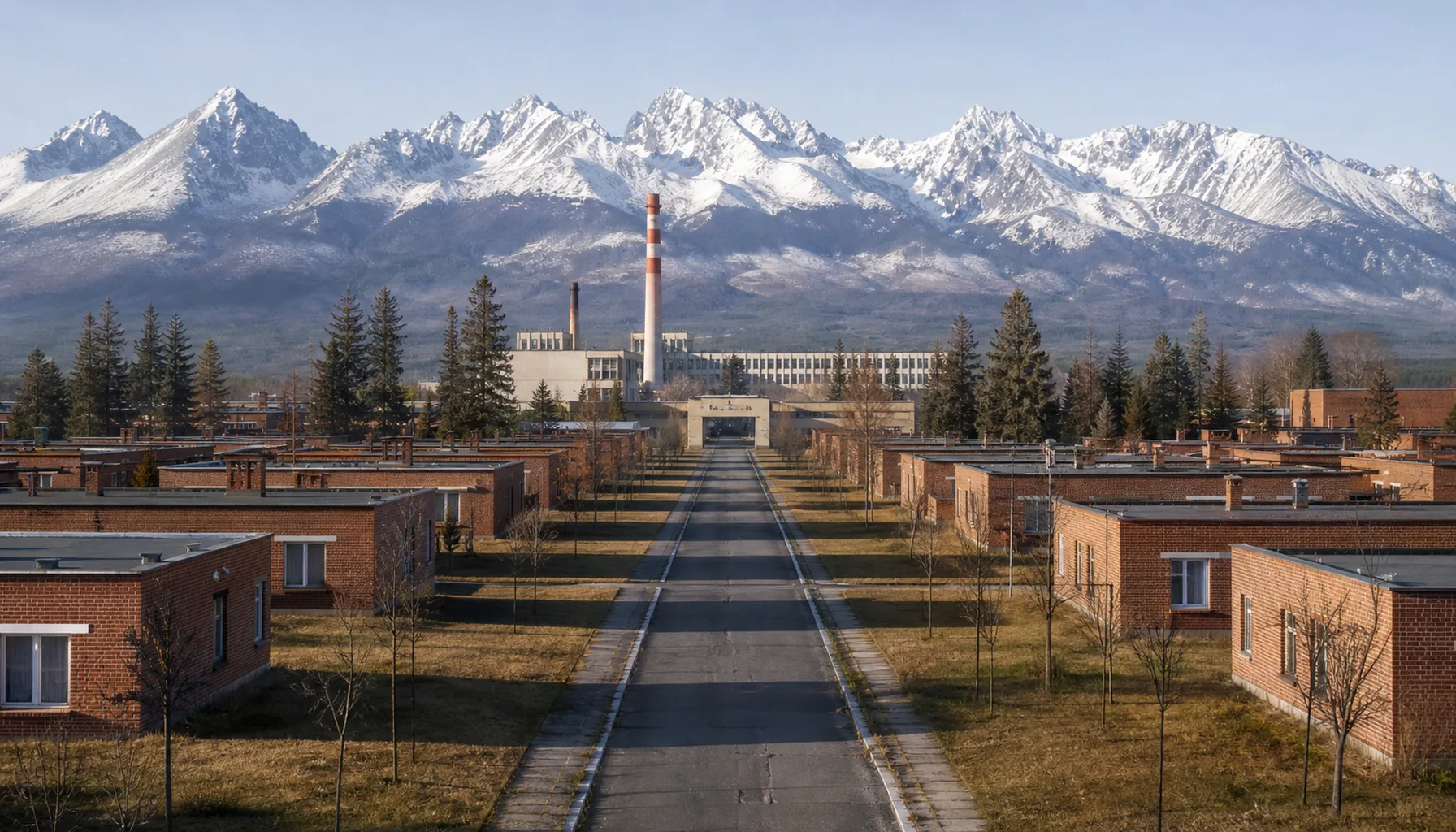
A town that began as a factory: in 1934 the Baťa company built a viscose works on meadows by the Poprad river and named the place after it — SVIT, for Slovenská viskózová továreň.Mesto, ktoré vzniklo ako továreň: v roku 1934 postavila firma Baťa na lúkach pri rieke Poprad závod na viskózu a miesto pomenovala po ňom — SVIT, teda Slovenská viskózová továreň.
Baťa-era brick housing at Svit with the High Tatras on the skylineBaťovská tehlová zástavba vo Svite s Vysokými Tatrami na obzore
Where it standsKde leží
Svit stands on the Poprad river a few kilometres west of Poprad, at the mouth of the Mlynica valley, which comes down from the High Tatras. The basin here is a little over 700 metres and the range fills the whole northern skyline; the main road and railway along the basin run past the town.Svit leží na rieke Poprad pár kilometrov západne od Popradu, pri ústí Mlynickej doliny, ktorá zbieha z Vysokých Tatier. Kotlina tu má o niečo viac než 700 metrov a pohorie vypĺňa celý severný obzor; hlavná cesta aj železnica vedúce kotlinou idú popri meste.
It is the youngest town in the basin and the only one built to a plan, which is obvious the moment you walk into it.Je najmladším mestom kotliny a jediným postaveným podľa plánu, čo je zjavné, len čo doň človek vojde.
The storyHistória
In 1934 the Baťa company of Zlín chose this stretch of meadow for a plant to make viscose — artificial silk — and built a town for the workforce at the same time. The name is an acronym: Slovenská viskózová továreň, the Slovak Viscose Factory. Baťa did the same thing at Baťovany in the upper Nitra valley, now Partizánske, and the two places read identically on the ground.V roku 1934 vybrala firma Baťa zo Zlína tento pás lúk pre závod na výrobu viskózy — umelého hodvábu — a súčasne preň postavila mesto pre robotníkov. Meno je skratka: Slovenská viskózová továreň. To isté urobila Baťa v Baťovanoch v hornom Ponitrí, dnešnom Partizánskom, a obe miesta sa v teréne čítajú rovnako.
The plan was the standard Baťa one and it survives almost intact: a grid of flat-roofed red-brick houses in short terraces, wide green strips between them, a boulevard leading to the works gate, and company schools, a hotel, a cinema and a sports ground built in the same functionalist idiom. Housing was graded by rank, as it was in every Baťa town, and the geometry made that visible.Plán bol štandardne baťovský a zachoval sa takmer neporušený: sieť tehlových domov s plochou strechou v krátkych radoch, medzi nimi široké zelené pásy, bulvár smerujúci k bráne závodu a podnikové školy, hotel, kino a športový areál v tom istom funkcionalistickom slohu. Bývanie sa odstupňovalo podľa postavenia, ako v každom baťovskom meste, a geometria to dávala najavo.
The works were nationalised after 1945 and the settlement became a municipality in its own right, and then a town. Artificial fibre gave way over the decades to packaging films and machine building, and a knitwear and hosiery plant worked alongside them for most of the twentieth century.Závod po roku 1945 znárodnili a osada sa stala samostatnou obcou a neskôr mestom. Umelé vlákno postupom desaťročí vystriedali obalové fólie a strojárstvo a väčšinu 20. storočia popri nich pracovala aj pletiarska a pančuchárska výroba.
What to seeČo vidieť
The town itself is the thing to look at. An hour on foot takes in the brick terraces, the boulevard, the works gate and the surviving Baťa-era public buildings, and it is one of the clearest pieces of interwar company-town planning in Slovakia — not pretty in the conventional sense, but coherent in a way almost nothing built since has managed.Pozerať sa tu oplatí na samotné mesto. Hodina pešo stačí na tehlové rady, bulvár, bránu závodu aj zachované verejné budovy z baťovskej éry — a je to jedna z najčitateľnejších ukážok medzivojnového plánovania továrenského mesta na Slovensku; nie pekná v obvyklom zmysle, ale celistvá tak, ako sa to od tých čias takmer nikomu nepodarilo.
The Mlynica valley opens directly behind the town and is a walking route up towards the mountains; the Poprad riverside carries a cycle path along the basin. Svit's sports clubs are old and unusually strong for a town this size — the basketball club in particular has been a fixture of the Slovak league for decades, another inheritance from the company era, which built the ground before it built much else.Mlynická dolina sa otvára priamo za mestom a je nástupom pešo do hôr; popri Poprade vedie kotlinou cyklotrasa. Športové kluby Svitu sú staré a na mesto tejto veľkosti neobyčajne silné — najmä basketbalový klub patrí k stáliciam slovenskej ligy už desaťročia. Aj to je dedičstvo podnikovej éry, ktorá postavila ihrisko skôr než väčšinu ostatného.
Work and industryPráca a priemysel
The works are still the town's reason for being. The Chemosvit group on the original estate makes flexible packaging film, much of it for food, along with machinery and its own energy and service companies; meat processing and other food firms sit on the edge of the industrial zone. Beyond that, a large share of the town commutes the few kilometres into Poprad.Závod je dodnes dôvodom existencie mesta. Skupina Chemosvit v pôvodnom areáli vyrába obalové fólie, z veľkej časti pre potraviny, popri nich stroje a prevádzkuje vlastné energetické a servisné spoločnosti; na okraji priemyselnej zóny stoja mäsokombinát a ďalšie potravinárske firmy. Okrem toho veľká časť mesta dochádza tých pár kilometrov do Popradu.
Getting thereAko sa tam dostať
Svit has its own station on the Žilina–Košice main line, served by regional trains — fast services stop at Poprad. Buses run from Poprad, and the road along the basin passes the town.Svit má vlastnú stanicu na hlavnej trati Žilina – Košice, na ktorej zastavujú osobné vlaky — rýchliky stoja v Poprade. Z Popradu premávajú autobusy a popri meste vedie cesta kotlinou.
Explore SvitObjavujte Svit
Every part of this place with a page of its own.Každá časť tohto miesta, ktorá má vlastnú stránku.