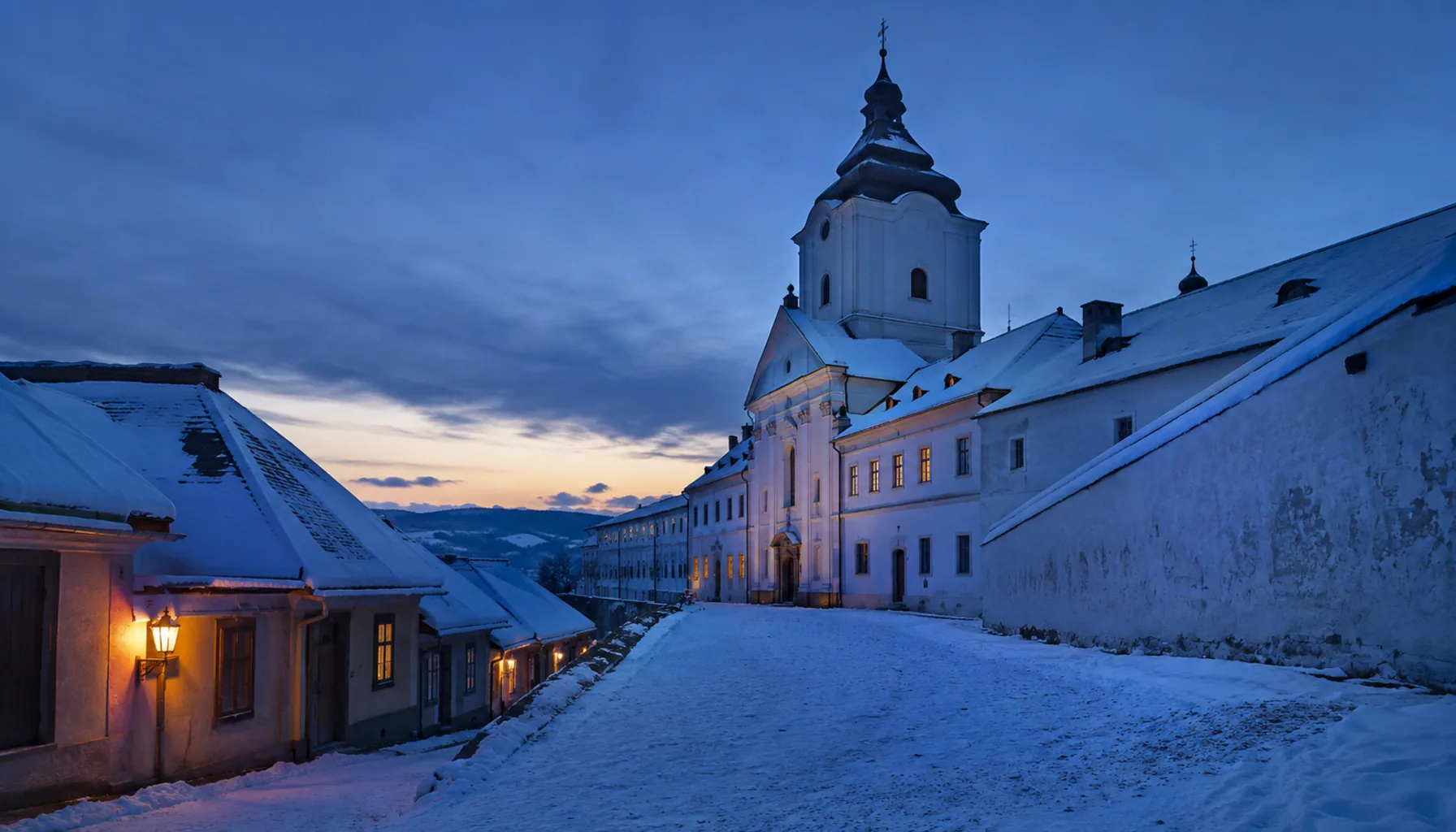
Podolinec keeps a monastery, a walled square and a bell tower built for a much larger town than the one living here now.Podolínec má kláštor, hradbami ohraničené námestie a zvonicu postavené pre oveľa väčšie mesto, než je to dnešné.
The Piarist church and monastery in Podolinec, founded in 1642 by the Polish starosta of the pledged Spiš towns.Piaristický kostol a kláštor v Podolínci, ktorý v roku 1642 založil poľský starosta zálohovaných spišských miest.
The year in PodolinecRok v Podolínci
Podolinec is a town of about three thousand people and its calendar is the one such towns keep: the church year first, the market and the town's own day after it. The parish church is dedicated to the Assumption, and that feast is the fixed point of the summer here as it is in most Spiš towns. A church the size of the Piarist one invites concerts and gets them from time to time, but there is no fixed season, so check what is actually on rather than planning a journey around it.Podolínec má okolo troch tisíc obyvateľov a jeho kalendár je taký, aký si mestá tejto veľkosti držia: najprv cirkevný rok, potom trh a mestský deň. Farský kostol je zasvätený Nanebovzatiu Panny Márie a tento sviatok je pevným bodom leta, ako vo väčšine spišských miest. Kostol takej veľkosti, aký majú piaristi, si priam pýta koncerty a z času na čas ich aj dostane, no pevnú koncertnú sezónu tu nečakajte — radšej si overte, čo sa práve chystá, než okolo toho naplánujete cestu.
Since December 2007 there has been no checkpoint on the Polish border a few kilometres up the valley, and for a small town's cultural life that means more than it sounds: the parishes, schools and choirs of two countries are within an easy drive of each other again. The real programme is in the town's own listings, and in those of Stará Ľubovňa half an hour away — the castle and open-air museum there, the Zamagurie villages, and the raftsmen working the Dunajec in the Pieniny all draw on the same audience.Od decembra 2007 nie je na poľskej hranici pár kilometrov proti prúdu doliny nijaká kontrola a pre kultúrny život malého mesta to znamená viac, než sa zdá: farnosti, školy a spevácke zbory dvoch krajín sú si opäť na dosah. Skutočný program nájdete v mestských oznamoch — a v oznamoch Starej Ľubovne pol hodiny odtiaľto, kde je hrad so skanzenom. Do rovnakého okruhu patria aj zamagurské dediny a pltníci na Dunajci v Pieninach.
Where culture livesKde žije kultúra
The largest cultural fact in Podolinec is the monastery. The Piarists came in 1642, and from 1648 the house trained members of the order as well as teaching local boys, so for three centuries the intellectual life of the town was a school run by a religious order. In 1950 the state suppressed the male orders and used this building to hold the men it took from them; the orders were legal again after 1989 and the buildings are back in church hands. Access to the church and the ranges around it is not a fixed museum opening — ask in the town.Najväčšou kultúrnou skutočnosťou Podolínca je kláštor. Piaristi sem prišli v roku 1642 a od roku 1648 tu dom vychovával aj vlastných členov rehole, takže vzdelanostný život mesta bol tri storočia školou v rukách rehole. V roku 1950 štát mužské rehole zrušil a v týchto budovách držal mužov, ktorých z nich odviedol; po roku 1989 boli rehole opäť legálne a objekt je dnes späť v cirkevných rukách. Vstup do kostola a do kláštorných krídel nemá pevné múzejné hodiny — treba sa spýtať v meste.
Everything else is what a town this size keeps and no more: a cultural centre with a hall and a programme, a library, amateur singing, and a school of art for children. We name none of them individually, because premises and programmes change faster than a page like this does. The larger institutions — the museums, the gallery network, a theatre — are in Stará Ľubovňa, Kežmarok and Poprad, and people here use them the way they use those towns' shops and hospital.Všetko ostatné je presne to, čo si mesto tejto veľkosti drží, a nič navyše: kultúrne stredisko so sálou a programom, knižnica, amatérsky spev a základná umelecká škola pre deti. Menovite tu neuvádzame ani jedno z nich, lebo priestory a programy sa menia rýchlejšie než takáto stránka. Väčšie inštitúcie — múzea, galérie, divadlo — sú v Starej Ľubovni, v Kežmarku a v Poprade a Podolínčania ich používajú rovnako ako tamojšie obchody a nemocnicu.
The buildings that carry itBudovy, ktoré ju nesú
Three buildings tell the whole story. The Gothic parish church of the Assumption is the oldest; beside it stands a free-standing bell tower that the townspeople built for themselves in 1659, in the middle of the worst century the town ever had — plague in 1646 and again in 1664, a flood and an earthquake in 1662, the monastery burnt in 1669 and a great fire through the town in 1684. Very little medieval fabric survives anywhere in Slovakia, and fire, not war, is usually the reason.Celý príbeh mesta rozprávajú tri stavby. Najstaršou je gotický farský kostol Nanebovzatia Panny Márie; vedľa neho stojí samostatná zvonica, ktorú si mešťania postavili v roku 1659, uprostred najhoršieho storočia, aké mesto zažilo — mor v rokoch 1646 a 1664, povodeň a zemetrasenie v roku 1662, požiar kláštora v roku 1669 a veľký požiar mesta v roku 1684. Stredovekého muriva sa na Slovensku zachovalo málo a na vine býva oheň, nie vojna.
The Baroque church and monastery are of a different order of expense, and nobody here paid for them. Stanisław Lubomirski, the Polish starosta who governed the pawned Spiš towns from Ľubovňa castle, founded the house: the money was Polish, the king was Polish, and the town was legally Hungarian. The long sloping square and the stretches of wall on the edge of the centre belong to a third layer again — the wall went up after a Mongol raid in 1285, and the privileges that paid for it were granted in 1292 and widened by King Louis I in 1345.Barokový kostol s kláštorom sú stavby celkom inej ceny a nezaplatil ich nikto odtiaľto. Dom rehoľe založil Stanisław Lubomirski, poľský starosta, ktorý zálohované spišské mestá spravoval z Ľubovnianskeho hradu: peniaze boli poľské, kráľ poľský a mesto právne uhorské. Dlhé svahovité námestie a zvyšky hradieb na okraji centra patria k ďalšej vrstve — múry vyrástli po mongolskom vpáde v roku 1285, mestské výsady, ktoré ich zaplatili, mesto dostalo v roku 1292 a kráľ Ľudovít I. ich v roku 1345 rozšíril.
A teaching house on a borderUčiaci dom na hranici
The Piarists were a teaching order and free schooling was the whole point of them. Their college took pupils from both sides of the mountains, and from 1648 it trained members of the order itself, which is the only reason a small town on a cold river has a building of this ambition. Read the monastery that way and its scale stops being strange: it is a school, built by people who did not live here, for children who did.Piaristi boli učiteľskou rehoľou a bezplatné školstvo bolo celým ich zmyslom. Ich kolégium prijímalo žiakov z oboch strán hôr a od roku 1648 vychovávalo aj vlastný dorast — to je jediný dôvod, prečo má malé mesto pri studenej rieke stavbu takých ambícií. Keď sa na kláštor pozeráte takto, jeho mierka prestane byť čudná: je to škola, ktorú postavili ľudia odinakiaľ pre deti odtiaľto.
The town's other public institutions arrived late and small. The branch railway up the Poprad valley began working in 1893 and Podolinec founded its own savings bank in 1897 — money and movement reaching a place that had had little of either. Neither was enough to keep people at home; like the whole of the northern Spiš, the town sent emigrants to America in the decades before 1914. A place governed in turn from Kraków, Vienna, Budapest and Prague tends to invest in what it can keep, and here that was a church, a school and a bell tower.Ostatné verejné inštitúcie prišli neskoro a v malom. Miestna železnica dolinou Popradu začala premávať v roku 1893 a v roku 1897 si mesto založilo vlastnú sporiteľňu — peniaze a pohyb prichádzali tam, kde bolo oboch málo. Ani to nestačilo, aby ľudia zostali doma: ako celý horný Spiš aj Podolínec posielal pred rokom 1914 vysťahovalcov do Ameriky. Mesto, ktoré spravovali z Krakova, z Viedne, z Budapešti aj z Prahy, investuje do toho, čo si môže udržať — a tu to boli kostol, škola a zvonica.