One of the oldest chartered towns of the Spiš, held by Poland for three and a half centuries, with a Piarist monastery founded by a Polish starosta and later used as an internment camp for Slovakia's religious orders.Jedno z najstarších výsadných miest Spiša, tri a pol storočia v poľských rukách, s piaristickým kláštorom, ktorý založil poľský starosta a ktorý neskôr slúžil ako internačný tábor pre slovenské rehole.
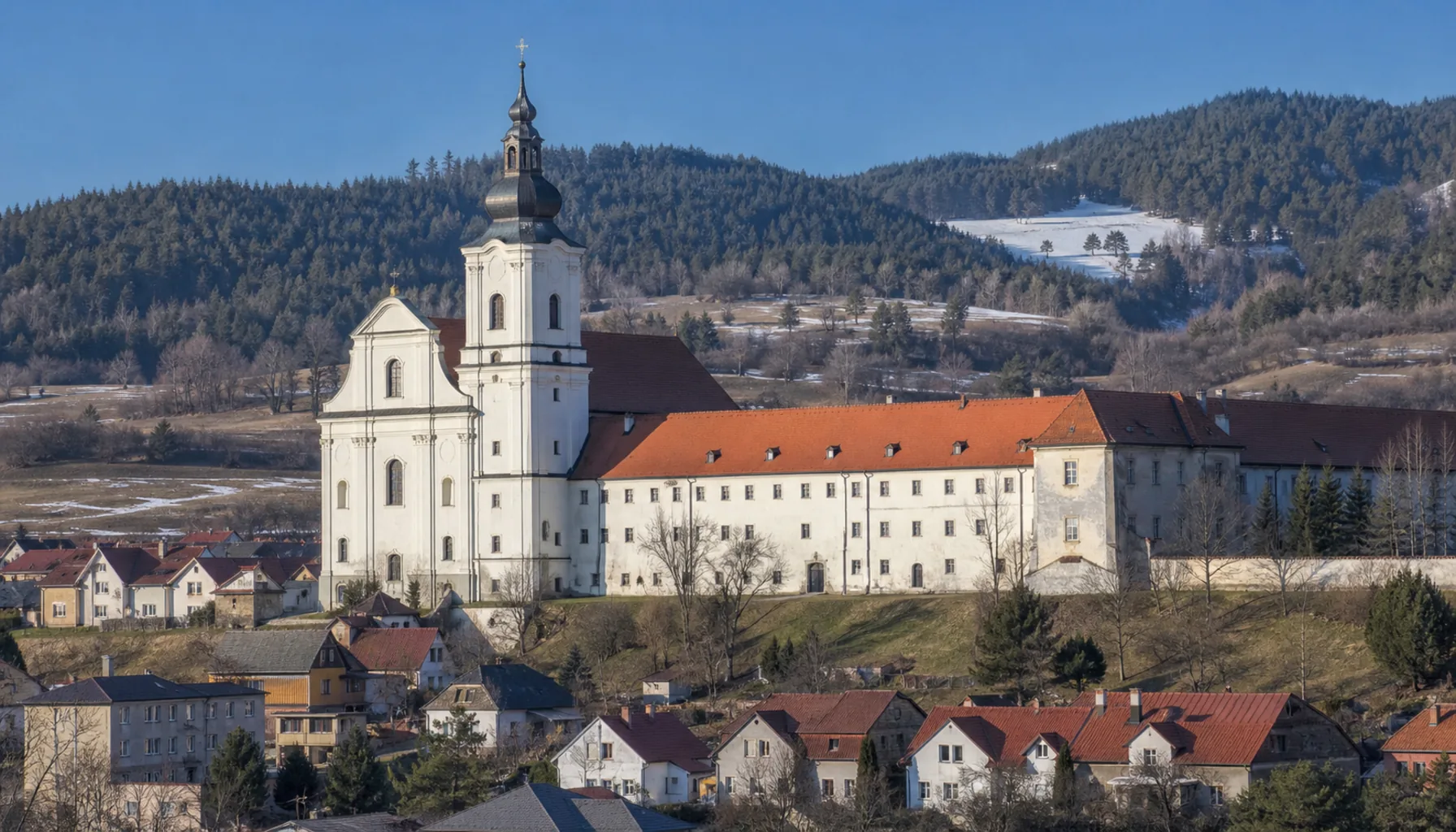
The Piarist church and monastery standing over the small town of PodolinecPiaristický kostol a kláštor nad malým mestom Podolinec
Where it standsKde leží
Podolinec lies on the Poprad river between Kežmarok and Stará Ľubovňa, where the valley narrows and the Spiš gives way to the border country of the north. The Levočské vrchy close the view south; north of the river the hills run on towards the Pieniny and Poland.Podolinec leží na rieke Poprad medzi Kežmarkom a Starou Ľubovňou tam, kde sa dolina zužuje a Spiš prechádza do severného pohraničia. Na juhu uzatvárajú výhľad Levočské vrchy, severne od rieky pokračujú kopce smerom k Pieninám a Poľsku.
It is a very small town that carries a very large history, and the buildings in it are out of scale with the place in a way that is immediately obvious.Je to veľmi malé mesto s veľmi veľkými dejinami a stavby v ňom sú voči jeho mierke natoľko predimenzované, že si to človek všimne okamžite.
The storyHistória
Podolinec is documented from the thirteenth century and was among the first settlements of the Spiš to be given town rights, with German settlers brought in after the Mongol invasion. It kept walls, a market and the usual burgher trades on the road along the Poprad valley. Then, in 1412, King Sigismund pawned thirteen Spiš towns and, separately, the estates of Ľubovňa, Podolinec and Hniezdne to the Polish crown. The pledge was meant to be temporary; it lasted until 1772, so for three hundred and sixty years the town was governed from Poland, and the mark that period left is the reason Podolinec looks the way it does.Podolinec je doložený od 13. storočia a patril medzi prvé spišské sídla, ktoré dostali mestské práva; po tatárskom vpáde sem priviedli nemeckých kolonistov. Držal si hradby, trh a bežné meštianske remeslá na ceste dolinou Popradu. Potom v roku 1412 dal kráľ Žigmund do zálohy poľskej korune trinásť spišských miest a osobitne aj panstvá Ľubovne, Podolinca a Hniezdneho. Záloh mal byť dočasný; trval do roku 1772, takže tristošesťdesiat rokov spravovali mesto z Poľska — a stopa, ktorú toto obdobie zanechalo, je dôvodom, prečo Podolinec vyzerá tak, ako vyzerá.
In 1642 Stanisław Lubomirski, the Polish starosta of the pawned towns, founded a house of the Piarist order here — one of the first north of the Carpathians. Its college taught generations of pupils from both sides of the mountains, and the church and monastery it built still dominate the town.V roku 1642 založil Stanisław Lubomirski, poľský starosta zálohovaných miest, v meste dom piaristov — jeden z prvých na sever od Karpát. Ich kolégium učilo generácie žiakov z oboch strán hôr a kostol s kláštorom, ktoré postavili, dodnes mestu dominujú.
In 1950 the Czechoslovak state suppressed the male religious orders overnight and used a handful of monasteries as internment centres for the men taken from them. Podolinec was one of those places. The buildings are back in church hands today, and that episode is part of what they are.V roku 1950 československý štát zo dňa na deň zlikvidoval mužské rehole a hŕstku kláštorov použil ako internačné strediská pre rehoľníkov, ktorých z nich odviezli. Podolinec bol jedným z týchto miest. Budovy sú dnes späť v cirkevných rukách a táto epizóda patrí k tomu, čím sú.
What to seeČo vidieť
The Piarist church and the monastery ranges around it are the town's set piece — a Baroque complex of a scale that only makes sense once you know who paid for it and why. The Gothic parish church of the Assumption stands nearby with its own free-standing bell tower, and fragments of the medieval town wall survive on the edges of the centre.Hlavným obrazom mesta sú piaristický kostol a kláštorné krídla okolo neho — barokový komplex takej mierky, ktorá dáva zmysel až vtedy, keď človek vie, kto ho zaplatil a prečo. Neďaleko stojí gotický farský Kostol Nanebovzatia Panny Márie s vlastnou samostatnou zvonicou a na okrajoch centra sa zachovali zvyšky stredovekých hradieb.
The square is long and sloping, lined with low burgher houses, and it takes twenty minutes to walk. What fills a day is what lies around it: Stará Ľubovňa with its castle and open-air museum, the Zamagurie villages, and the Dunajec gorge in the Pieniny, where the raftsmen work the border river — all within half an hour by car.Námestie je dlhé a mierne stúpa, lemujú ho nízke meštianske domy a prejde sa za dvadsať minút. Deň zaplní to, čo leží okolo: Stará Ľubovňa s hradom a skanzenom, obce Zamaguria a prielom Dunajca v Pieninách, kde pltníci splavujú hraničnú rieku — všetko do polhodiny autom.
Work and industryPráca a priemysel
The town is small and its economy is modest: sawmilling and timber, building trades, some food processing, and a good deal of commuting to Stará Ľubovňa, Kežmarok and Poprad. The villages around it farm cattle and potatoes on high, cold ground, and seasonal work in Tatra and Pieniny tourism takes up part of the year.Mesto je malé a jeho hospodárstvo skromné: píly a drevárstvo, stavebné remeslá, trochu potravinárstva a hlavne dochádzka do Starej Ľubovne, Kežmarku a Popradu. Okolité obce chovajú dobytok a pestujú zemiaky na vysoko položenej chladnej pôde a časť roka zaberá sezónna práca v tatranskom a pieninskom cestovnom ruchu.
Getting thereAko sa tam dostať
Podolinec is on the branch railway from Poprad through Kežmarok and Spišská Belá to Stará Ľubovňa and Plaveč. Buses run from Stará Ľubovňa and Kežmarok, and the road follows the Poprad valley in both directions.Podolinec leží na odbočnej trati z Popradu cez Kežmarok a Spišskú Belú do Starej Ľubovne a Plavča. Autobusy premávajú zo Starej Ľubovne a Kežmarku a cesta sleduje dolinu Popradu na obe strany.
Explore PodolinecObjavujte Podolinec
Every part of this place with a page of its own.Každá časť tohto miesta, ktorá má vlastnú stránku.