Prešov region · VillagesPrešovský kraj · Obce
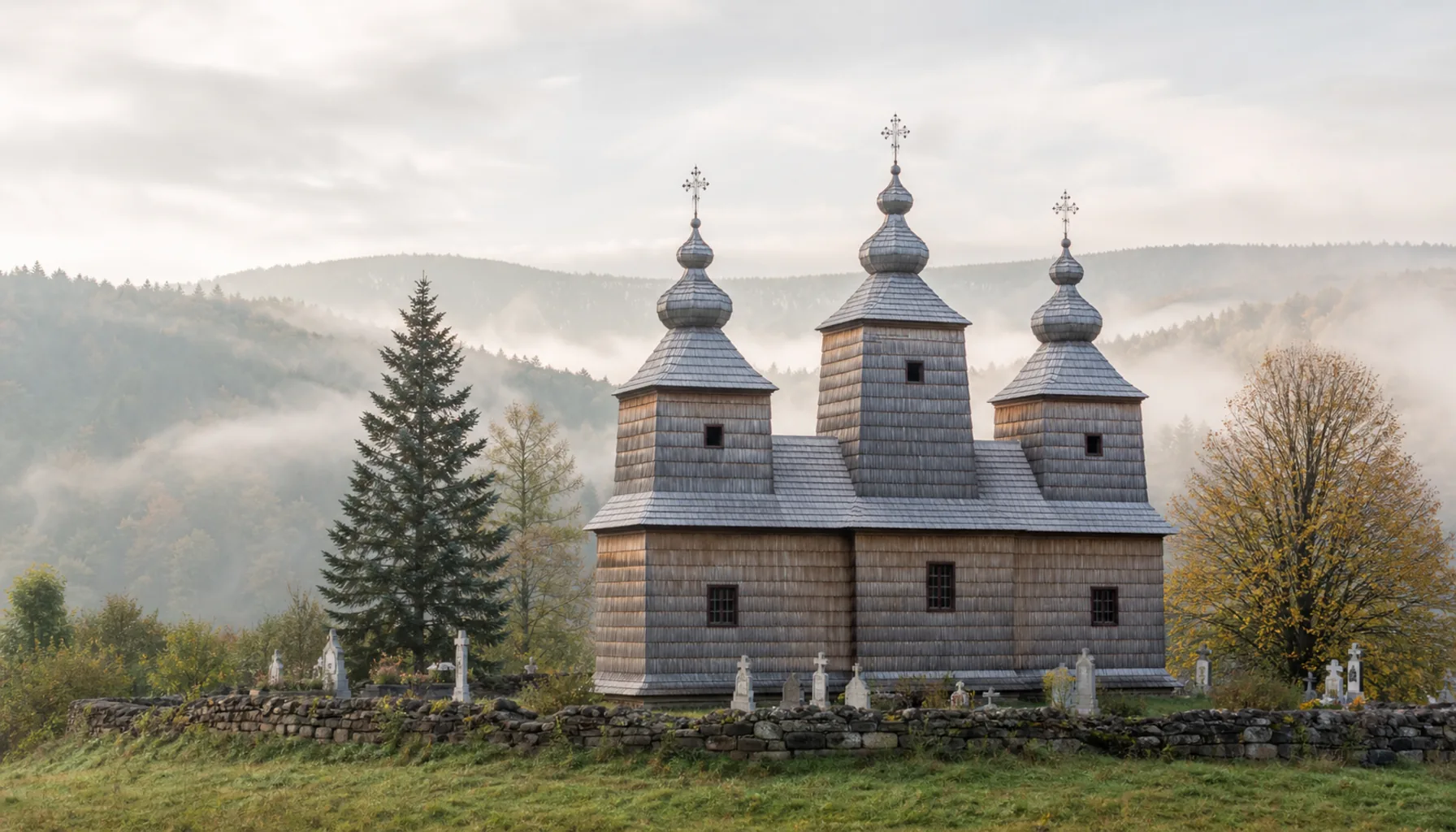
A hamlet north of Svidník with one of the oldest Eastern-rite wooden churches in the country: St Nicholas, built in 1658, three log cells in a line under three shingled towers, with an eighteenth-century iconostasis inside and a stone wall round its graveyard.Osada severne od Svidníka s jedným z najstarších drevených chrámov východného obradu v krajine: svätý Mikuláš z roku 1658, tri zrubové priestory v jednej osi pod tromi šindľovými vežami, vnútri ikonostas z 18. storočia a okolo cintorína kamenný múr.
Bodružal lies in a side valley off the road running north from Svidník to the Dukla Pass, in the rounded flysch hills of the Low Beskids. The Polish border is a few kilometres over the ridge. The village is a short line of houses along a stream, with the church standing above them behind a wall.Bodružal leží v bočnej doline pri ceste, ktorá vedie zo Svidníka na sever k Duklianskemu priesmyku, v oblých flyšových kopcoch Nízkych Beskýd. Poľská hranica je pár kilometrov za hrebeňom. Obec je krátkym radom domov pozdĺž potoka a chrám stojí nad nimi za múrom.
These high, poor valleys were settled late, by Rusyn herding families moving along the arc of the Carpathians under a separate body of Wallachian custom. They lived off sheep, cattle, timber and thin fields, and the villages they founded stayed small because the ground could not carry more.Tieto vysoko položené a chudobné doliny osídlili neskoro rusínske pastierske rodiny, ktoré sa presúvali po oblúku Karpát podľa osobitného valaského práva. Živili sa ovcami, dobytkom, drevom a chudobnými poľami a obce, ktoré založili, zostali malé, lebo pôda viac neuniesla.
The church was built in 1658, in the generation after the Union of Uzhhorod began drawing the eastern parishes of this country into communion with Rome; the parish is Greek Catholic today. It is among the oldest surviving wooden churches of the eastern rite in Slovakia, and it was inscribed on the World Heritage List in 2008.Chrám postavili v roku 1658, generáciu po tom, ako Užhorodská únia začala privádzať východné farnosti tejto krajiny do jednoty s Rímom; farnosť je dnes gréckokatolícka. Patrí k najstarším zachovaným dreveným chrámom východného obradu na Slovensku a v roku 2008 ho zapísali do zoznamu svetového dedičstva.
In the autumn of 1944 the front stood in these valleys for weeks during the Carpathian-Dukla operation, and much of the district was burnt out and rebuilt afterwards. The church came through it. What emptied the village was slower: emigration before the First World War, and the drift to the towns after the Second.Na jeseň 1944 stál v týchto dolinách počas karpatsko-duklianskej operácie front celé týždne a veľká časť okresu vyhorela a stavala sa nanovo. Chrám to prežil. Obec vyprázdnilo niečo pomalšie: vysťahovalectvo pred prvou svetovou vojnou a odchod do miest po druhej.
The building is three cells in a line, each lower than the one before it, under three towers with onion cupolas and forged crosses; everything, walls included, is clad in shingle that weather has turned silver. It stands in its graveyard inside a stone enclosure, and what the listing protects is the whole ensemble — church, wall, gate and crosses — not the church alone.Stavba je z troch častí v jednej osi, každá nižšia než predchádzajúca, pod tromi vežami s cibuľovými baňami a kovanými krížmi; všetko vrátane stien je pobité šindľom, ktorý čas striebri. Stojí na cintoríne v kamennej ohrade a chránený je celý areál — chrám, múr, brána aj kríže — nielen samotná stavba.
Inside, the three spaces follow one another and grow lower and darker towards the east: the entrance chamber under the tower, the nave, and the sanctuary hidden behind the iconostasis. That screen is the eighteenth-century one, tiers of icons with the royal doors in the middle, and it is why the interior is worth the trouble of arranging.Vnútri idú tri priestory za sebou a smerom na východ sú stále nižšie a tmavšie: babinec pod vežou, loď a svätyňa ukrytá za ikonostasom. Ten je z 18. storočia — rady ikon s cárskymi dverami uprostred — a je dôvodom, prečo sa oplatí návštevu interiéru vybaviť.
Outside the wall there is nothing else: a few houses, meadows, forest. Bodružal is one stop on a run of wooden churches — Ladomirová, Miroľa, Príkra, Krajné Čierno, Nižný Komárnik — and most people drive several of them in a day.Za múrom už nie je nič iné: pár domov, lúky a les. Bodružal je jednou zastávkou na trase drevených chrámov — Ladomirová, Miroľa, Príkra, Krajné Čierno, Nižný Komárnik — a väčšina ľudí ich za deň prejde niekoľko.
Bodružal is inhabited, though by very few people, and the church is a working Greek Catholic parish church rather than an exhibit. It is locked, and opened by a keyholder or a guide, seasonally and by arrangement; there is a charge, and photography inside is usually restricted or not allowed. Services are services.Bodružal je obývaný, hoci len veľmi málo ľuďmi, a chrám je funkčným gréckokatolíckym farským kostolom, nie exponátom. Býva zamknutý a otvára ho kľúčnik alebo sprievodca, sezónne a po dohovore; platí sa vstupné a fotografovanie vnútri býva obmedzené alebo zakázané. Bohoslužba je bohoslužba.
There is no visitor infrastructure to speak of — this is a village, not a site. The graveyard is in use, the wall is old and the shingle is under permanent repair, so keep to the paths and expect one of these churches to be in scaffolding in any given summer.Návštevnícke zázemie tu prakticky nie je — je to obec, nie lokalita. Cintorín sa používa, múr je starý a šindeľ je v neustálej oprave, takže sa držte chodníkov a počítajte s tým, že v ktoromkoľvek lete bude jeden z týchto chrámov v lešení.
There is no railway in the district. The approach is by the main road from Svidník towards the Dukla Pass and then a turn into the side valley; buses from Svidník are few, and a car is the practical way to reach this church and the others near it.V okrese nie je železnica. Ide sa hlavnou cestou zo Svidníka smerom na Duklu a potom odbočkou do bočnej doliny; autobusov zo Svidníka je málo a k tomuto chrámu — aj k tým ostatným v okolí — sa prakticky dostanete autom.
Sixteen videos for Bodružal.Šestnásť videí — Bodružal.