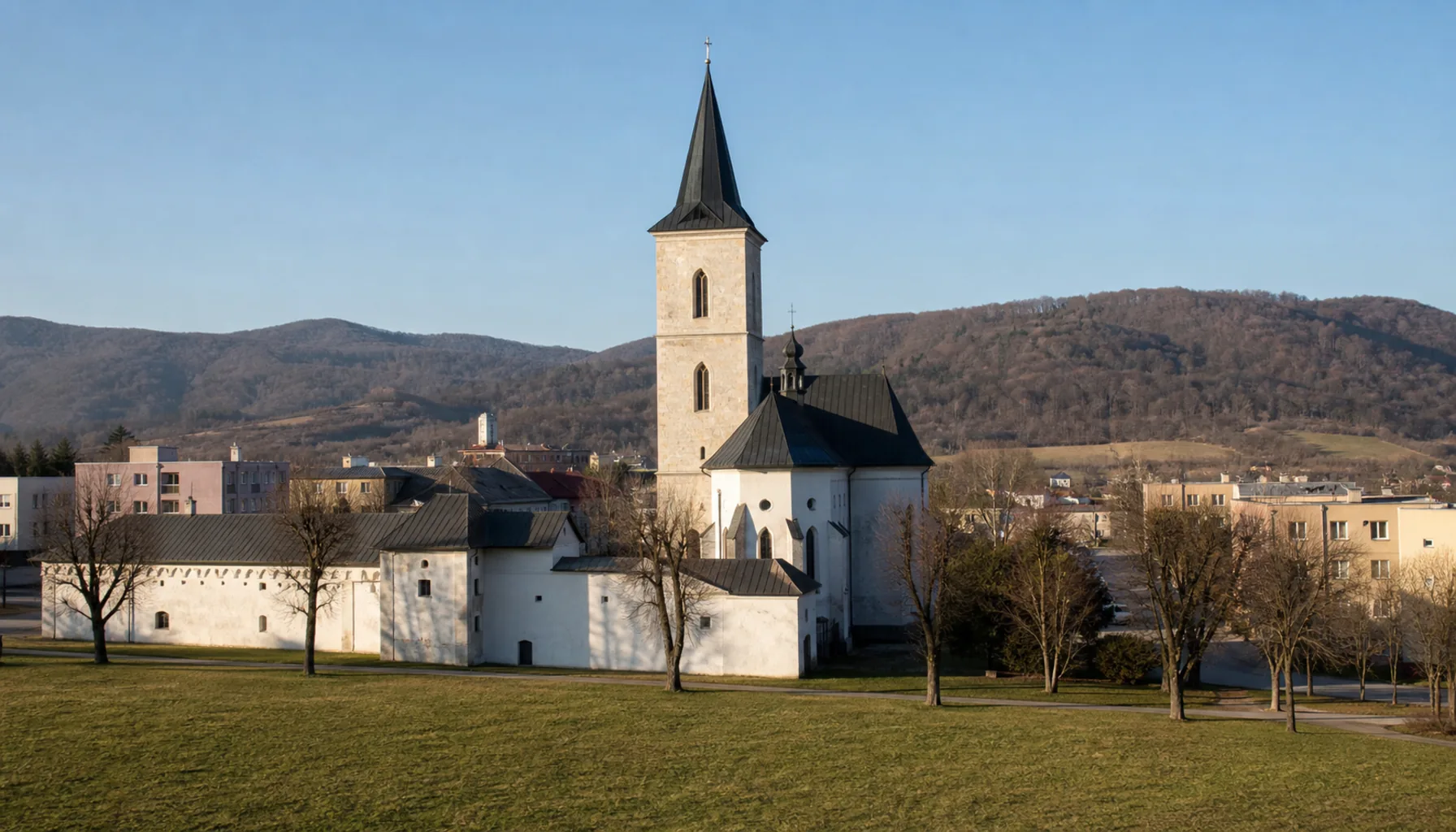
A district seat on the upper Ondava between Svidník and the Domaša reservoir, with the surviving wing of a fortified manor beside its parish church and an electronics works that has been the town's best-known employer since the 1950s.Okresné mesto na hornej Ondave medzi Svidníkom a Domašou, so zachovaným krídlom opevneného kaštieľa pri farskom kostole a s elektrotechnickým závodom, ktorý je jeho najznámejším zamestnávateľom od päťdesiatych rokov.
The parish church at Stropkov, with the surviving wing of the Renaissance manor beside itFarský kostol v Stropkove a vedľa neho zachované krídlo renesančného kaštieľa
Where it standsKde leží
Stropkov stands on the Ondava where the river has come down out of the Low Beskids and is still running through hill country, about sixty kilometres north-east of Prešov. Svidník is twenty kilometres north-west, Humenné a similar distance south-east, and the Domaša reservoir begins a short way downstream.Stropkov leží na Ondave tam, kde rieka už zišla z Nízkych Beskýd, no stále tečie kopcovitým krajom, asi šesťdesiat kilometrov severovýchodne od Prešova. Svidník je dvadsať kilometrov na severozápad, Humenné podobne ďaleko na juhovýchod a kúsok po prúde sa začína vodná nádrž Domaša.
The district is thinly settled and its villages are largely Rusyn and Greek Catholic; Stropkov is the market, the offices and the schools for all of them.Okres je riedko osídlený a jeho dediny sú z veľkej časti rusínske a gréckokatolícke; Stropkov je pre ne pre všetky trhom, úradom aj školou.
The storyHistória
Stropkov first appears in the written record in the Middle Ages as a market town on the road up the Ondava, and it was held by a succession of noble families who kept a fortified seat here. The castle was rebuilt in the sixteenth century as a Renaissance fortified manor with bastions and a moat; a wing of it survives beside the parish church, which is more than a town of this size usually has to show.Stropkov sa v písomnostiach objavuje v stredoveku ako trhové mesto na ceste hore Ondavou a držali ho po sebe šľachtické rody, ktoré tu mali opevnené sídlo. Hrad prestavali v šestnástom storočí na renesančný opevnený kaštieľ s baštami a vodnou priekopou; jeho krídlo sa zachovalo pri farskom kostole, čo je viac, než mesto tejto veľkosti obyčajne má.
The market rights and the road were what the town lived on, and it stayed a country town — Greek Catholic and Roman Catholic side by side.Mesto žilo z trhových práv a z cesty a zostalo vidieckym mestom — gréckokatolíci a rímskokatolíci vedľa seba.
In the autumn of 1944 the Carpathian–Dukla operation brought the front to the Ondava. The fighting in the hills above the town went on for months and Stropkov was badly damaged; most of what stands in the centre now is post-war.Na jeseň 1944 priniesla karpatsko-duklianska operácia front na Ondavu. Boje v kopcoch nad mestom trvali mesiace a Stropkov bol ťažko poškodený; väčšina toho, čo dnes v centre stojí, je povojnová.
What to seeČo vidieť
The Roman Catholic parish church, Gothic in origin and much rebuilt, together with the surviving wing of the Renaissance manor beside it, is the historic core of the town; the Greek Catholic church records the other half of the district's religious life.Rímskokatolícky farský kostol, pôvodom gotický a mnohokrát prestavaný, a vedľa neho zachované krídlo renesančného kaštieľa tvoria historické jadro mesta; gréckokatolícky kostol pripomína druhú polovicu náboženského života okresu.
Most people pass through Stropkov on the way somewhere else, and the somewhere else is worth naming. Domaša, the long reservoir on the Ondava south of the town, is the summer destination of the whole region. North lie the Dukla battlefield and the museums at Svidník, and the wooden churches of the district — Greek Catholic and Orthodox, log-built, several of them on the World Heritage List — are spread through the villages on either side of the road.Väčšina ľudí prechádza Stropkovom cestou niekam inam a to inam stojí za pomenovanie. Domaša, dlhá nádrž na Ondave južne od mesta, je letným cieľom celého kraja. Na sever je duklianske bojisko a svidnícke múzeá a po dedinách po oboch stranách cesty sú roztrúsené drevené kostolíky okresu — gréckokatolícke a pravoslávne, zrubové, niekoľko z nich v zozname svetového dedičstva.
The hills themselves are the quiet attraction. The Low Beskids are rolling rather than dramatic, almost empty of traffic, and good for cycling and for long walks on which very few people are met.Tichou atrakciou sú samotné kopce. Nízke Beskydy sú skôr zvlnené než dramatické, takmer bez dopravy a vhodné na bicyklovanie a dlhé prechádzky, na ktorých človek stretne len málokoho.
Work and industryPráca a priemysel
The electronics works founded here in the late 1950s as part of the Tesla combine is still the town's best-known employer, making door-entry systems, intercoms and electrical installation material. Around it are timber, light engineering, food processing and the public sector — health care, the schools and the district offices.Elektrotechnický závod, ktorý tu koncom päťdesiatych rokov vznikol ako súčasť Tesly, je stále najznámejším zamestnávateľom mesta a vyrába domáce vrátniky, dorozumievacie systémy a elektroinštalačný materiál. Okolo neho stojí drevospracovanie, ľahké strojárstvo, potravinárstvo a verejný sektor — zdravotníctvo, školy a okresné úrady.
That is not enough for the district, which has been one of the poorest in Slovakia for a long time. Unemployment is high, farming has shrunk to grass and cattle on land that never suited arable, and a great many people work in Košice, in Bohemia or further west and come home at weekends.Na okres to nestačí — patrí dlhodobo k najchudobnejším na Slovensku. Nezamestnanosť je vysoká, hospodárenie sa zúžilo na trávu a dobytok na pôde, ktorá nikdy nebola oráčinou, a veľa ľudí pracuje v Košiciach, v Čechách alebo ešte ďalej na západ a domov chodí na víkendy.
Getting thereAko sa tam dostať
Road and bus. The route up the Ondava from Vranov nad Topľou and Humenné passes through the town and continues to Svidník and the Dukla Pass, and buses from Prešov, Svidník, Humenné and Vranov are the practical way in; trains are not part of the picture here.Cesta a autobus. Trasa hore Ondavou z Vranova nad Topľou a Humenného vedie mestom a pokračuje do Svidníka a na Duklu; autobusy z Prešova, Svidníka, Humenného a Vranova sú praktickým spôsobom, ako sa sem dostať. S vlakom tu rátať netreba.
Explore StropkovObjavujte Stropkov
Every part of this place with a page of its own.Každá časť tohto miesta, ktorá má vlastnú stránku.