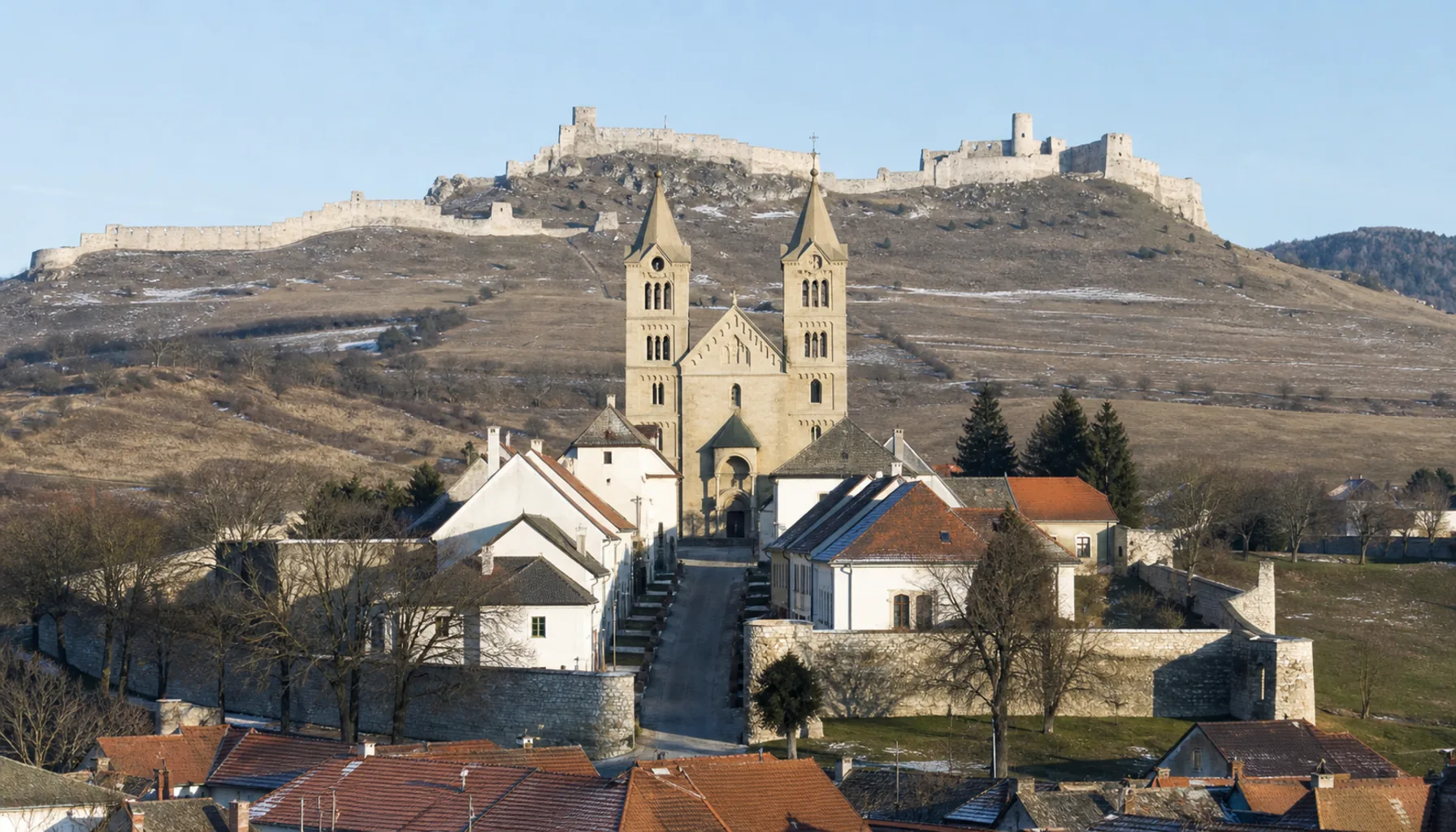
The town in the saddle between two World Heritage neighbours — Spiš Castle on its travertine hill to the east, and Spišská Kapitula, the walled town of canons, on the ridge to the west. Podhradie is the ordinary place that holds the extraordinary pair together.Mesto v sedle medzi dvoma susedmi zo zoznamu svetového dedičstva — Spišským hradom na travertínovej kope na východe a Spišskou Kapitulou, opevneným mestečkom kanonikov, na hrebeni na západe. Podhradie je to všedné miesto, ktoré tú výnimočnú dvojicu drží pokope.
Spišská Kapitula on its ridge above Spišské Podhradie, the twin towers of St Martin's cathedral at the head of its single walled streetSpišská Kapitula na hrebeni nad Spišským Podhradím, dvojica veží Katedrály svätého Martina na čele jej jedinej opevnenej ulice
Where it standsKde leží
Spišské Podhradie lies in the shallow valley between two hills in the middle of Spiš, about fifteen kilometres east of Levoča and a similar distance north-east of Spišská Nová Ves. The castle rock rises on one side of it and the ridge of Spišská Kapitula on the other, and the town sits in the gap between them with a long street for a square.Spišské Podhradie leží v plytkej doline medzi dvoma kopcami uprostred Spiša, asi pätnásť kilometrov východne od Levoče a podobne ďaleko severovýchodne od Spišskej Novej Vsi. Na jednej strane sa nad ním dvíha hradná kopa, na druhej hrebeň Spišskej Kapituly, a mesto sedí v medzere medzi nimi s dlhou ulicou namiesto námestia.
The whole group — the castle, the Kapitula, the town, and the village church of the Holy Spirit at Žehra a few kilometres south-east, with its medieval wall paintings — was inscribed on the World Heritage List together in 1993. Levoča, over the hills to the west, was added to the same inscription later.Celá skupina — hrad, Kapitula, mesto a dedinský Kostol Ducha Svätého v Žehre pár kilometrov na juhovýchod so stredovekými nástennými maľbami — bola do zoznamu svetového dedičstva zapísaná spoločne v roku 1993. Levoča za kopcami na západe pribudla k tomu istému zápisu neskôr.
The storyHistória
The castle above the town has its own chapters on this site and there is no need to retell it here. What matters for Podhradie is the relationship: the town is there because the castle was — the market and workshop settlement under the walls, supplying and serving the fortress — and its name says as much, since podhradie means simply the place below the castle.Hrad nad mestom má na tejto stránke vlastné kapitoly a niet dôvodu prerozprávať ho aj tu. Pre Podhradie je podstatný vzťah: mesto je tu preto, že tu bol hrad — trhová a remeselnícka osada pod hradbami, ktorá pevnosť zásobovala a obsluhovala — a hovorí to už jeho meno, lebo podhradie znamená jednoducho miesto pod hradom.
Spišská Kapitula on the opposite ridge was the other pole of the town's life and a wholly separate jurisdiction behind its own wall. A collegiate chapter was established there in the twelfth century and the provost of Spiš governed a large ecclesiastical territory from it; when the Spiš bishopric was founded in 1776 the Kapitula became its seat, and it is the seat of the diocese still.Spišská Kapitula na protiľahlom hrebeni bola druhým pólom mestského života a celkom samostatnou jurisdikciou za vlastným múrom. V dvanástom storočí tam vzniklo kolegiátne prepoštstvo a spišský prepošt odtiaľ spravoval rozsiahle cirkevné územie; keď v roku 1776 vzniklo Spišské biskupstvo, Kapitula sa stala jeho sídlom a sídlom diecézy je dodnes.
Podhradie itself was a market town of the Spiš Germans, and one of those pledged to the Polish crown in 1412 against a loan never repaid; they were not returned until 1772. Crafts, the fairs and the trade of the castle estate carried it, and fires and the shifting trade routes cut it back to the small town it still is.Samotné Podhradie bolo trhovým mestom spišských Nemcov a patrilo medzi mestá, ktoré boli v roku 1412 zálohované poľskej korune za pôžičku, ktorú nikto nikdy nesplatil; späť sa vrátili až v roku 1772. Živili ho remeslá, jarmoky a obchod hradného panstva a požiare i presun obchodných ciest ho zmenšili na mestečko, akým je dodnes.
What to seeČo vidieť
Spišská Kapitula is the reason to stop. It is a single street inside a wall, with a gate at each end, the canons' houses down both sides and the Cathedral of St Martin at the head of it — late Romanesque, built in the middle of the thirteenth century, with a twin-towered west front and a late-Gothic chapel added by the Zápoľský family at the end of the fifteenth. Local usage calls it the Slovak Vatican, a remark about what it is rather than how big.Spišská Kapitula je dôvodom, prečo zastaviť. Je to jediná ulica vnútri múru, s bránou na oboch koncoch, s kanonickými domami po oboch stranách a s Katedrálou svätého Martina na jej čele — neskororománskou, postavenou v polovici trinásteho storočia, s dvojvežovým západným priečelím a s neskorogotickou kaplnkou, ktorú na konci pätnásteho storočia pristavali Zápoľskovci. V kraji sa jej hovorí slovenský Vatikán, čo je poznámka o tom, čím je, nie o tom, aká je veľká.
Inside the cathedral are a fourteenth-century wall painting of the coronation of Charles Robert of Anjou and, set into the floor by the entrance, the white stone lion at which oaths were once sworn. Below the ridge the town has a long widening square with a Gothic parish church at one end and low houses down both sides, restored in patches; from it the castle and the Kapitula can be seen in a single view, which is not possible from either.V katedrále je nástenná maľba korunovácie Karola Róberta z Anjou zo štrnásteho storočia a pri vchode do dlážky osadený biely kamenný lev, na ktorom sa kedysi prisahalo. Pod hrebeňom má mesto dlhé rozširujúce sa námestie s gotickým farským kostolom na jednom konci a nízkymi domami po oboch stranách, obnovenými len miestami; práve odtiaľ vidno hrad aj Kapitulu naraz, čo sa ani z jedného z nich nedá.
Two travertine hills flank the town and each takes an hour. Dreveník, east of the castle, is a broken block of travertine full of clefts, towers and small caves, protected as a nature reserve; Sivá Brada, west of the town beside the road, is a live travertine dome with mineral springs and a chapel on top.Mesto lemujú dva travertínové kopce a na každý stačí hodina. Dreveník východne od hradu je rozlámaný travertínový blok plný puklín, veží a malých jaskýň, chránený ako prírodná rezervácia; Sivá Brada západne od mesta pri ceste je živá travertínová kopa s minerálnymi prameňmi a kaplnkou na temene.
Work and industryPráca a priemysel
Podhradie is a small town in a district with little industry, and a good deal of what work there is comes off the hill: Spiš Castle is one of the most visited monuments in Slovakia, and the coach traffic supports guides, catering, accommodation and shops through the season. Public services, small workshops, forestry and farming make up the rest.Podhradie je malé mesto v okrese s minimom priemyslu a nemálo práce sem prichádza z kopca: Spišský hrad je jednou z najnavštevovanejších pamiatok na Slovensku a zájazdová doprava živí počas sezóny sprievodcov, gastronómiu, ubytovanie aj obchody. Zvyšok tvoria verejné služby, malé prevádzky, lesníctvo a hospodárenie na dne kotliny.
The seasonal swing is severe — busy from spring to autumn, very quiet outside it — and, like much of Spiš, this is a district with long-standing unemployment where working elsewhere for part of the year is ordinary.Sezónny výkyv je prudký — od jari do jesene rušno, mimo toho veľké ticho — a ako veľká časť Spiša je to okres s dlhodobou nezamestnanosťou, kde je práca časť roka inde bežnou vecou.
Getting thereAko sa tam dostať
The main road across Spiš from Poprad and Levoča to Prešov passes the town, and the buses along it are the usual way in. A short branch railway drops down to Spišské Vlachy on the Košice–Žilina main line, but services on it are few — check before relying on it. The car parks for the castle are on its own hill, not in the town.Popri meste vedie hlavná cesta cez Spiš z Popradu a Levoče do Prešova a autobusy po nej sú obvyklým spôsobom, ako sa sem dostať. Krátka odbočná železnica klesá do Spišských Vlách na hlavnú trať Košice – Žilina, spojov na nej je však málo — pred cestou si ich overte. Vodiči nech rátajú s tým, že parkoviská k hradu sú na hradnom kopci, nie v meste.