Spišská Stará Ves · ZamagurieSpišská Stará Ves · Zamagurie
Culture in Spišská Stará VesKultúra v Spišskej Starej Vsi
The only town in Zamagurie: a long square rebuilt after the fire of 1878, a Gothic church that came through every one of them, and Goral country on both banks of the Dunajec.Jediné mesto Zamaguria: dlhé námestie prestavané po požiari v roku 1878, gotický kostol, ktorý prežil všetky požiare, a goralský kraj na oboch brehoch Dunajca.
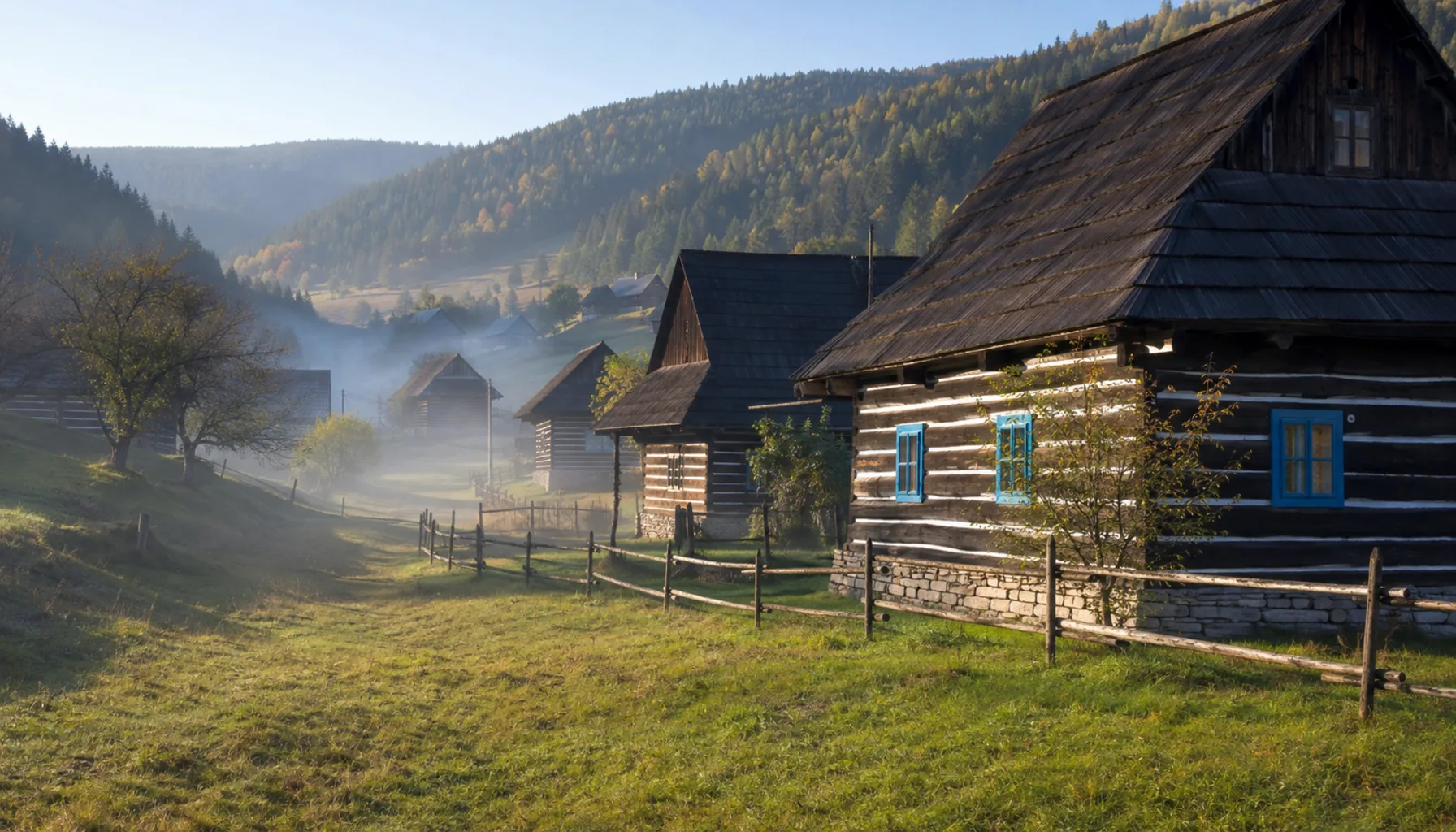
Goral log houses in Osturňa, the village of timber architecture in the hills west of Spišská Stará Ves.Goralské zrubové domy v Osturni, dedine drevenej architektúry v kopcoch západne od Spišskej Starej Vsi.
The year in Spišská Stará VesRok v Spišskej Starej Vsi
This has been a market town since 1399, when it was given a Tuesday market along with freedom from tolls and the right to import, store and sell drink; Ferdinand III granted the market right again in 1655, after the town had all but lost it. A market right is a licence to be a town at all, and for five centuries the fair days were the fixed points of the year. What is left of that is a small town's ordinary calendar - market days, a summer celebration, church feasts, school and club events - and the town's own listings are the place to check it.Trhovým mestom je Spišská Stará Ves od roku 1399, keď dostala utorkový trh spolu s oslobodením od mýta a s právom dovážať, skladovať a predávať nápoje; Ferdinand III. jej trhové právo znova udelil v roku 1655, keď oň už takmer prišla. Trhové právo je povolením byť vôbec mestom a jarmočné dni boli päť storočí pevnými bodmi roka. Zostal z toho obyčajný kalendár malého mesta - trhové dni, letné slávnosti, cirkevné sviatky, školské a záujmové podujatia - a overiť si ho treba v mestských oznamoch.
The visitor year is short and very concentrated. The traditional raft trips through the Dunajec gorge run in the warm months and set the rhythm of the whole of Zamagurie; cyclists come along the cross-border route around the Tatras, and Polish day traffic crosses at Lysá nad Dunajcom a few kilometres north. Outside the summer this is a very quiet place, and the town says so itself rather than pretending otherwise.Návštevnícky rok je krátky a veľmi sústredený. Tradičné plte prechádzajú prielomom Dunajca v teplých mesiacoch a udávajú rytmus celému Zamaguriu; po cezhraničnej cyklotrase okolo Tatier prichádzajú cyklisti a pár kilometrov na sever prechádzajú cez hranicu v Lysej nad Dunajcom poľskí jednodňoví návštevníci. Mimo leta je tu veľmi ticho a mesto to samo priznáva, namiesto toho, aby predstieralo opak.
Where culture livesKde žije kultúra
Spišská Stará Ves keeps what a town of a couple of thousand people can keep: a cultural centre with a hall, a library, a school of art for children, and the folk groups and church choirs that a Goral district produces without being asked. We name none of them here, because programmes and premises change faster than a page like this does. Between 1849 and 1960 the town was the seat of the Magura district, and the offices, court and schools that came with that status supported more organised cultural life than it has been able to since.Spišská Stará Ves si drží to, čo si mesto s dvoma tisíckami obyvateľov udržať môže: kultúrny dom so sálou, knižnicu, základnú umeleckú školu a folklórne skupiny i cirkevné zbory, ktoré goralský kraj vydáva sám od seba. Nemenujeme ich, lebo programy a priestory sa menia rýchlejšie než takáto stránka. V rokoch 1849 až 1960 bolo mesto sídlom Magurského okresu a úrady, súd a školy, ktoré k tomu patrili, uniesli organizovanejší kultúrny život, než aký mesto zvláda odvtedy.
The institutions people actually travel for are outside the town, and it is honest to say so. Downstream at Červený Kláštor the old Carthusian house on the Slovak bank of the Dunajec is a museum monument with its own pages on this site; west in the hills, Osturňa is a Goral village of log houses strung out for kilometres along a single valley and protected as a reserve of folk architecture. Both are a short drive, and neither is in the town.Inštitúcie, za ktorými ľudia naozaj cestujú, sú mimo mesta, a je poctivé to povedať. Po prúde v Červenom Kláštore stojí bývalý kartuziánsky kláštor na slovenskom brehu Dunajca, sprístupnený ako múzeum a s vlastnými stránkami na tomto webe; na západ v kopcoch je Osturňa, goralská dedina zrubových domov roztiahnutá kilometre pozdĺž jedinej doliny a chránená ako rezervácia ľudovej architektúry. Oboje je kúsok autom a ani jedno nie je v meste.
The buildings that carry itBudovy, ktoré ju nesú
The town does not look its age, and there is a reason. Plague killed almost the whole population in 1710, the town burned down completely in 1712, four more fires went through it between 1746 and 1760, and a last great fire in 1878 took it again. The long widening square and the low houses down both sides of it date from the rebuilding after that fire. A wooden town under shingle roofs, put up again each time by people who had just lost everything, does not accumulate old buildings.Mesto nevyzerá na svoj vek a má to príčinu. V roku 1710 vyhubil mor takmer celé obyvateľstvo, v roku 1712 mesto úplne vyhorelo, v rokoch 1746 až 1760 ním prešli ďalšie štyri požiare a posledný veľký požiar v roku 1878 ho zobral znova. Dlhé rozšírené námestie a nízke domy po oboch jeho stranách pochádzajú z prestavby po tomto požiari. Drevené mesto pod šindľovými strechami, znova a znova stavané ľuďmi, ktorí práve o všetko prišli, staré domy nezhromažďuje.
One building came through all of it: the Gothic parish church of the Assumption, with a chancel of the fourteenth century and a main altar of 1765. It is the oldest thing in the town and the only one that ties the place on the ground to the charters - to the laying out of the town on German law in 1308 by a šoltýs named Friedrich, to the Carthusians of Lechnica who held it from 1337, and to the kings who met on this border road, Matthias Corvinus and Casimir IV of Poland among them, in 1474.Jedna stavba prešla všetkým: gotický farský kostol Nanebovzatia Panny Márie so svätyňou zo 14. storočia a s hlavným oltárom z roku 1765. Je najstaršou vecou v meste a jedinou, ktorá spája miesto na zemi s listinami - s vymeraním mesta na nemeckom práve v roku 1308 šoltýsom Friedrichom, s kartuziánmi z Lechnice, ktorým patrilo od roku 1337, i s kráľmi, čo sa na tejto pohraničnej ceste stretávali, medzi nimi Matejom Korvínom a poľským Kazimírom IV. v roku 1474.
Goral countryGoralský kraj
Zamagurie keeps more timber building, more painted furniture and more of its own dialect than anywhere else in Spiš, and the river is the reason. The Dunajec is the border, but for most of this town's history it was a seam rather than a wall: the same Goral speech, the same roofs and the same trade ran along both banks. The name in the old records, Antiqua Villa, the old village, says the place was already here when the planned villages around it were being laid out.Zamagurie si zachovalo viac drevených stavieb, viac maľovaného nábytku a viac vlastného nárečia než ktorákoľvek iná časť Spiša a príčinou je rieka. Dunajec je hranicou, ale väčšinu dejín tohto mesta bol skôr švíkom než múrom: po oboch brehoch znela tá istá goralčina, stáli tie isté strechy a chodil ten istý obchod. Meno zo starých zápisov, Antiqua Villa, stará ves, hovorí, že osada tu bola už vtedy, keď sa okolo nej vymeriavali plánované dediny.
The line hardened in 1920, when the frontier with Poland was drawn and fourteen villages of this district, Nedeca among them, were awarded to Poland; the castle whose estate the town had belonged to became a Polish monument across the water. The Pieniny were protected from both sides all the same, in 1932, the first cross-border protected area in Europe, and the Slovak national park followed in 1967. Since both countries entered the Schengen area at the end of 2007 the crossing has almost stopped being a frontier at all.Čiara stvrdla v roku 1920, keď sa vytýčila hranica s Poľskom a štrnásť dedín tohto okresu, medzi nimi Nedeca, pripadlo Poľsku; hrad, k panstvu ktorého mesto kedysi patrilo, sa stal poľskou pamiatkou za vodou. Pieniny napriek tomu chránili obe strany už od roku 1932, ako prvé cezhraničné chránené územie v Európe, a slovenský národný park pribudol v roku 1967. Odkedy obe krajiny vstúpili koncom roka 2007 do schengenského priestoru, prechod takmer prestal byť hranicou.