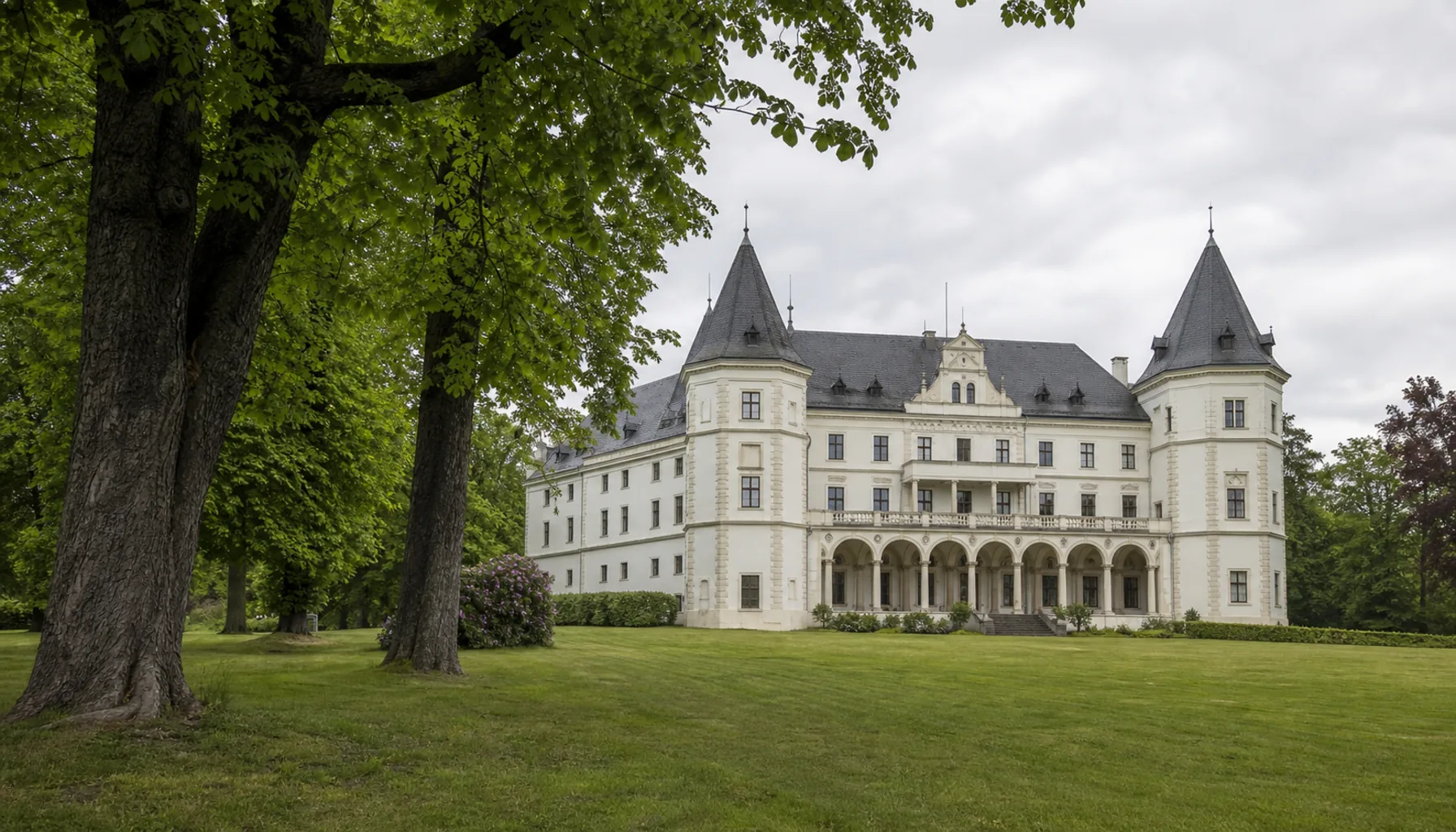
The market town of upper Zemplín, where the Cirocha joins the Laborec — a Renaissance chateau of the Drugeth family, an open-air museum behind it, and the roads east into the Vihorlat and the Poloniny.Trhové mesto horného Zemplína pri ústí Cirochy do Laborca — renesančný kaštieľ Drugethovcov, skanzen za ním a cesty na východ do Vihorlatu a Polonín.
The Renaissance chateau of Humenné and its park, home of the Vihorlat MuseumRenesančný kaštieľ v Humennom a jeho park, sídlo Vihorlatského múzea
Where it standsKde leží
Humenné lies where the Cirocha joins the Laborec, in a basin ringed by the wooded hills of the Beskids and the Vihorlat. It is the largest town of upper Zemplín and the practical centre for the whole north-eastern corner of the country.Humenné leží tam, kde sa Cirocha vlieva do Laborca, v kotline obklopenej zalesnenými kopcami Beskýd a Vihorlatu. Je najväčším mestom horného Zemplína a praktickým centrom celého severovýchodného kúta krajiny.
Košice is roughly ninety kilometres to the south-west. From Humenné the valleys open north towards Medzilaborce and east towards Snina, and both roads end at a border — Polish one way, Ukrainian the other. The Laborec valley has been the corridor from the Hungarian plain to the Carpathian passes for as long as there have been armies to use it.Košice sú asi deväťdesiat kilometrov na juhozápad. Z Humenného sa doliny otvárajú na sever k Medzilaborciam a na východ k Snine a obe cesty končia pri hranici — jedna pri poľskej, druhá pri ukrajinskej. Dolina Laborca slúži ako koridor z uhorskej roviny ku karpatským priesmykom odjakživa a vojská ju využili pri každom ťažení.
The storyHistória
The town belonged for centuries to the Drugeths, Neapolitan nobles granted estates in the east after the dynastic wars of the early fourteenth century, who ran upper Zemplín first from the castle at Brekov and then from the residence they built in the town itself.Mesto po stáročia patrilo Drugethovcom, neapolským šľachticom, ktorí dostali východné panstvá po dynastických vojnách na začiatku 14. storočia a horný Zemplín spravovali najprv z hradu Brekov a potom zo sídla, ktoré si postavili priamo v meste.
They founded a Jesuit college here in the early seventeenth century, which made Humenné a school town long before it was an industrial one.Na začiatku 17. storočia tu založili jezuitské kolégium, takže Humenné bolo školským mestom dávno predtým, než sa stalo priemyselným.
Both world wars came through the valley. The Carpathian front of 1914 and 1915 was fought over these ridges, and the fighting of autumn 1944 followed the same passes; the military cemeteries in the villages around the town date from one or the other.Údolím prešli obe svetové vojny. O tieto hrebene sa bojovalo na karpatskom fronte v rokoch 1914 a 1915 a boje na jeseň 1944 prechádzali tými istými priesmykmi; vojenské cintoríny v obciach okolo mesta pochádzajú z jednej alebo z druhej vojny.
What to seeČo vidieť
The chateau in the centre began as a Drugeth fortress, was rebuilt into a Renaissance residence, and was given its present French neo-Renaissance face in the nineteenth century. It holds the Vihorlat Museum, with period interiors, natural history and the history of the region.Kaštieľ v centre vznikol ako drugethovská pevnosť, prestavali ho na renesančné sídlo a v 19. storočí dostal dnešnú francúzsku novorenesančnú podobu. Sídli v ňom Vihorlatské múzeum s dobovými interiérmi, prírodovedou a dejinami kraja.
Behind it, in the chateau park, stands the open-air museum of folk architecture — farmsteads from the Zemplín villages and a wooden Greek Catholic church brought from Nová Sedlica, the easternmost village in Slovakia.Za ním, v kaštieľskom parku, stojí skanzen ľudovej architektúry — usadlosti zo zemplínskych dedín a drevený gréckokatolícky chrám prenesený z Novej Sedlice, najvýchodnejšej obce Slovenska.
The ruin of Brekov Castle on its limestone crag a few kilometres south-west is the other short trip out of town, with a second ruin, Jasenov, on the ridge just south of it; the Vihorlat hills beyond them carry marked trails, and the road east from Humenné is the way into the Poloniny.Zrúcanina Brekovského hradu na vápencovom brale pár kilometrov na juhozápad je druhým krátkym výletom z mesta a hneď na juh od neho stojí na hrebeni ďalšia zrúcanina, Jasenov; za nimi vedú Vihorlatom značené chodníky a cesta na východ z Humenného je vstupom do Polonín.
Work and industryPráca a priemysel
Humenné industrialised in the 1950s and 1960s around a chemical works built to make synthetic fibres; the site still functions as an industrial complex with several companies on it. Meat processing is the other well-known trade — MECOM, one of Slovakia's larger processors, is based here.Humenné industrializovali v 50. a 60. rokoch okolo chemického závodu na výrobu syntetických vlákien; areál dodnes funguje ako priemyselný komplex s viacerými firmami. Druhým známym odvetvím je mäsopriemysel — sídli tu MECOM, jeden z väčších slovenských spracovateľov.
Timber, engineering, retail and public services fill out the rest, and the town's hospital and schools serve a catchment far larger than itself. Like the whole north-east, the district exports workers as well as goods: a great many households here live partly on wages earned in Bratislava, Bohemia or further west.Zvyšok dopĺňa drevo, strojárstvo, obchod a verejné služby a mestská nemocnica so školami obsluhujú oveľa väčšie územie, než je samo mesto. Ako celý severovýchod aj tento okres vyváža popri tovare aj pracovnú silu: mnohé domácnosti tu žijú sčasti zo mzdy zarobenej v Bratislave, v Čechách alebo ešte ďalej na západ.
Getting thereAko sa tam dostať
Humenné is the rail junction of the north-east: lines come in from Košice and from Prešov and continue north towards Medzilaborce and the Polish border and east to Snina and Stakčín. Buses reach the valleys the railway does not.Humenné je železničným uzlom severovýchodu: trate sem prichádzajú od Košíc aj od Prešova a pokračujú na sever k Medzilaborciam a poľskej hranici a na východ do Sniny a Stakčína. Do dolín, kam železnica nedosiahne, sa dostanete autobusom.
Explore HumennéObjavujte Humenné
Every part of this place with a page of its own.Každá časť tohto miesta, ktorá má vlastnú stránku.