A market town rebuilt after the front stood in it for three months, and the practical base for the wooden churches of the upper Topľa.Trhové mestečko, ktoré sa muselo postaviť nanovo po troch mesiacoch frontu, a praktická základňa pre drevené chrámy hornej Tople.
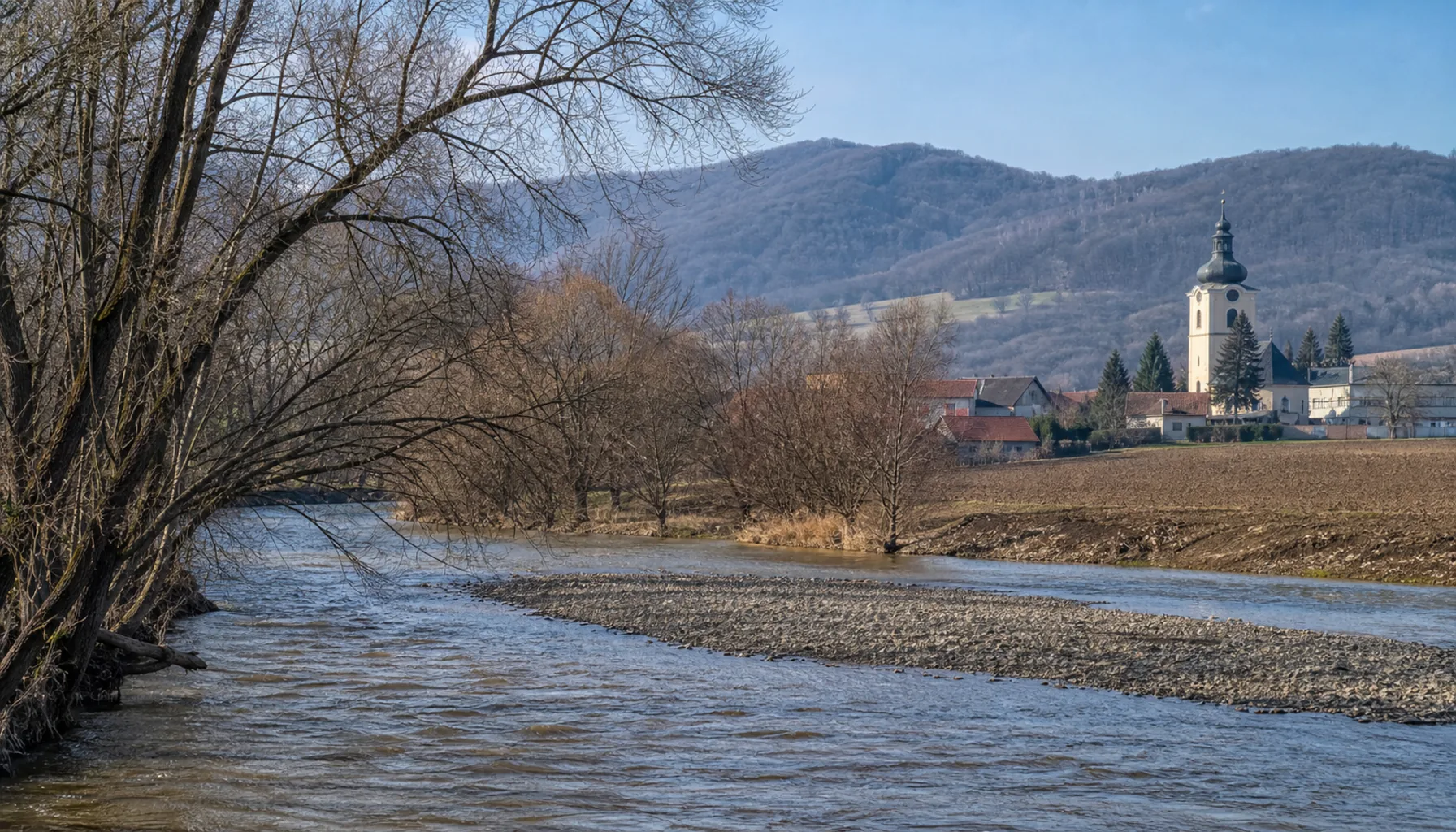
The Topľa running past Giraltovce under the rounded forested hills of the Ondava Highlands.Topľa tečie popri Giraltovciach pod oblými zalesnenými kopcami Ondavskej vrchoviny.
The year in GiraltovceRok v Giraltovciach
Giraltovce have kept a market calendar longer than they have kept anything else. Weekly markets and annual fairs date from the early nineteenth century, and for a village with no castle, no mine and poor fields they were the entire reason the place counted as a town at all: the trade of the whole upper Topľa valley pulled into one small square. Around the middle of that century the fairs were joined by an administrative district — a notary, a court, a school, offices. The offices went in 1960, when the state redrew the map and moved the district to Svidník. The habit of coming into town did not.Giraltovce si trhový kalendár držia dlhšie než čokoľvek iné. Týždenné trhy a výročné jarmoky sa tu konajú od začiatku 19. storočia a pre dedinu bez hradu, bez bane a s chudobnými poľami boli jediným dôvodom, prečo sa vôbec počítala za mestečko: obchod celej hornej Tople sa stiahol na jedno malé námestie. Zhruba v polovici toho storočia k jarmokom pribudol okresný úrad — notár, súd, škola, kancelárie. Úrady zanikli v roku 1960, keď štát prekreslil mapu a okres presunul do Svidníka. Zvyk chodiť do mesta nezanikol.
What is on now is what a town of four thousand serving several dozen villages can carry: a summer town celebration, school and cultural-centre events through the colder half of the year, and the parish feast days — the odpust — that still order the calendar in the Greek Catholic and Roman Catholic villages around. We give no dates and no programme here, because in a town this size they are set season by season and the town's own noticeboard and website are the only reliable source. Anyone travelling for one of these should assume it is for the village first and the visitor second, which is also what makes it worth the trip.Dnešný program je taký, aký unesie štvortisícové mesto obsluhujúce niekoľko desiatok obcí: letné mestské slávnosti, podujatia školy a kultúrneho domu cez chladnejšiu polovicu roka a odpustové slávnosti, ktoré v okolitých gréckokatolíckych a rímskokatolíckych obciach dodnes určujú rok. Dátumy ani program tu neuvádzame — v meste tejto veľkosti sa určujú sezónu po sezóne a jediným spoľahlivým zdrojom je mestská tabuľa a stránka mesta. Kto sem príde na slávnosť, nech počíta s tým, že je predovšetkým pre dedinu a až potom pre návštevníka; práve preto za ňu cesta stojí.
Where culture livesKde žije kultúra
The institutions are the ordinary ones and they are not hard to find: a cultural centre with a hall and a programme, a library, the schools, and the amateur choirs and folk groups this district produces without much encouragement. We name none of them individually, because premises and programmes here change faster than a page like this can be rewritten. There is no municipal museum and no gallery, and the town does not pretend otherwise.Inštitúcie sú tu obyčajné a nie je ťažké ich nájsť: kultúrny dom so sálou a programom, knižnica, školy a amatérske spevácke a folklórne skupiny, ktoré tento kraj vydáva aj bez veľkého povzbudzovania. Menovite ich neuvádzame, lebo priestory aj programy sa tu menia rýchlejšie, než sa dá takáto stránka prepísať. Mestské múzeum ani galéria tu nie sú a mesto sa netvári, že by boli.
For collections you go out of town, and the roads are empty in both directions. Svidník to the north keeps a museum of Ukrainian and Rusyn culture with an open-air village museum beside it, and beyond that lie the Dukla battlefield and its memorials; Bardejov, over the ridge to the west, has its museum on a World Heritage square. Giraltovce sit almost exactly between them, which is a fair description of the town's cultural position in general — not the destination, but the place on the road where the two halves of the north-east meet.Za zbierkami sa chodí von z mesta a cesty sú prázdne na obe strany. Vo Svidníku na severe je múzeum ukrajinskej a rusínskej kultúry so skanzenom, za ním duklianske bojisko s pamätníkmi; Bardejov za západným hrebeňom má múzeum na námestí zapísanom v Zozname svetového dedičstva. Giraltovce ležia takmer presne medzi nimi, čo dobre vystihuje aj ich kultúrne postavenie: nie sú cieľom cesty, ale miestom, kde sa obe polovice severovýchodu stretávajú.
The buildings that carry itBudovy, ktoré ju nesú
Most of central Giraltovce dates from the second half of the twentieth century, and that is not neglect but war. From the autumn of 1944 the Carpathian–Dukla operation drove the front into these hills and then it stopped moving: the ridges were held through the winter and the town lay inside the fighting zone for three months, until it was taken on 18 January 1945. What survived was largely rebuilt. Reading Giraltovce therefore means reading a plan — the square, the river, the road to the pass — rather than a street of old façades.Väčšina centra Giraltoviec pochádza z druhej polovice 20. storočia a nie je to zanedbanosť, ale vojna. Od jesene 1944 zatlačila karpatsko-duklianska operácia front do týchto kopcov a potom sa zastavil: hrebene sa držali celú zimu a mesto ležalo tri mesiace v bojovom pásme, kým ho 18. januára 1945 neoslobodili. To, čo zostalo, sa väčšinou stavalo nanovo. Čítať Giraltovce preto znamená čítať pôdorys — námestie, rieku, cestu na Duklu — a nie ulicu starých fasád.
The churches are the exception, and they carry the confessional history openly: a Roman Catholic parish and a Greek Catholic one, the latter belonging to the tradition most of the surrounding villages follow. The Greek Catholic Church was dissolved outright by the state in 1950 and its parishes handed over; it was permitted again only in 1968, a break of eighteen years that older people here remember directly. The other piece of built memory is the military cemetery, where 64 men who died in the town's First World War hospital between October 1914 and April 1915 are buried in one ground — sixty-three of the Austro-Hungarian army and one Russian.Výnimkou sú kostoly a tie nesú konfesionálne dejiny celkom otvorene: rímskokatolícka farnosť a gréckokatolícka, ktorá patrí k tradícii väčšiny okolitých obcí. Gréckokatolícku cirkev štát v roku 1950 zrušil a jej farnosti odovzdal inde; povolená bola znova až v roku 1968, po osemnásťročnom zlome, ktorý si starší ľudia pamätajú osobne. Druhým kusom stavanej pamäti je vojenský cintorín: 64 mužov, ktorí zomreli v miestnej vojenskej nemocnici medzi októbrom 1914 a aprílom 1915, leží v jednej zemi — šesťdesiattri z rakúsko-uhorskej armády a jeden ruský vojak.
The road to the wooden churchesCesta k dreveným chrámom
The reason most travellers stop in Giraltovce is not in Giraltovce. The Greek Catholic and Orthodox villages of the Svidník and Bardejov districts keep a remarkable concentration of wooden churches — log-built, shingled, the domes stepping down from the tower, a painted iconostasis inside — and several of them are on the UNESCO World Heritage List. The shortest routes between them run through the town or within a few kilometres of it, and the buses from Prešov, Svidník and Bardejov all stop here.Dôvod, prečo väčšina cestujúcich v Giraltovciach zastaví, nie je v Giraltovciach. Gréckokatolícke a pravoslávne obce svidníckeho a bardejovského okresu si zachovali pozoruhodné množstvo drevených chrámov — zrubových, krytých šindľom, s kupolami klesajúcimi od veže a s maľovaným ikonostasom vnútri — a niekoľko z nich je zapísaných v Zozname svetového dedičstva UNESCO. Najkratšie cesty medzi nimi vedú cez mesto alebo pár kilometrov od neho a autobusy z Prešova, Svidníka i Bardejova tu zastavujú.
They are working parish churches, not exhibits. Many are locked and opened by a keyholder who lives in the village; some are served in rotation by a priest who covers several parishes; none of them keeps museum hours. Ask in the village rather than turning up expecting a ticket desk, and go on the assumption that a service takes precedence over your visit. Giraltovce, with its shops, its health centre and its position on the road, is the practical base for a day spent doing exactly that.Sú to živé farské chrámy, nie exponáty. Mnohé bývajú zamknuté a otvára ich kľúčnik, ktorý býva v dedine; v niektorých sa slúži striedavo, lebo kňaz má na starosti viac farností; nijaký z nich nemá otváracie hodiny múzea. Pýtajte sa v obci namiesto toho, aby ste čakali pokladňu, a rátajte s tým, že bohoslužba má prednosť pred návštevou. Giraltovce s obchodmi, zdravotným strediskom a polohou na ceste sú praktickou základňou na deň strávený presne takto.