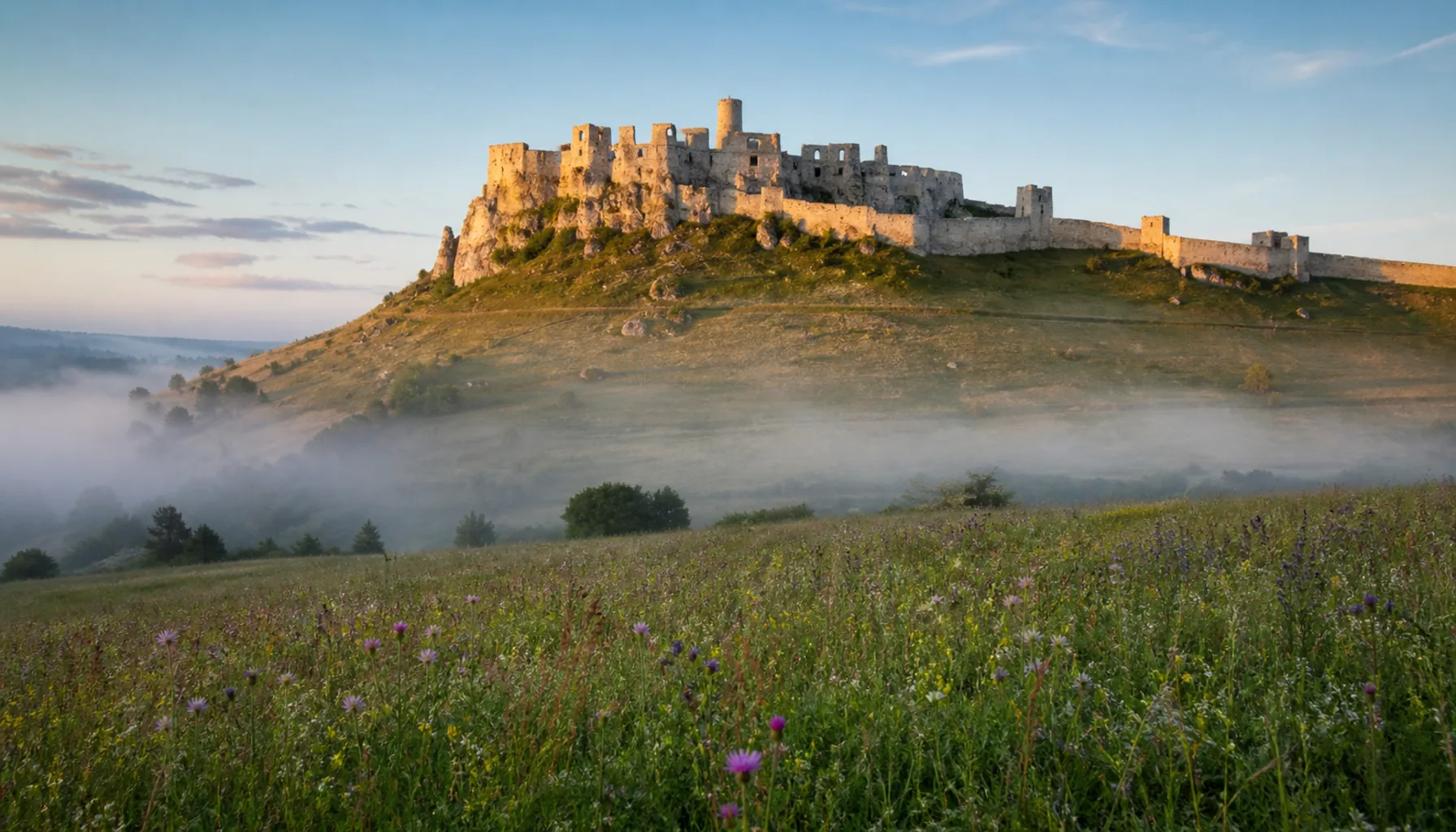
A Thousand Years on a Travertine HillTisíc rokov na travertínovej kope
People fortified this hill long before anyone cut a stone for a castle. A hillfort stood on the travertine crown in prehistory, exploiting exactly the advantages the medieval builders would later take for granted: a steep, bare hummock in the middle of an open basin, visible from everywhere and with a view of everything. Stone building began in the twelfth century, and Spiš grew into one of the great royal strongholds of the northern Kingdom of Hungary — the administrative and military anchor of a border province.Ľudia opevňovali túto kopu dávno predtým, než na hrad opracovali prvý kameň. Na travertínovom temene stálo v praveku hradisko, ktoré využívalo presne tie prednosti, aké neskôr stredovekí stavitelia považovali za samozrejmé: strmý, holý pahorok uprostred otvorenej kotliny, na ktorý je vidieť odvšadiaľ a z ktorého je vidieť všetko. Kamenná stavba sa začala v dvanástom storočí a Spišský hrad vyrástol na jednu z veľkých kráľovských pevností severu Uhorského kráľovstva — správnu a vojenskú oporu pohraničnej provincie.
When the Mongol armies broke into the kingdom in 1241, the castle held. It was one of the few places in the region that did, and the decades after the invasion were spent making it stronger still. Two centuries later it was fortifying against an entirely different enemy: through the wars of the fifteenth century, when mercenary captains and rival claimants to the Hungarian throne fought over Spiš, squat artillery bastions were thrown out in front of the older walls. Both layers are still legible as you walk — thin, tall, early stonework behind; thick, low, gunpowder-age stonework in front.Keď v roku 1241 vtrhli do kráľovstva mongolské vojská, hrad odolal. Bol jedným z mála miest v kraji, ktoré vydržali, a desaťročia po vpáde sa venovali tomu, aby bol ešte silnejší. O dve storočia neskôr sa opevňoval proti celkom inému nepriateľovi: počas vojen pätnásteho storočia, keď o Spiš bojovali žoldnierski kapitáni a súperiaci uchádzači o uhorský trón, vyrástli pred staršími hradbami zavalité delové bastióny. Obe vrstvy sú pri prechádzke stále čitateľné — tenké, vysoké, staršie murivo vzadu; hrubé, nízke murivo veku pušného prachu vpredu.
The great families follow in order. The Zápoľský family held the castle from the fifteenth century and made it the seat of what was, for a generation, the most powerful house in the kingdom. The Thurzó family — magnates and financiers of the mining towns — took it over in the sixteenth. From the seventeenth century it belonged to the Csáky family, who kept it, at least on paper, into the twentieth. Long before that, though, they had moved down to warmer manor houses in the valley, and the hilltop had become garrison, granary and store rather than home. Then, in 1780, fire took the roofs. Nobody put them back.Veľké rody nasledujú v jasnom slede. Zápoľskovci držali hrad od pätnásteho storočia a spravili z neho sídlo rodu, ktorý bol po jednu generáciu najmocnejší v celom kráľovstve. V šestnástom storočí ho prevzali Thurzovci — magnáti a finančníci banských miest. Od sedemnásteho storočia patril Csákyovcom, ktorí si ho, aspoň na papieri, udržali až do dvadsiateho storočia. Dávno predtým sa však presťahovali do teplejších kaštieľov v doline a z kopca sa stala skôr posádka, sýpka a sklad než domov. Potom, v roku 1780, zobral požiar strechy. Nikto ich už nevrátil.
What UNESCO inscribed in 1993 was never the castle alone. The listing covers a whole cultural landscape: Spišský hrad itself; Spišská Kapitula, the tiny walled ecclesiastical town on the ridge opposite, with the Cathedral of St Martin at its centre; the town of Spišské Podhradie between them; and the village church of the Holy Spirit at Žehra, a short drive away, with its medieval wall paintings. Levoča, over the hills to the west, was added to the same inscription later. Come for the castle by all means — but understand that you are standing in the middle of a set of four.To, čo UNESCO v roku 1993 zapísalo, nebol nikdy iba hrad. Zápis zahŕňa celú kultúrnu krajinu: samotný Spišský hrad; Spišskú Kapitulu, drobné opevnené cirkevné mestečko na protiľahlom hrebeni s Katedrálou svätého Martina v strede; mesto Spišské Podhradie medzi nimi; a dedinský Kostol Ducha Svätého v Žehre, kúsok autom odtiaľto, so stredovekými nástennými maľbami. Levoča za kopcami na západe bola k tomu istému zápisu pridaná neskôr. Pokojne príďte pre hrad — ale vedzte, že stojíte uprostred štvorice.