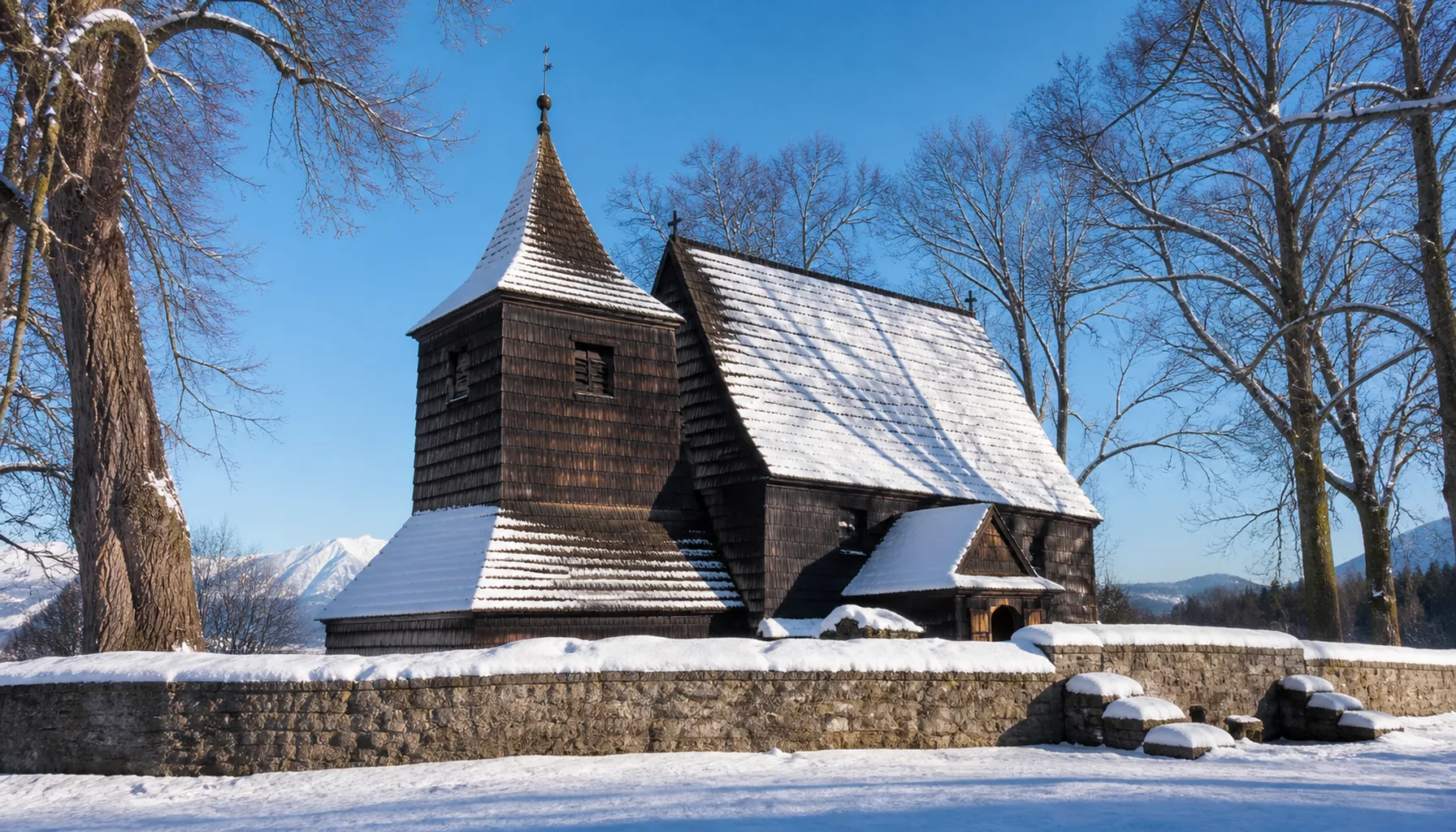
A toll town on the old Polish road that kept a small medieval wooden church — All Saints, dark shingle outside and painted timber within, on the UNESCO list since 2008.Mýtne mesto na starej poľskej ceste, ktoré si zachovalo malý stredoveký drevený kostolík — Všetkých svätých, zvonka tmavý šindeľ, vnútri maľované drevo, od roku 2008 v zozname UNESCO.
The shingled wooden Church of All Saints above TvrdošínŠindľový drevený Kostol Všetkých svätých nad Tvrdošínom
Where it standsKde leží
Tvrdošín stands on the Orava river between Nižná and Trstená, at the point where the road up the Oravica valley towards the Western Tatras leaves the main valley. The Skorušinské vrchy rise east; the dam of the Orava reservoir is a few kilometres upstream.Tvrdošín leží na rieke Orave medzi Nižnou a Trstenou, práve tam, kde z hlavnej doliny odbočuje cesta dolinou Oravice smerom k Západným Tatrám. Na východe sa dvíhajú Skorušinské vrchy, hrádza Oravskej priehrady je pár kilometrov proti prúdu.
The town is the seat of its district, which covers the eastern half of the Upper Orava. Medvedzie, once a separate village, is now one of its quarters.Mesto je sídlom okresu, ktorý pokrýva východnú polovicu hornej Oravy. Medvedzie, kedysi samostatná dedina, je dnes jednou z jeho mestských častí.
The storyHistória
Tvrdošín is one of the oldest settlements in Orava. It grew as a customs point on the road to Poland, where the crown's duty was collected on goods crossing the mountains, and it held market privileges from the fourteenth century. Salt and cloth came south through the gate; cattle, timber and iron went north.Tvrdošín patrí k najstarším sídlam na Orave. Vyrástol ako colná stanica na ceste do Poľska, kde sa vyberalo kráľovské clo z tovaru prechádzajúceho cez hory, a od 14. storočia mal trhové výsady. Cez bránu smerovali na juh soľ a súkno, na sever dobytok, drevo a železo.
The river was a working road too. Timber cut in the Orava forests was bound into rafts and floated down to the Váh and on towards the lowland, a trade that employed whole villages until the railways and then the dam ended it.Aj rieka bola pracovnou cestou. Drevo vyťažené v oravských lesoch viazali do pltí a plavili dolu na Váh a ďalej do nížiny — remeslo, ktoré živilo celé dediny, kým ho neukončili železnice a napokon priehrada.
The twentieth century brought industry to the district rather than to the town itself: at Nižná, six kilometres downstream, a state electronics works built television sets sold under the Orava name, and it drew workers from every village around. Much of the district's engineering still sits in that ring of villages rather than in Tvrdošín.Dvadsiate storočie prinieslo priemysel skôr do okresu než do samotného mesta: v Nižnej, šesť kilometrov po prúde, vyrábal štátny elektrotechnický podnik televízory predávané pod značkou Orava a sťahoval robotníkov zo všetkých okolitých dedín. Veľká časť okresného strojárstva sídli dodnes skôr v tomto venci obcí než v Tvrdošíne.
What to seeČo vidieť
The Church of All Saints is what people come for. It is a small late-Gothic timber church on a rise above the town, its core built in the fifteenth century and its interior painted in the seventeenth, shingled outside and dark and low within. It was carefully restored in the early 1990s, a piece of work that was recognised with a European conservation award, and in 2008 it was inscribed on the UNESCO list of wooden churches of the Slovak Carpathians. Access to the interior is limited — ask locally rather than assume.Ľudia sem prichádzajú pre Kostol Všetkých svätých. Je to malý neskorogotický drevený kostolík na vyvýšenine nad mestom, s jadrom z 15. storočia a interiérom vymaľovaným v 17. storočí, zvonka pokrytý šindľom, vnútri tmavý a nízky. Začiatkom 90. rokov ho starostlivo obnovili — táto práca získala európske ocenenie za pamiatkovú obnovu — a v roku 2008 ho zapísali do zoznamu UNESCO medzi drevené chrámy slovenských Karpát. Vstup do interiéru je obmedzený, radšej sa vopred spýtajte, než by ste sa naň spoliehali.
The town's gallery is devoted to Mária Medvecká, the painter who was born in Medvedzie and spent her working life here; her landscapes and portraits of Orava are the best-known painting the region produced, and the collection is part of the Orava Gallery.Mestská galéria je venovaná Márii Medveckej, maliarke, ktorá sa narodila v Medvedzí a prežila tu svoj tvorivý život; jej oravské krajiny a portréty sú najznámejšou maľbou, akú kraj vydal, a zbierka patrí Oravskej galérii.
Tvrdošín is also the road head for the country behind it: the thermal pools at Oravice, the open-air Museum of the Orava Village at Zuberec and the trails into the Roháče all start from the turning here, and all are covered elsewhere on this site.Tvrdošín je zároveň vstupnou bránou do krajiny za sebou: termálne bazény v Oraviciach, Múzeum oravskej dediny v Zuberci aj chodníky do Roháčov sa začínajú pri tunajšej odbočke a všetkým sa venujú iné časti tejto stránky.
Work and industryPráca a priemysel
The town's own industry is electronics — sensors and measuring equipment are made here — with timber, joinery and building trades around it, and the larger engineering plants of the district within easy commuting distance at Nižná and Krivá. Tourism adds a season's work at both ends of the year.Vlastným priemyslom mesta je elektrotechnika — vyrábajú sa tu snímače a meracia technika — a okolo nej drevárstvo, stolárstvo a stavebníctvo, pričom väčšie strojárske závody okresu sú na dochádzku v Nižnej a Krivej. Cestovný ruch pridáva sezónnu prácu na oboch koncoch roka.
Getting thereAko sa tam dostať
Tvrdošín is on the branch railway from Kraľovany to Trstená, and on the main road up the valley. Buses run to Dolný Kubín, Trstená and Námestovo, and up the side valley to Zuberec and Oravice.Tvrdošín leží na lokálnej trati z Kraľovian do Trstenej a na hlavnej ceste dolinou. Autobusy premávajú do Dolného Kubína, Trstenej a Námestova a bočnou dolinou do Zuberca a Oravíc.
Explore TvrdošínObjavujte Tvrdošín
Every part of this place with a page of its own.Každá časť tohto miesta, ktorá má vlastnú stránku.