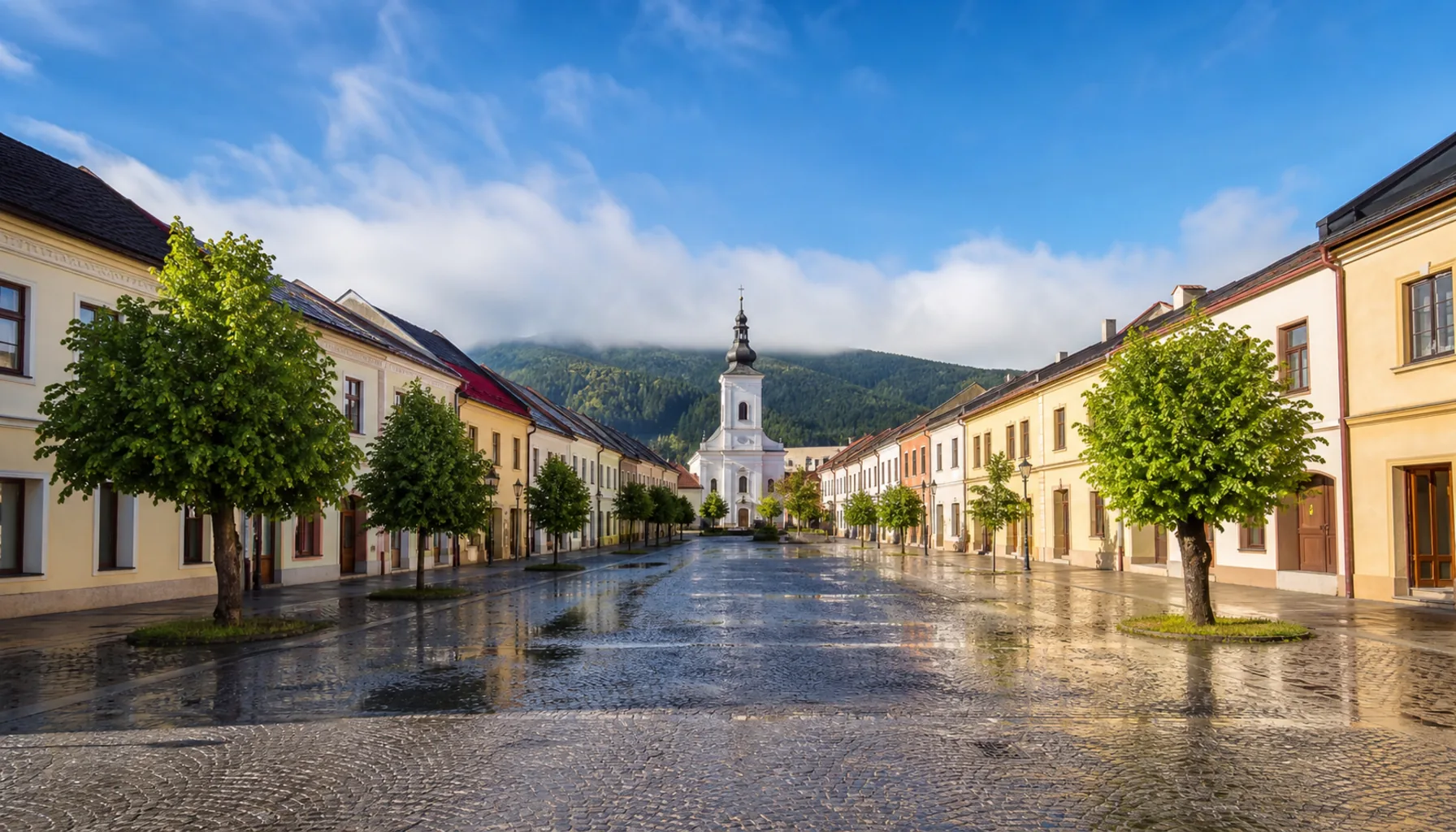
The old market town at the top of the Orava valley, on the road to Kraków, where the Orava railway ends and an electronics plant is the largest employer for miles around.Staré trhové mesto v hornej časti oravskej doliny na ceste do Krakova, kde končí oravská železnica a kde je závod na elektroniku najväčším zamestnávateľom široko-ďaleko.
The long market square of Trstená with its church at the headDlhé trhové námestie v Trstenej s kostolom v čele
Where it standsKde leží
Trstená stands on the Oravica, a short tributary that comes down from the Western Tatras and joins the Orava just below the town, in the upper part of the valley between Tvrdošín and the Polish border. The Skorušinské vrchy rise to the east, with the Roháče ridge behind them; the Orava reservoir begins a few kilometres north-west.Trstená leží na Oravici, krátkom prítoku, ktorý zbieha zo Západných Tatier a hneď pod mestom sa vlieva do Oravy, v hornej časti doliny medzi Tvrdošínom a poľskou hranicou. Na východe sa dvíhajú Skorušinské vrchy a za nimi hrebeň Roháčov; pár kilometrov na severozápad sa začína Oravská priehrada.
The road north out of the town crosses into Poland at Chyžné and runs on towards Kraków. That road is the reason Trstená exists at all, and it still carries the freight and the shoppers in both directions.Cesta na sever z mesta prekračuje poľskú hranicu pri Chyžnom a pokračuje smerom na Krakov. Práve tejto ceste vďačí Trstená za svoju existenciu a dodnes po nej ide náklad aj nakupujúci na obe strany.
The storyHistória
Trstená was granted market privileges in the later Middle Ages and lived on the traffic over the passes: salt and cloth coming south, cattle, linen and later timber going north. Its fairs served the whole of the Upper Orava, and its burghers were the closest thing this end of the valley had to a merchant class.Trstená získala trhové výsady v neskorom stredoveku a žila z dopravy cez priesmyky: soľ a súkno prichádzali z juhu, dobytok, plátno a neskôr drevo išli na sever. Jej jarmoky obsluhovali celú hornú Oravu a jej mešťania boli tým najbližším k obchodníckej vrstve, čo tento koniec doliny mal.
Martin Hattala, born here in 1821, is the town's national figure. A priest and philologist, he wrote the grammar of the 1850s that settled Slovak spelling along essentially the lines still used today — the reform that turned Štúr's language into the standard one.Národnou osobnosťou mesta je Martin Hattala, narodený tu v roku 1821. Kňaz a jazykovedec napísal v 50. rokoch 19. storočia gramatiku, ktorá ustálila slovenský pravopis v podstate v podobe, akú používame dodnes — reformu, ktorá zo štúrovčiny urobila spisovný jazyk.
The railway came up the valley in the twentieth century and Trstená became its terminus. The line once ran on towards the border, but the cross-border section has long been out of use, and the track has ended here for many years.Železnica prišla dolinou v 20. storočí a Trstená sa stala jej konečnou. Trať kedysi pokračovala smerom k hranici, no cezhraničný úsek je už dávno mimo prevádzky a koľaj tu končí celé desaťročia.
What to seeČo vidieť
The centre is a long market square with the parish church at its head and rows of low burgher houses along its sides — the shape a small Upper Hungarian market town took, with the space kept clear for stalls. It is a modest centre, walked in twenty minutes, and it is the only proper square in the Upper Orava.Centrom je dlhé trhové námestie s farským kostolom v čele a s radmi nízkych meštianskych domov po stranách — tvar, aký nadobúdali malé uhorské trhové mestečká, s priestorom ponechaným pre stánky. Je to skromné centrum, prejde sa za dvadsať minút, a je jediným poriadnym námestím na hornej Orave.
The real excursions are outside. Up the Oravica valley to the south-east, at Oravice under the Western Tatras, warm water from a deep borehole feeds an outdoor thermal complex that runs all year — snow on the fences and steam off the pools is the standard winter image. The same road continues to Zuberec, the open-air museum of the Orava village and the Roháče trails.Skutočné výlety sú za mestom. Dolinou Oravice na juhovýchod, v Oraviciach pod Západnými Tatrami, plní teplá voda z hlbokého vrtu vonkajší termálny areál otvorený po celý rok — sneh na plotoch a para nad bazénmi sú jeho typickým zimným obrazom. Tá istá cesta pokračuje do Zuberca, k Múzeu oravskej dediny a na roháčske chodníky.
North-west the reservoir laps almost to the town's fields, with the dam and the boat landings a short drive away, and the peat bogs at Suchá Hora on the border are a protected raised-bog landscape of a kind now rare in Slovakia.Na severozápade siaha priehrada takmer k mestským poliam, hrádza a prístaviská sú na krátku cestu autom a rašeliniská pri Suchej Hore na hranici tvoria chránenú krajinu vrchoviskového typu, aká je dnes na Slovensku vzácna.
Work and industryPráca a priemysel
Electronics is the town's industry and the Upper Orava's biggest employer: control boards, power supplies and loudspeakers have been made in Trstená since 1997, and a cable and wire works stands beside the plant. A second local firm builds forestry machinery — skidders and forwarders used across Central Europe — which is a fitting trade for a valley this heavily forested.Priemyslom mesta a najväčším zamestnávateľom hornej Oravy je elektrotechnika: riadiace dosky, zdroje a reproduktory sa v Trstenej vyrábajú od roku 1997 a vedľa závodu stojí káblovňa. Druhá miestna firma stavia lesné stroje — vyvážacie súpravy a lesné traktory používané po celej strednej Európe — čo je pre takto zalesnenú dolinu príznačné remeslo.
Around them are timber, food processing and farming cooperatives, and a steady cross-border trade with the Polish side that works in whichever direction prices happen to favour.Okolo nich stojí drevárstvo, potravinárstvo a poľnohospodárske družstvá — a stály cezhraničný obchod s poľskou stranou, ktorý funguje vždy tým smerom, ktorému práve prajú ceny.
Getting thereAko sa tam dostať
Trstená is the end of the branch railway from Kraľovany via Dolný Kubín and Tvrdošín. Buses connect it with Námestovo, Dolný Kubín and Žilina, and the main road runs north to the Polish crossing at Chyžné.Trstená je konečnou lokálnej trate z Kraľovian cez Dolný Kubín a Tvrdošín. Autobusy ju spájajú s Námestovom, Dolným Kubínom a Žilinou a hlavná cesta vedie na sever k poľskému priechodu v Chyžnom.
Explore TrstenáObjavujte Trstená
Every part of this place with a page of its own.Každá časť tohto miesta, ktorá má vlastnú stránku.