Veľké Kapušany · East Slovak LowlandVeľké Kapušany · Východoslovenská nížina
Culture in Veľké KapušanyKultúra vo Veľkých Kapušanoch
Veľké Kapušany is not a monument town and does not claim to be: what it has is a plain Reformed church, a wetland full of birds a few kilometres away, and a native son who spent his life collecting the songs ordinary people sang.Veľké Kapušany nie sú pamiatkovým mestom a ani sa tak netvária: majú jednoduchý reformovaný kostol, mokraď plnú vtáctva pár kilometrov odtiaľto a rodáka, ktorý celý život zbieral piesne, aké spievali obyčajní ľudia.
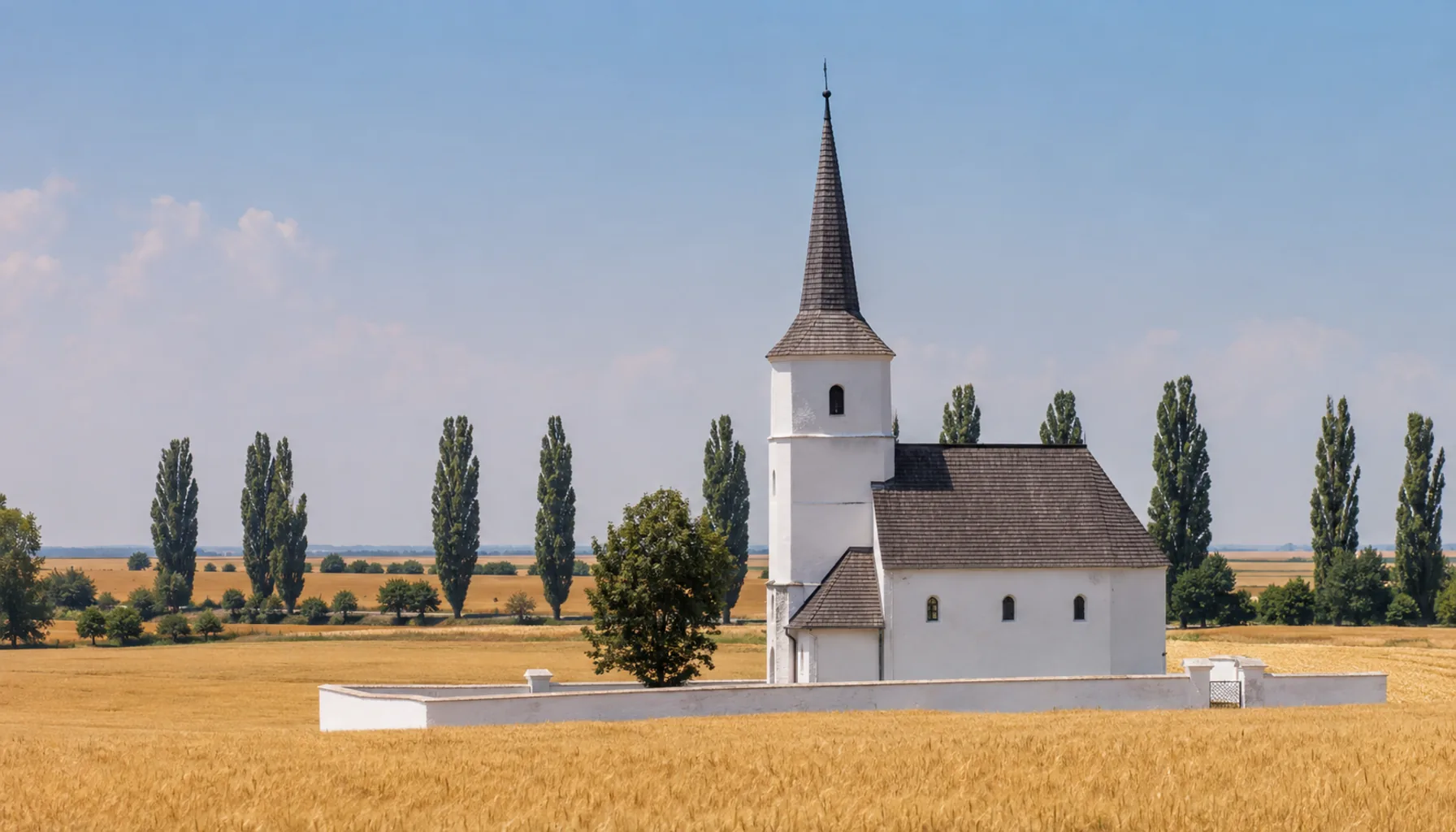
A whitewashed Reformed church with its slender spire above the flat lowland at Veľké Kapušany.Obielený reformovaný kostol so štíhlou vežou nad rovinou pri Veľkých Kapušanoch.
The year in Veľké KapušanyRok vo Veľkých Kapušanoch
We cannot give you a festival calendar for this town, and inventing one would be worse than saying so. What Veľké Kapušany keeps is the year of a small district town: a town day, markets, a Christmas programme, the church calendar, and whatever the cultural centre has in its hall.Kalendár slávností tohto mesta vám dať nevieme a vymyslieť si ho by bolo horšie, než to priznať. Veľké Kapušany držia rok malého okresného mesta: dni mesta, trhy, vianočný program, cirkevný kalendár a to, čo má kultúrne stredisko v sále.
Much of that life happens in Hungarian, the everyday language of the town and of most villages around it — Nagykapos is the town's own name for itself. Amateur theatre, choirs and folk groups are the usual shape it takes here. The two dates most worth timing a visit to are not civic at all: spring and autumn migration on the Latorica, when the protected wetland south-west of the town fills with birds.Veľká časť tohto života prebieha po maďarsky — maďarčina je každodenným jazykom mesta aj väčšiny okolitých dedín a Nagykapos je meno, ktoré si mesto dáva samo. Ochotnícke divadlo, spevácke zbory a folklórne súbory sú tu obvyklou podobou takéhoto života. Dva termíny, kvôli ktorým sa však najviac oplatí načasovať návštevu, mestské nie sú: jarný a jesenný ťah vtákov na Latorici, keď sa chránená mokraď juhozápadne od mesta zaplní vtáctvom.
Where culture livesKde žije kultúra
The institutions are the standard ones of a district town and we name none individually, because programmes and premises change faster than a page like this does: a cultural centre with a hall, a public library, a school of art for children, and the schools, which carry a large share of what is performed.Inštitúcie sú tie obvyklé pre okresné mesto a jednotlivo ich nemenujeme, pretože programy a priestory sa menia rýchlejšie než takáto stránka: kultúrne stredisko so sálou, mestská knižnica, základná umelecká škola a školy, ktoré nesú veľkú časť toho, čo sa hrá a spieva.
There is no regional museum here. The collections of the southern Zemplín are at Trebišov, in the Andrássy manor house to the west, and Michalovce is the nearer town for a cinema and a larger programme. Saying so is more use than listing what is not there.Vlastivedné múzeum tu nie je. Zbierky južného Zemplína sú v Trebišove, v andrássyovskom kaštieli na západe, a Michalovce sú bližším mestom pre kino a väčší program. Povedať to je užitočnejšie než vypisovať, čo tu nestojí.
The Reformed congregations are the other institution, and here they are a cultural one as much as a religious one. Calvinism reached this lowland in the sixteenth century and took hold completely: in 1851 the geographer Elek Fényes counted 814 Reformed inhabitants here against 231 Roman Catholics. A congregation elected its own minister and ran its own school, and the parish is still where much of a village's music and calendar sit.Druhou inštitúciou sú reformované cirkevné zbory a tu sú kultúrnou inštitúciou rovnako ako náboženskou. Kalvinizmus prišiel do tejto nížiny v šestnástom storočí a udomácnil sa dôkladne: geograf Elek Fényes tu v roku 1851 napočítal 814 reformovaných oproti 231 rímskym katolíkom. Zbor si volil vlastného farára a viedol si vlastnú školu, a fara je dodnes miestom, kde sedí veľká časť hudby a kalendára obce.
The buildings that carry itBudovy, ktoré ju nesú
The mark of the region is the Reformed church: plain white walls, a slender spire, no ornament to speak of, and the same form repeated from here south to the Bodrog. Once you have seen a few of them the whole lowland reads as one building type.Znakom kraja je reformovaný kostol: hladké biele steny, štíhla veža, žiadna ozdoba hodná reči — a tá istá podoba sa opakuje odtiaľto na juh až k Bodrogu. Keď ich pár uvidíte, celá nížina sa začne čítať ako jeden stavebný typ.
There is no castle and no grand square, and the reason is on the map. Veľké Kapušany belonged to Ung county, whose seat was Ungvár — now Uzhhorod, just across today's border. The monumental building went there; all the medieval record shows here is a parish and a priest at the church of St Nicholas. The district's real monument is at Leles a few kilometres south: a Premonstratensian place of authentication, licensed by the king to draw up and store legal documents, which is why a village like this has a written history at all.Hrad tu nie je a veľké námestie tiež nie, a dôvod je na mape. Veľké Kapušany patrili do Užskej stolice, ktorej sídlom bol Ungvár — dnes Užhorod, hneď za dnešnou hranicou. Reprezentatívne stavby pripadli jemu; stredoveký záznam tu ukazuje len farnosť a kňaza pri kostole svätého Mikuláša. Skutočná pamiatka okresu stojí pár kilometrov na juh, v Lelese: premonštrátske hodnoverné miesto, kráľom oprávnené vyhotovovať a uchovávať právne listiny — a práve preto má obec ako táto vôbec nejaké písané dejiny.
What the twentieth century put here instead is infrastructure: the transshipment yard at Maťovce, where the Russian-gauge railway out of Ukraine ends and freight moves onto Slovak track; the compressor halls of the gas station east of the town; and the chimneys of the Vojany power station over the fields to the south. None of it was built to be looked at, which is part of why it is worth looking at.To, čo sem namiesto toho postavilo dvadsiate storočie, je infraštruktúra: prekladisko v Maťovciach, kde sa končí širokorozchodná trať z Ukrajiny a náklad prechádza na slovenský rozchod; kompresorové haly plynovej stanice východne od mesta; a komíny vojnianskej elektrárne nad poliami na juhu. Nič z toho nikto nestaval na pozeranie, a čiastočne práve preto sa na to oplatí pozerať.
The man who collected the songsMuž, ktorý zbieral piesne
János Erdélyi was born in Veľké Kapušany on 1 April 1814 and became one of the leading Hungarian critics and philosophers of his century. What puts him on this page is what he collected: folk poetry — the songs ordinary people actually sang — published on the argument that a nation's literature has to grow out of them rather than be written over them.János Erdélyi sa vo Veľkých Kapušanoch narodil 1. apríla 1814 a stal sa jedným z popredných maďarských kritikov a filozofov svojho storočia. Na túto stránku patrí pre to, čo zbieral: ľudovú poéziu — piesne, ktoré ľudia naozaj spievali — vydávanú s argumentom, že literatúra národa musí z nich vyrásť, a nie sa cez ne prepísať.
The national awakening that reached this town was the Hungarian one, not the Slovak. In Ung county the movement that mattered was being made in Pest, while a hundred and fifty kilometres west Slovak writers were codifying a literary language of their own — both at once, inside one kingdom, and this is one of the places where the seam shows.Národné obrodenie, ktoré doľahlo do tohto mesta, bolo maďarské, nie slovenské. V Užskej stolici sa hnutie, na ktorom záležalo, robilo v Pešti, kým stopäťdesiat kilometrov na západ slovenskí spisovatelia kodifikovali vlastný spisovný jazyk — oboje naraz a v jednom kráľovstve, a toto je jedno z miest, kde ten šev vidno.
What else the nineteenth century left is smaller: the craft guilds had been destroyed by the kuruc wars and never came back, and what arrived instead, around 1900, was a roller mill, a printing shop and in 1910 the railway. A printing press in a small market town is a cultural fact as much as an industrial one.Čo tu devätnáste storočie zanechalo ešte, je menšie: cechy zničili kurucké vojny a už sa neobnovili, a namiesto nich prišiel okolo roku 1900 valcový mlyn, tlačiareň a v roku 1910 železnica. Tlačiareň v malom trhovom meste je kultúrnym faktom rovnako ako priemyselným.