A town whose cultural year is three loud months at the water and nine quiet ones on the road, with one Renaissance house and one burned college behind it.Mesto, ktorého kultúrny rok tvoria tri hlučné mesiace pri vode a deväť tichých pri ceste, a za nimi jeden renesančný dom a jedna zhorená škola.
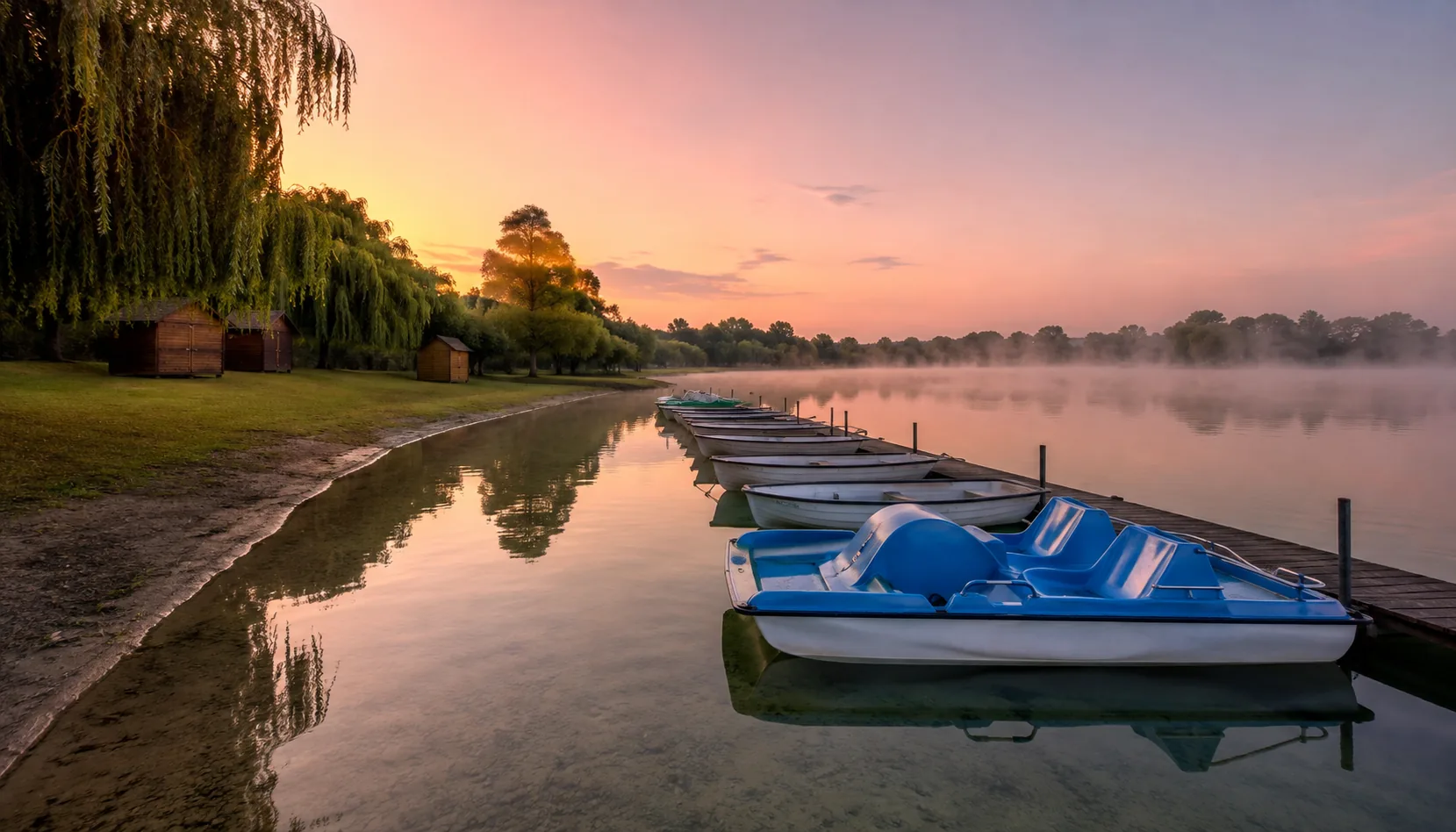
First light on the Sunny Lakes at Senec, the flooded gravel pits that became western Slovakia's busiest bathing place.Prvé svetlo na Slnečných jazerách v Senci – zaplavené štrkoviská, z ktorých sa stalo najrušnejšie kúpalisko západného Slovenska.
The year in SenecRok v Senci
The calendar here is short and loud. Slnečné jazerá, the Sunny Lakes — connected gravel pits with grass and sand shores — fill from roughly June to August, and July weekends draw as many people as anywhere in the country. Boats and pedalos for hire, campsites, a long row of summer food stalls, and a thermal swimming complex beside the lakes that stretches the season at both ends.Kalendár je tu krátky a hlasný. Slnečné jazerá — poprepájané štrkoviská s trávnatými a piesočnatými brehmi — sa plnia zhruba od júna do augusta a júlové víkendy patria k najrušnejším v krajine. Požičovne loďiek a šliapadiel, kempy, dlhý rad letných stánkov s jedlom a termálne kúpalisko vedľa jazier, ktoré sezónu predlžuje na oboch koncoch.
What that does to the cultural year is unusual. For three months almost everything is outdoors and aimed at people who have come for the day; for the other nine Senec is a district town on a busy road and the programme belongs to its own people. Both halves are real, and a visitor who arrives in February will find a different place from the one on the postcards.S kultúrnym rokom to robí zvláštnu vec. Tri mesiace je takmer všetko vonku a mierené na ľudí, ktorí prišli na deň; zvyšných deväť je Senec okresným mestom pri rušnej ceste a program patrí jeho vlastným obyvateľom. Obe polovice sú skutočné a kto príde vo februári, nájde iné mesto, než aké je na pohľadniciach.
We name no festivals and no dates. A town of this size keeps the calendar you would expect — town days, seasonal markets, church feasts, concerts at the lakes in summer — but it is set year by year, and the town's own listings are the place to check what is actually on.Názvy podujatí ani termíny tu neuvádzame. Mesto tejto veľkosti si vedie kalendár, aký človek čaká — mestské dni, sezónne trhy, hody, v lete koncerty pri jazerách — ale zostavuje sa rok po roku a to, čo naozaj beží, treba hľadať v mestskom programe.
Where culture livesKde žije kultúra
Senec is not a museum town, and the honest thing is to say so. Its heritage is one exceptional building and a short circuit of the square — an hour's walk, no more, and best combined with the water rather than treated as the reason for the trip.Senec nie je múzejné mesto a čestnejšie je to povedať rovno. Jeho pamiatky sú jedna výnimočná budova a krátky okruh po námestí — hodinka chôdze, nie viac, a najlepšie k tomu prísť popri vode, nie kvôli tomu samému.
The name from here that travelled furthest belongs to a man born in the town in 1574. Albert Szenczi Molnár translated the Psalms into Hungarian and compiled the Latin-Hungarian dictionary that schools in this kingdom used for generations, and he took his surname from Senec. It remains the town's largest single contribution to the written word.Meno, ktoré sa odtiaľto dostalo najďalej, patrí človeku narodenému v meste roku 1574. Albert Szenczi Molnár preložil žalmy do maďarčiny a zostavil latinsko-maďarský slovník, z ktorého sa v tomto kráľovstve učili celé generácie, a priezvisko si vzal práve zo Senca. Dodnes je to najväčší prínos mesta k písanému slovu.
The everyday institutions are those of any district town, and we describe them as a category rather than name them, because premises and programmes change faster than a page like this does: a cultural centre with a hall and a programme, a library, amateur choirs and folk groups, and a school of art for children.Každodenné inštitúcie sú tu tie, aké má každé okresné mesto, a radšej ich opíšeme ako kategóriu, než by sme ich menovali, lebo priestory a programy sa menia rýchlejšie ako takáto stránka: kultúrne stredisko so sálou a programom, knižnica, ochotnícke spevokoly a folklórne skupiny a základná umelecká škola.
The buildings that carry itBudovy, ktoré ju nesú
The Turkish House on the main square is the building people come for: a Renaissance manor put up in 1556, with a half-round bastion on one wing that says plainly what its builders expected of the century they were living in. What exactly earned it the nickname is not certain, and the town does not pretend otherwise.Turecký dom na hlavnom námestí je tá budova, kvôli ktorej sa sem chodí: renesančný kaštieľ postavený roku 1556, s polkruhovou baštou na jednom krídle, ktorá jasne hovorí, čo jeho stavitelia od svojho storočia čakali. Čo presne mu dalo prezývku, isté nie je, a mesto sa netvári inak.
The parish church continues a much older foundation — a church of St Nicholas is recorded at Senec in 1323, just as the place began to matter. From the 1330s it held a market every Tuesday, by 1412 there was a toll station on the road east out of Pressburg, and in 1439 the village was raised to a market town. The square is the shape all of that left behind: somewhere the traffic had to stop and pay.Farský kostol nadväzuje na oveľa staršiu fundáciu — kostol svätého Mikuláša sa v Senci spomína roku 1323, práve keď obec začínala niečo znamenať. Od tridsiatych rokov 14. storočia sa tu každý utorok konal trh, do roku 1412 pribudla mýtna stanica na ceste na východ z Prešporka a v roku 1439 sa z obce stalo zemepanské mestečko. Námestie je tvar, ktorý po tom všetkom ostal: miesto, kde doprava musela zastať a zaplatiť.
What is missing counts too. Nothing survives of the small fifteenth-century stronghold that gave the town its German name, Wartberg — watch-hill — on a plain with no hills at all. And nothing whatever survives of the building described below.Ráta sa aj to, čo tu nie je. Z malej pevnôstky z pätnásteho storočia, po ktorej dostalo mesto nemecké meno Wartberg — strážny vrch — na rovine bez jediného vrchu, nezostalo nič. A z budovy opísanej nižšie nezostalo vôbec nič.
Thirteen years as the kingdom's business schoolTrinásť rokov vysokou školou kráľovstva
In 1763 the Empress Maria Theresa and the Hungarian chancellor Ferenc Esterházy founded the Collegium Oeconomicum at Senec: the first school of higher education in the Kingdom of Hungary to teach economics, accounting and the running of estates instead of theology and law.Roku 1763 založili cisárovná Mária Terézia a uhorský kancelár Ferenc Esterházy v Senci Collegium Oeconomicum: prvú vysokú školu v Uhorskom kráľovstve, ktorá učila hospodárstvo, účtovníctvo a správu majetkov namiesto teológie a práva.
It was a deliberate Enlightenment decision. The state had worked out that it needed officials who could measure a field and keep a ledger, and that such men had to be trained rather than born into the job. For thirteen years a market town on the Pressburg road was where the kingdom taught its administrators. The college burned down in 1776 and was never rebuilt here; Maria Theresa let the town off its taxes for two years afterwards.Bolo to vedomé osvietenské rozhodnutie. Štát prišiel na to, že potrebuje úradníkov, ktorí vedia odmerať pole a viesť účtovnú knihu, a že takých ľudí treba vyškoliť, nie sa do toho narodiť. Trinásť rokov bolo mestečko pri prešporskej ceste miestom, kde si kráľovstvo školilo svojich správcov. Kolégium v roku 1776 zhorelo a už ho tu neobnovili; Mária Terézia potom mestu na dva roky odpustila dane.
Nothing of it stands, and Senec makes rather less of the episode than it might. It is still the most surprising thing in the town's record: an ordinary trading place on flat ground, briefly the address at which a kingdom learned to count.Nestojí z nej nič a Senec z tej epizódy robí menej, než by mohol. Aj tak zostáva najprekvapivejšou vecou v dejinách mesta: obyčajné obchodné miesto na rovine, na chvíľu adresa, na ktorej sa kráľovstvo učilo počítať.