Zvolen · where the Slatina meets the HronZvolen · sútok Slatiny a Hrona
A Gothic royal castle at the foot of one of the largest squares in Slovakia, a gallery collection inside it, a summer stage in its courtyard, and a deserted castle in the woods across the river.Gotický kráľovský zámok na konci jedného z najväčších námestí na Slovensku, galerijná zbierka vnútri, letné javisko na nádvorí a opustený hrad v lesoch nad riekou.
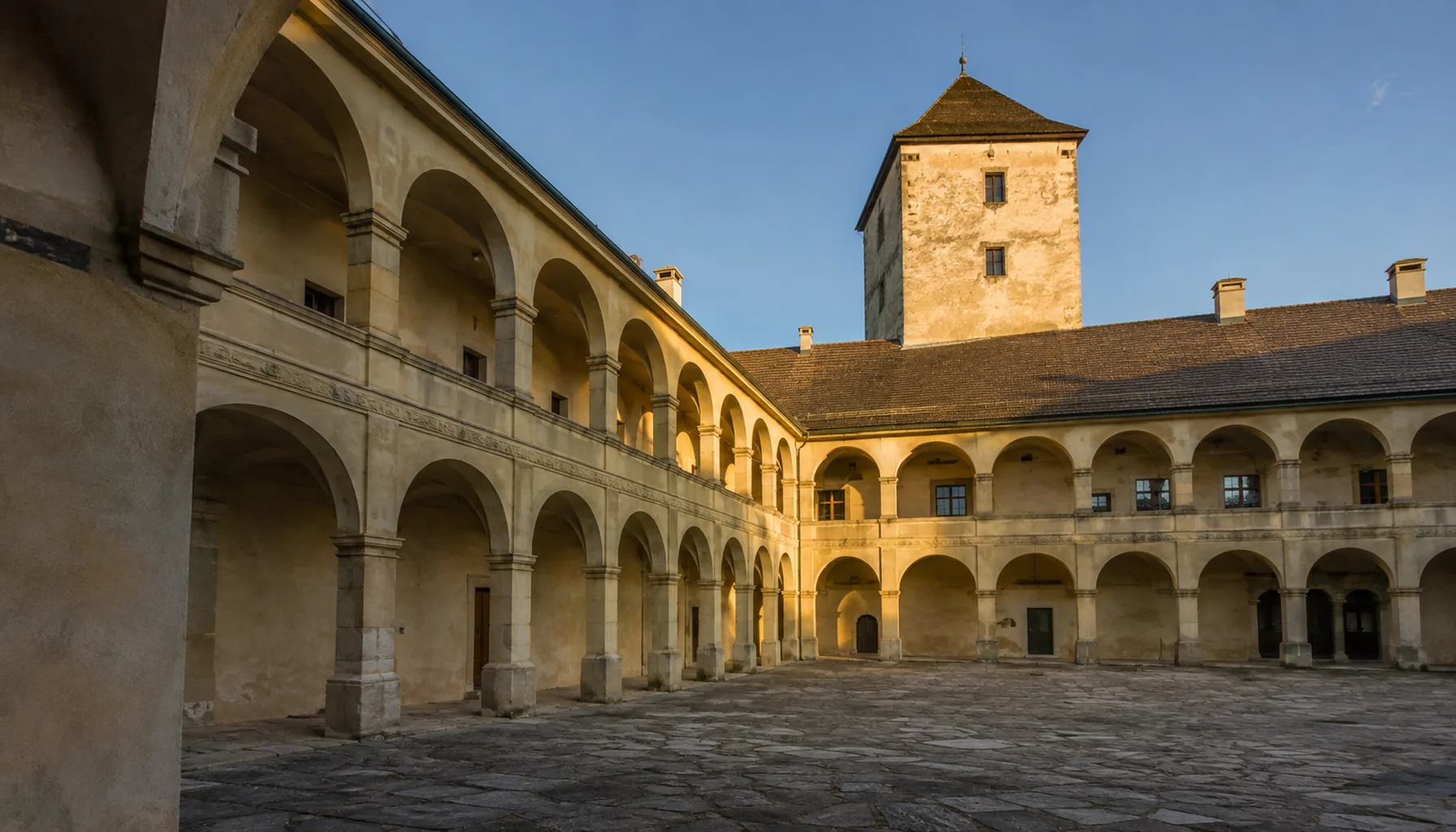
The fixed point of the Zvolen year is the castle courtyard in summer. Since 1974 it has been the stage of the Zvolen Castle Games, the town's theatre festival, and playing in an arcaded fourteenth-century courtyard is the whole point of it: the setting does half the work and the audience sits inside the building rather than looking at it. We give no dates here, because a festival that has run for this long still fixes its programme year by year, and the organisers publish it.Pevným bodom zvolenského roka je v lete nádvorie zámku. Od roku 1974 je javiskom Zvolenských zámockých hier, mestského divadelného festivalu, a hrať na arkádovom nádvorí zo štrnásteho storočia je celý zmysel veci: prostredie urobí polovicu práce a divák sedí v budove, namiesto aby si ju obzeral zvonku. Termíny tu neuvádzame, lebo aj festival s takou históriou zostavuje program rok po roku a zverejňujú ho organizátori.
Around it runs the year of a working town of forty thousand with a university in it. A professional theatre has been here since 1949 and keeps an autumn-to-spring season; the schools, the churches and the cultural centre fill the rest; and term time changes the feel of the streets, because a technical university brings several thousand students into a town this size. The outdoor half of the year belongs to the hill opposite. Across the river Pustý hrad, the Deserted Castle, is a free open-air ruin on a steep wooded hill: no ticket desk and no collection, only walls, cisterns and tower stumps among the trees, and the view down onto the town. It takes a half day and there is nothing up there to shelter in.Okolo neho beží rok pracujúceho štyridsaťtisícového mesta s univerzitou. Profesionálne divadlo tu je od roku 1949 a hrá od jesene do jari; zvyšok zapĺňajú školy, kostoly a kultúrne stredisko; a semester mení atmosféru ulíc, lebo technická univerzita privedie do mesta tejto veľkosti niekoľko tisíc študentov. Vonkajšia polovica roka patrí kopcu oproti. Nad riekou je Pustý hrad voľne prístupnou zrúcaninou na strmom zalesnenom kopci: žiadna pokladnica, žiadna expozícia, len múry, cisterny a pahýle veží medzi stromami a pohľad zhora na mesto. Zaberie pol dňa a hore sa niet kde schovať.
The castle is both monument and museum. It is furnished and open, and it holds a permanent collection of the Slovak National Gallery, old European painting hung in a medieval royal house, which is a stranger and better combination than it sounds. What people remember afterwards is the arcaded courtyard and the King's Hall with its coffered ceiling of painted Roman emperors. An hour here is the most concentrated hour a visitor can spend in the region.Zámok je pamiatkou aj múzeom naraz. Je zariadený a prístupný a sídli v ňom stála zbierka Slovenskej národnej galérie, teda staré európske maliarstvo zavesené v stredovekom kráľovskom dome, čo je zvláštnejšie a lepšie spojenie, než znie. Návštevníkom najviac utkvie arkádové nádvorie a Kráľovská sieň s kazetovým stropom s namaľovanými rímskymi cisármi. Hodina tu je najhutnejšou hodinou, akú možno v regióne stráviť.
The town also carries the institutions a district centre of this size runs: a professional theatre since 1949, a cultural centre with a hall and a programme, a library, a school of art for children, cinema and church music. We name none of the smaller ones individually, because premises and programmes change faster than a page like this does; the useful thing to say is that Zvolen has the full set rather than the thin version, which is not true of every town in this part of Slovakia. The Technical University in Zvolen, the National Forest Centre and the administration of the Poľana Biosphere Reserve are all seated here as well, an unusual concentration of knowledge for a town of forty thousand.Mesto má aj inštitúcie, aké prevádzkuje okresné centrum tejto veľkosti: profesionálne divadlo od roku 1949, kultúrne stredisko so sálou a programom, knižnicu, základnú umeleckú školu, kino a chrámovú hudbu. Menšie z nich menovite neuvádzame, lebo priestory a programy sa menia rýchlejšie než takáto stránka; podstatné je, že Zvolen má úplnú zostavu, nie jej okresanú verziu, čo sa nedá povedať o každom meste v tejto časti Slovenska. Sídli tu aj Technická univerzita vo Zvolene, Národné lesnícke centrum a správa Biosférickej rezervácie Poľana, čo je na štyridsaťtisícové mesto nezvyčajná koncentrácia poznania.
The square is the town's largest single work of architecture: very long, very wide, among the largest in the country, with the Gothic Church of St Elizabeth standing free at its upper end and the castle closing the lower one. It was rebuilt in 2002. Zvolen could afford it because it was a free royal town from 1238, one of the first four on the territory of today's Slovakia alongside Trnava, Banská Štiavnica and Krupina; the Mongol invasion destroyed the original charter in 1241 and King Béla IV issued a new one on 28 December 1243. Those liberties went not to German settlers, as in the mining towns, but to the local Slavic population. In 1847 the town elected Ľudovít Štúr, who had codified written Slovak on the central Slovak dialect a few years earlier, as its deputy to the Hungarian Diet.Námestie je najväčším architektonickým dielom mesta: veľmi dlhé, veľmi široké, patriace k najväčším v krajine, s gotickým Kostolom svätej Alžbety voľne stojacim na hornom konci a so zámkom uzatvárajúcim dolný. V roku 2002 ho prestavali. Zvolen si ho mohol dovoliť, lebo od roku 1238 bol slobodným kráľovským mestom, jedným zo štyroch prvých na území dnešného Slovenska popri Trnave, Banskej Štiavnici a Krupine; pôvodnú listinu zničil v roku 1241 vpád Mongolov a kráľ Belo IV. vydal novú 28. decembra 1243. Výsady nedostali nemeckí osadníci ako v banských mestách, ale miestne slovanské obyvateľstvo. V roku 1847 si mesto zvolilo za vyslanca na uhorský snem Ľudovíta Štúra, ktorý pár rokov predtým kodifikoval spisovnú slovenčinu na základe stredoslovenského nárečia.
The castle at the foot of the square was built between 1360 and 1382 by Louis I the Great, not on a rock but on level ground, a compact rectangular block round a courtyard on the model of the Italian urban palaces his Angevin family knew. It was a hunting seat, and the forests of the basin and of Poľana are the reason it exists. In 1385 his daughter Mary was married to Sigismund of Luxembourg here. Two centuries later, with the Ottoman frontier about fifty kilometres south, the castle was wrapped in Renaissance defences and given the corner towers it still has, and from 1575 a permanent garrison was stationed in the town. The first Zvolen was not down here at all: Pustý hrad on the wooded hill covered one of the largest castle sites in Slovakia, an upper and a lower castle the better part of a kilometre apart, and it burned in 1451 during the fighting between Ján Jiskra's troops and John Hunyadi's army and was never rebuilt. On the castle courtyard the foundations of a three-nave Romanesque basilica of St Nicholas are marked out.Zámok na konci námestia dal v rokoch 1360 až 1382 postaviť Ľudovít I. Veľký, a to nie na skale, ale na rovine: kompaktný obdĺžnikový blok okolo nádvoria podľa vzoru talianskych mestských palácov, ktoré jeho anjouovská rodina poznala. Bol to poľovnícky zámok a lesy kotliny a Poľany sú dôvodom, prečo vznikol. V roku 1385 sa tu vydávala jeho dcéra Mária za Žigmunda Luxemburského. O dve storočia neskôr, keď osmanská hranica prebiehala asi päťdesiat kilometrov na juh, zámok obostavali renesančným opevnením a dostal nárožné vežice, ktoré má dodnes, a od roku 1575 v meste sídlila stála posádka. Prvý Zvolen nebol tu dole vôbec: Pustý hrad na zalesnenom kopci zaberal jednu z najväčších hradných plôch na Slovensku, horný a dolný hrad takmer kilometer od seba, v roku 1451 vyhorel počas bojov medzi vojskami Jána Jiskru a Jána Huňadyho a nikto ho už neobnovil. Na nádvorí zámku sú vyznačené základy trojloďovej románskej baziliky svätého Mikuláša.
Zvolen's culture is a forest culture, and that is not a figure of speech. The town lived off the royal estate, off its market and off timber floated down the Hron on rafts, and it has processed wood from the surrounding forests for a century. In 1952 the College of Forestry and Wood Technology was founded here, which is the decision that made Zvolen the country's forestry capital rather than just a place with a lot of trees around it; it became the Technical University in Zvolen in 1991. The modern version of a very old fact is that the forests are why anyone built here at all.Zvolenská kultúra je lesnou kultúrou a nie je to obrazné vyjadrenie. Mesto žilo z kráľovského panstva, z trhu a z dreva, ktoré sa po Hrone splavovalo na pltiach, a drevo z okolitých lesov spracúva už storočie. V roku 1952 tu vznikla Vysoká škola lesnícka a drevárska, a práve toto rozhodnutie urobilo zo Zvolena lesnícke hlavné mesto krajiny, nielen miesto s množstvom stromov naokolo; v roku 1991 sa premenila na Technickú univerzitu vo Zvolene. Moderná podoba veľmi starej skutočnosti znie: lesy sú dôvodom, prečo tu vôbec niekto staval.
The other thing that made the modern town arrived on rails. The line from Lučenec reached Zvolen on 18 June 1871 and the line onward to Vrútky opened on 12 August 1872, joining it to the Košice to Bohumín railway; more followed, and within a generation Zvolen was one of the four great railway junctions of Slovakia alongside Bratislava, Košice and Žilina. Railway workshops, printing works and a bank opened, and a small county town began turning into an industrial one. It is still the crossroads, and anyone crossing central Slovakia passes through whether they mean to or not. Those workshops are also why the town's twentieth-century memory is what it is: in the Slovak National Uprising of 1944 they built three armoured trains out of boiler plate, named Štefánik, Hurban and Masaryk, and the castle served as a brigade headquarters and a hospital until German troops broke the Uprising's centre on 27 October 1944.Druhá vec, ktorá urobila dnešné mesto, prišla po koľajniciach. Trať z Lučenca dorazila do Zvolena 18. júna 1871 a trať ďalej do Vrútok otvorili 12. augusta 1872, čím sa mesto napojilo na Košicko-bohumínsku železnicu; nasledovali ďalšie a za jednu generáciu bol Zvolen jedným zo štyroch veľkých železničných uzlov Slovenska popri Bratislave, Košiciach a Žiline. Vznikli železničné dielne, tlačiareň a banka a z malého stoličného mesta sa začalo stávať priemyselné. Križovatkou je dodnes a kto prechádza stredným Slovenskom, prejde cez Zvolen, či chce, alebo nie. Práve tie dielne sú aj dôvodom, prečo má mesto takú pamäť dvadsiateho storočia, akú má: počas Slovenského národného povstania v roku 1944 v nich z kotlového plechu postavili tri pancierové vlaky s menami Štefánik, Hurban a Masaryk a zámok slúžil ako veliteľstvo brigády a nemocnica, kým nemecké vojská 27. októbra 1944 nezlomili centrum povstania.
Sixteen videos for Culture in Zvolen.Šestnásť videí — Kultúra vo Zvolene.