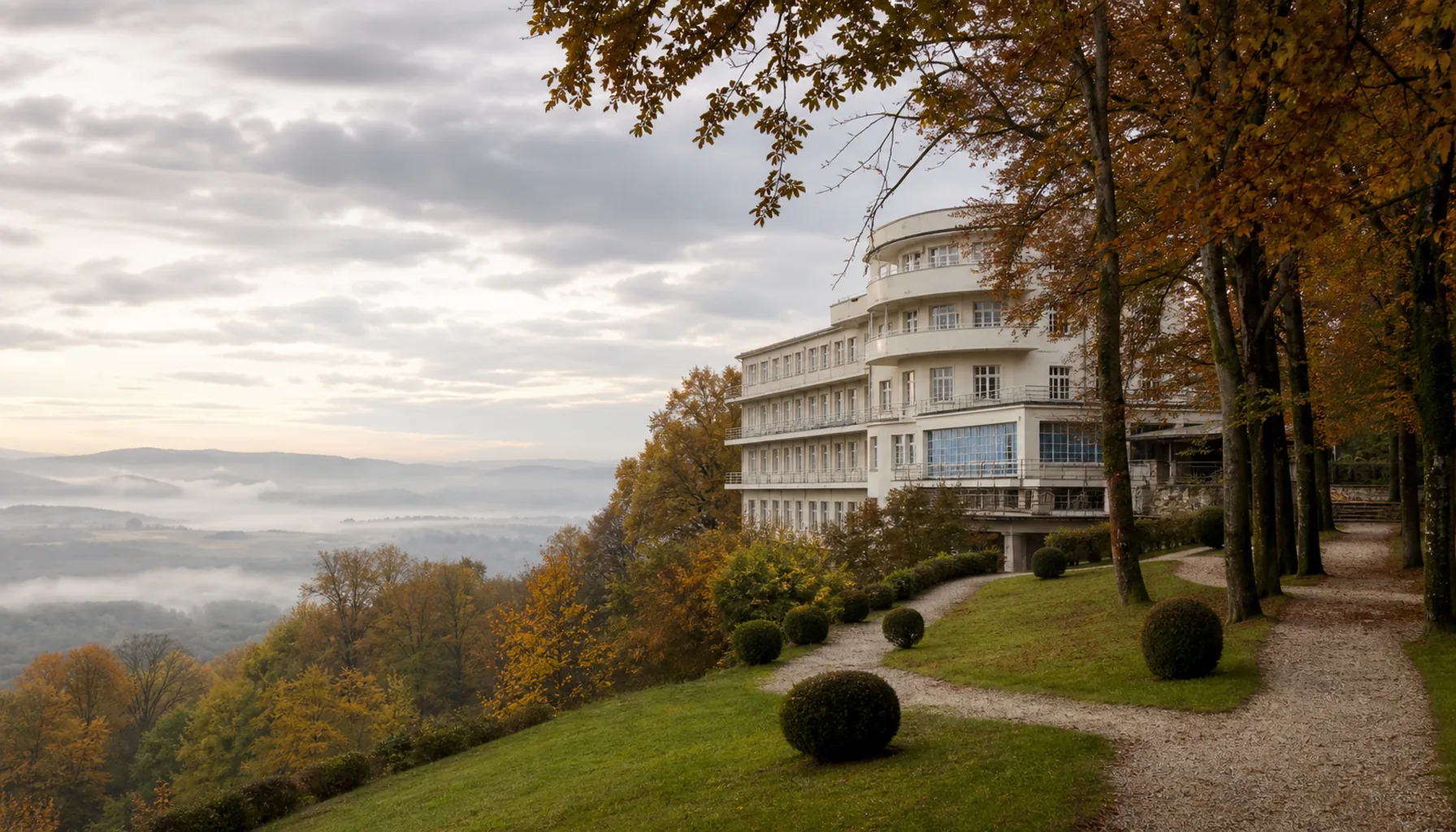
Sliač · spa terrace above the HronSliač · kúpeľná terasa nad Hronom
Culture in SliačKultúra na Sliači
A spa park and an interwar sanatorium on the hill, a fighter airbase on the flat ground below, and a town assembled out of two villages in between.Kúpeľný park a medzivojnové sanatórium na kopci, stíhacia letecká základňa na rovine pod ním a mesto poskladané z dvoch dedín medzi tým.
The Palace, the 1930s sanatorium that still dominates the spa terrace at Sliač, standing above the springs and the park.Palace — sanatórium z tridsiatych rokov, ktoré dodnes dominuje kúpeľnej terase v Sliači nad prameňmi a parkom.
The year in SliačRok na Sliači
Sliač runs on a treatment calendar rather than a festival one, and that is the first thing to understand about it. This is a working medical spa: people come on referral, stay for a course of treatment and structure the day around it, so the atmosphere is one of scheduled baths and slow walks in the park. Organised bathing here has kept a fixed season in the warm months since the seventeenth and eighteenth centuries, and although the sanatoria now work all year, the park, the terraces and the walking are still at their best from late spring to autumn.Sliač žije podľa liečebného, nie festivalového kalendára, a to je prvá vec, ktorú o ňom treba vedieť. Sú to fungujúce liečebné kúpele: ľudia sem prichádzajú na návrh lekára, ostávajú na liečebný cyklus a podľa neho si delia deň, takže atmosféru tvoria naplánované kúpele a pomalé prechádzky parkom. Organizované kúpanie tu má pevnú sezónu v teplých mesiacoch už od sedemnásteho a osemnásteho storočia, a hoci sanatóriá dnes pracujú celý rok, park, terasy aj prechádzky sú najlepšie od neskorej jari do jesene.
The one date the wider public associates with Sliač belongs to the airfield rather than to the spa: in recent years the field's most visible public role has been as the venue for Slovakia's international air show, which fills the terrace with people who have not come for their hearts. It runs on announced dates and is not a fixture we will pin to a month here. Check before you travel, and expect the town to be full when it is on. Otherwise the year is made of the country around. The wooded slopes above the town run on into the Kremnické vrchy with marked paths, sections of cycle route follow the Hron below the terrace, and the railway through the town puts Zvolen castle and Banská Bystrica's square minutes away.Jediný dátum, ktorý si so Sliačom spája širšia verejnosť, patrí letisku, nie kúpeľom: v posledných rokoch je najviditeľnejšou verejnou úlohou letiska medzinárodná letecká šou, ktorá naplní terasu ľuďmi, čo neprišli kvôli srdcu. Koná sa v ohlásených termínoch a neuvádzame tu, na ktorý mesiac pripadá. Overte si to pred cestou a rátajte s tým, že počas nej býva mesto plné. Inak rok tvorí okolitá krajina. Zalesnené svahy nad mestom prechádzajú do Kremnických vrchov so značkovanými chodníkmi, popod terasu vedú úseky cyklotrasy pozdĺž Hrona a železnica cez mesto má Zvolenský zámok aj banskobystrické námestie na pár minút.
Where culture livesKde žije kultúra
The spa park is the town's public room. It is open to walk through: old trees, the springs, the drinking pavilion, and the Palace standing over all of it. Spa culture is a real thing and this is a good place to watch it, because the form has survived here almost unchanged since the nineteenth century, when a bath was a social occasion as much as a treatment and the nobility of the surrounding counties came for both. Today the same paths carry patients on a prescribed walk, which is a quieter version of the same idea. One older piece of spa furniture is worth looking for: the chapel dedicated to Saint Hildegard, built beside the springs in 1855 at the expense of the Habsburg Archduke Albrecht, which in a business built on reputation was an advertisement as much as a devotion.Kúpeľný park je verejnou sálou mesta. Dá sa ním voľne prejsť: staré stromy, pramene, pitný pavilón a nad tým všetkým Palace. Kúpeľná kultúra je skutočná vec a toto je dobré miesto, kde ju možno pozorovať, lebo jej podoba sa tu od 19. storočia takmer nezmenila, keď bol kúpeľ rovnako spoločenskou udalosťou ako liečbou a šľachta okolitých stolíc prichádzala pre oboje. Dnes po tých istých chodníkoch chodia pacienti na predpísanú prechádzku, čo je tichšia verzia toho istého. Za pozretie stojí jeden starší kus kúpeľného inventára: kaplnka zasvätená svätej Hildegarde, postavená pri prameňoch v roku 1855 na náklady habsburského arcivojvodu Albrechta, ktorá bola v podniku stojacom na povesti rovnako reklamou ako zbožnosťou.
Sliač does not carry the institutions of a town its size, and it does not need to. Zvolen and Banská Bystrica are minutes away by train and hold the theatres, museums and galleries of the region between them; what the town itself keeps is what a small municipality keeps, a cultural centre and hall, a library, the schools and the churches. We name none of them individually, because in a place this size premises and programmes change faster than a page like this does.Sliač nemá inštitúcie mesta svojej veľkosti a ani ich nepotrebuje. Zvolen a Banská Bystrica sú vlakom na pár minút a delia sa o divadlá, múzeá a galérie celého regiónu; samotné mesto si drží to, čo si drží malá obec, teda kultúrny dom so sálou, knižnicu, školy a kostoly. Menovite tu neuvádzame ani jedno z nich, lebo v mieste tejto veľkosti sa priestory a programy menia rýchlejšie než takáto stránka.
The buildings that carry itBudovy, ktoré ju nesú
The landmark is the Palace, the large sanatorium built on the hill in the 1930s when the spa was rebuilt to a modern standard under Czechoslovakia. It is a confident piece of interwar architecture and it still dominates the terrace, which is unusual: most Slovak spas are defined by their nineteenth-century fabric, and here the twentieth century won. Below it the park keeps the older layer, the springs themselves with their pools and pavilion, in a layout that has been added to rather than replaced.Dominantou je Palace, veľké sanatórium postavené na kopci v tridsiatych rokoch, keď sa kúpele v Československu prestavali na moderný štandard. Je to sebavedomá medzivojnová architektúra a terasu ovláda dodnes, čo je nezvyčajné: väčšinu slovenských kúpeľov určuje zástavba 19. storočia, tu vyhralo dvadsiate. Pod ním si park drží staršiu vrstvu, samotné pramene s bazénmi a pavilónom, v usporiadaní, ktoré sa skôr dopĺňalo, než prestavovalo.
The town below the hill is younger than either. It was put together at the end of the 1950s out of the villages of Hájniky and Rybáre and the spa settlement between them, with sources giving 1959 or 1960 for the merger, and made a town in 1969. The two village names are the oldest thing in Sliač and they say exactly what the place was: rybár is a fisherman, hájnik a gamekeeper. Rybáre appears in 1249 as part of the Zvolen castle estate, and these were service villages, people who kept the king's forest and caught the king's fish rather than free farmers with land of their own. The springs themselves were used in the thirteenth century and reached the written record because this was royal hunting country, with the castle Louis I built at Zvolen in the 1370s a few kilometres downstream; in 1851 the geographer Fényes Elek listed Sliač as three bathing pools and four drinking springs.Mesto pod kopcom je mladšie než jedno aj druhé. Vzniklo koncom päťdesiatych rokov spojením obcí Hájniky a Rybáre a kúpeľnej osady medzi nimi, pričom pramene uvádzajú rok 1959 alebo 1960, a v roku 1969 získalo štatút mesta. Mená oboch dedín sú na Sliači to najstaršie a hovoria presne, čím miesto bolo: rybár chytal ryby, hájnik strážil les. Rybáre sa spomínajú v roku 1249 ako súčasť zvolenského hradného panstva a išlo o služobnícke dediny, o ľudí, ktorí strážili kráľov les a lovili kráľove ryby, nie o slobodných gazdov s vlastnou pôdou. Samotné pramene sa využívali v trinástom storočí a do písomných záznamov sa dostali preto, že šlo o kráľovský poľovný revír, pár kilometrov nižšie s hradom, ktorý dal v sedemdesiatych rokoch 14. storočia postaviť vo Zvolene Ľudovít I.; v roku 1851 uviedol geograf Fényes Elek Sliač ako tri kúpeľné bazény a štyri pitné pramene.
Warm water, and Tri dubyTeplá voda a Tri duby
Everything the spa does rests on one accident of geology. The water comes out of the ground warm and still carrying a great deal of dissolved carbon dioxide, which should not happen: gas normally escapes from water as it warms, so warm-and-strongly-carbonated is rare. The baths fizz accordingly. After 1948 the nationalised spa was pointed at a single speciality that follows directly from that chemistry, because bathing in carbonated water widens the small vessels in the skin and eases the load on the heart, and cardiac rehabilitation is still what Sliač does.Všetko, čo kúpele robia, stojí na jednej geologickej náhode. Voda vychádza zo zeme teplá a stále nesie veľké množstvo rozpusteného oxidu uhličitého, čo by sa nemalo stávať: plyn z vody pri ohreve zvyčajne unikne, takže teplá a silne uhličitá voda je vzácnosť. Kúpele preto perlia. Po roku 1948 znárodnené kúpele nasmerovali na jedinú špecializáciu, ktorá z tejto chémie priamo vyplýva, lebo kúpeľ v uhličitej vode rozširuje drobné cievy v koži a odľahčuje srdce, a kardiologická rehabilitácia je tým, čo Sliač robí dodnes.
The flat ground by the river carries the other half of the town. The first military aircraft landed at Tri duby on 15 July 1935 and a flying school opened there in May 1936, so both halves of modern Sliač were in place before the war. When the Slovak National Uprising began in 1944 the field became its main airfield: transports brought in weapons and ammunition and carried out the wounded, and on 17 September 1944 František Fajtl led in the 1st Czechoslovak Independent Fighter Air Regiment from the USSR, flying from here and from nearby Zolná. The field was bombed that same month. Flying restarted on 21 March 1945, when it was renamed the SNP airfield after the uprising it had served. From 1968 until 1991 the field held a Soviet garrison of several thousand men within sight of a town whose business was rest and recovery; civil aviation was separated from the military side on 1 January 1991, and since 1993 this has been the home base of the Slovak air force's fighters. A heart spa and a fighter base share one name.Rovina pri rieke nesie druhú polovicu mesta. Prvé vojenské lietadlá pristáli na Troch duboch 15. júla 1935 a v máji 1936 tam otvorili leteckú školu, takže obe polovice dnešného Sliača existovali už pred vojnou. Keď sa v roku 1944 začalo Slovenské národné povstanie, stalo sa letisko jeho hlavným: transportné lietadlá privážali zbrane a strelivo a odvážali ranených a 17. septembra 1944 privítalo 1. československý samostatný stíhací letecký pluk, ktorý priviedol zo ZSSR František Fajtl a ktorý lietal odtiaľto a z neďalekej Zolnej. V tom istom mesiaci letisko bombardovali. Lietať sa tu začalo znova 21. marca 1945, keď dostalo meno Letisko SNP podľa povstania, ktorému slúžilo. Od roku 1968 do roku 1991 sídlila na letisku sovietska posádka s niekoľkými tisíckami mužov na dohľad od mesta, ktorého živobytím bol oddych a doliečenie; civilná prevádzka sa od vojenskej oddelila 1. januára 1991 a od roku 1993 je toto domovská základňa stíhačiek slovenského letectva. Kúpele na liečbu srdca a stíhacia základňa nesú jedno meno.