Nová Baňa · the Hron and the Štiavnica HillsNová Baňa · Pohronie a Štiavnické vrchy
A royal mining town whose gold ran out and whose mines closed in 1887, with a museum in the Gothic town hall on the square that keeps, among other things, the story of the first working steam engine on the European mainland.Kráľovské banské mesto, ktorému došlo zlato a ktorému v roku 1887 zavreli bane; v gotickej radnici na námestí sídli múzeum, ktoré uchováva okrem iného príbeh prvého fungujúceho parného stroja na európskej pevnine.
Summer here happens at the Tajch. The reservoir the old mining engineers built in the woods above the town to store water power for the mines is now the local swimming lake — industrial equipment repurposed as a summer place, which has happened to a good many things in this region. It is a short way up from the square, and it is what the town does with July.Leto sa tu odohráva na Tajchu. Nádrž, ktorú starí banskí inžinieri postavili v lese nad mestom, aby zadržiavala vodnú silu pre bane, je dnes miestnym kúpaliskom — priemyselné zariadenie premenené na letné miesto, čo sa v tomto kraji stalo dosť veciam. Od námestia je to kúsok hore a je to to, čo mesto robí s júlom.
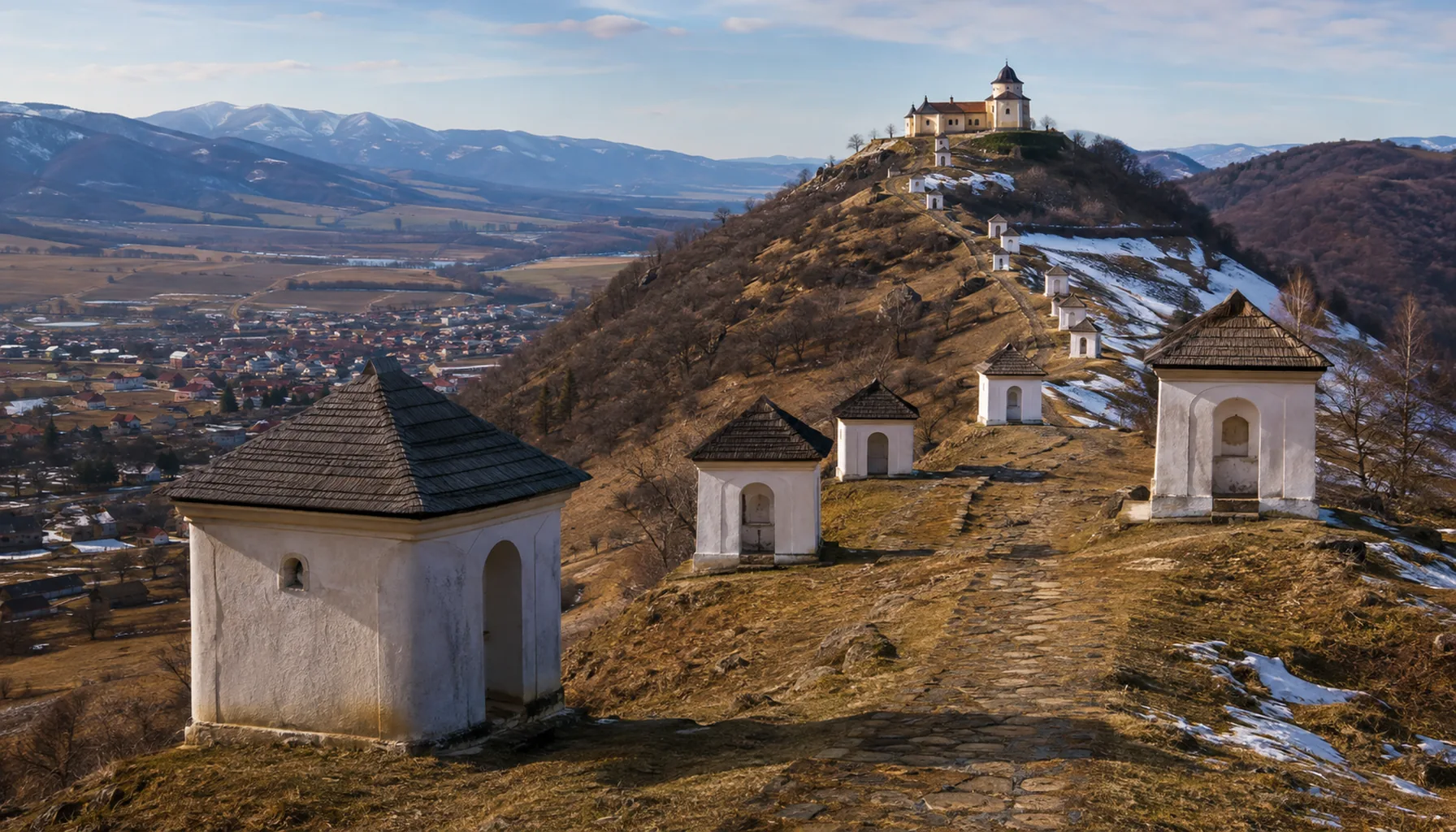
The Baroque Calvary is the other fixed walk. A calvary is built to be gone through in order, chapel by chapel, ending in the church at the top, and the days it is most walked are in Holy Week; the rest of the year it is simply the best half hour out of the town, with the whole valley below you.Druhou pevnou prechádzkou je baroková kalvária. Kalvária je stavaná na to, aby sa ňou prechádzalo po poriadku, kaplnka po kaplnke, s kostolom na konci hore, a najviac sa po nej chodí vo Veľkom týždni; po zvyšok roka je to jednoducho najlepšia polhodina, akú z mesta urobíte, s celou dolinou pod sebou.
For the rest, the calendar is what a Slovak town of this size keeps: markets on the square, a town day, church feasts, the cultural centre's programme and the concerts of the school of art. Dates move from year to year and nothing here is announced nationally, so the town's own listings are the source to use.Inak je kalendár taký, aký si drží slovenské mesto tejto veľkosti: trhy na námestí, dni mesta, cirkevné sviatky, program kultúrneho strediska a koncerty základnej umeleckej školy. Termíny sa rok od roka menia a nič sa tu neoznamuje celoštátne, takže použiteľným zdrojom sú vlastné oznamy mesta.
The Pohronie Museum sits in the old town hall on the square — Gothic in origin, remodelled over the centuries — and its collections cover the mining of this stretch of the river and the story of the engine. There is a neatness to that: the building that once governed the town is now the building that explains it.Pohronské múzeum sídli v starej radnici na námestí — pôvodom gotickej, po stáročiach viackrát prestavanej — a jeho zbierky pokrývajú baníctvo na tomto úseku rieky a príbeh parného stroja. Je v tom istá úhľadnosť: budova, ktorá kedysi mesto spravovala, ho dnes vysvetľuje.
Mining is remembered in this town rather than practised. The mines were closed as unprofitable in 1887, five and a half centuries after the first miners came over the hills from Kremnica and Pukanec; gold was still in the rock, but not enough to pay wages, pumps and pit timber at nineteenth-century prices. Everything the town has said about itself since is record-keeping rather than work.Baníctvo sa v tomto meste skôr pripomína, než prevádzkuje. Bane zavreli ako nerentabilné v roku 1887, päť a pol storočia po tom, ako cez kopce prišli prví baníci z Kremnice a Pukanca; zlato v skale ešte bolo, ale nie natoľko, aby pri cenách devätnásteho storočia zaplatilo mzdy, čerpadlá a banské drevo. Všetko, čo mesto odvtedy o sebe hovorí, je uchovávanie pamäti, nie práca.
The rest is the ordinary equipment of a Slovak town of this size: a cultural centre with a hall and a programme, a library, amateur groups and a school of art for children. We name none of them individually, because programmes and premises change faster than a page like this does.Zvyšok je bežné vybavenie slovenského mesta tejto veľkosti: kultúrne stredisko so sálou a programom, knižnica, amatérske súbory a základná umelecká škola. Jednotlivo ich tu nemenujeme, lebo programy a priestory sa menia rýchlejšie než takáto stránka.
On 8 September 1345 King Louis I confirmed Nová Baňa as a free royal mining town: its miners and burghers answered to the king rather than to any local lord, elected their own council and kept a share of what came out of the ground. It joined the seven royal mining towns of what is now central Slovakia, Kremnica and Banská Štiavnica among them, and the square, the Gothic town hall and the Gothic parish church above it are what the boom of the later fourteenth century paid for.Ôsmeho septembra 1345 kráľ Ľudovít I. potvrdil Novú Baňu ako slobodné kráľovské banské mesto: jej baníci a mešťania podliehali kráľovi, nie miestnemu zemepánovi, volili si vlastnú radu a časť toho, čo vyšlo zo zeme, si ponechali. Pripojila sa k siedmim kráľovským banským mestám dnešného stredného Slovenska, medzi ktorými boli Kremnica aj Banská Štiavnica, a námestie, gotická radnica a gotický farský kostol nad ním sú tým, čo zaplatil rozmach druhej polovice štrnásteho storočia.
Nothing on that scale was built here again, and the reason is on the record. In 1664 Ottoman troops destroyed the town — one of the rarer cases in Slovakia where the phrase means what the documents say rather than local legend, since the fortress of Nové Zámky had fallen the year before and raiding columns rode up the river valleys from it. The risings and plagues of that century nearly emptied the place, and what went up afterwards was modest.Nič takého rozsahu sa tu už nepostavilo a dôvod je doložený. V roku 1664 osmanské vojská mesto zničili — jeden z tých vzácnejších prípadov na Slovensku, keď tá veta znamená to, čo naozaj hovoria pramene, a nie miestnu legendu, lebo pevnosť Nové Zámky padla rok predtým a nájazdné kolóny vyrážali odtiaľ hore riečnymi dolinami. Povstania a mory toho storočia mesto takmer vyprázdnili a to, čo vyrástlo potom, bolo skromné.
Ten kilometres downstream, where the Hron cuts through a gap in the hills, stands the fortified Benedictine abbey of Hronský Beňadik: a Gothic church and cloister behind walls, founded in the eleventh century and rebuilt as a stronghold when the Ottoman frontier came close. It is the largest monument in this part of the valley.Desať kilometrov po prúde, kde Hron preteká úžinou v kopcoch, stojí opevnené benediktínske opátstvo Hronský Beňadik: gotický kostol a kláštor za múrmi, založené v jedenástom storočí a prestavané na pevnosť, keď sa priblížila osmanská hranica. Je to najväčšia pamiatka tejto časti doliny.
The problem was water: the shafts above the town stood flooded deeper than horse-driven pumps could lift. In 1722 an atmospheric steam engine of the kind Thomas Newcomen had built in England was erected over one of them, under the English engineer Isaac Potter, to pump them out. It condensed steam inside a cylinder so that ordinary air pressure pushed the piston down — clumsy, hungry for fuel, and revolutionary. It was the first working steam engine anywhere on the European mainland.Problémom bola voda: šachty nad mestom stáli zatopené hlbšie, než dokázali vyzdvihnúť čerpadlá poháňané koňmi. V roku 1722 nad jednou z nich postavili atmosférický parný stroj toho druhu, aký v Anglicku staval Thomas Newcomen; viedol to anglický inžinier Isaac Potter. Vo valci kondenzoval paru, takže piest stlačil obyčajný tlak vzduchu — neohrabané, náročné na palivo a prevratné. Bol to prvý fungujúci parný stroj na európskej pevnine.
The engine itself is long gone, which is the point worth making on a page about culture: what a town keeps is not always a building. Potter's engine survives as a record, as an account in the museum, and as the thing the town says about itself — a machine of the industrial revolution set to work in a Slovak mining town decades before there was an industrial revolution to speak of.Samotný stroj je dávno preč, a práve to sa oplatí povedať na stránke o kultúre: to, čo si mesto uchová, nie je vždy budova. Potterov stroj prežíva ako záznam, ako výklad v múzeu a ako to, čo mesto hovorí samo o sebe — stroj priemyselnej revolúcie uvedený do práce v slovenskom banskom meste desaťročia predtým, než sa dala nejaká priemyselná revolúcia vôbec spomínať.
Glass is the other memory. With mining faltering, one of the oldest glassworks in the Kingdom of Hungary was set up at Stará Huta just outside the town in 1630 — the valley had sand, endless firewood and potash burned from beech ash — and in 1907, twenty years after the mines closed, a glassworks was built in Nová Baňa itself. Glass rather than gold is what this district went on making.Druhou pamäťou je sklo. Keď baníctvo slablo, vznikla v roku 1630 v Starej Hute kúsok za mestom jedna z najstarších sklární v Uhorsku — dolina mala piesok, nekonečné palivové drevo a potaš pálenú z bukového popola — a v roku 1907, dvadsať rokov po zatvorení baní, postavili sklárňu priamo v Novej Bani. Tento kraj vyrábal ďalej sklo, nie zlato.
Sixteen videos for Culture in Nová Baňa.Šestnásť videí — Kultúra v Novej Bani.