Banská Bystrica region · TownsBanskobystrický kraj · Mestá
Nová BaňaNová Baňa
One of the old royal mining towns of the Hron, where gold was dug out of the hills above the river — and where, in 1722, the first working steam engine on the European mainland was set to pumping water out of a flooded shaft.Jedno zo starých kráľovských banských miest na Hrone, kde sa v kopcoch nad riekou dobývalo zlato — a kde v roku 1722 spustili prvý fungujúci parný stroj na európskej pevnine, aby odčerpával vodu zo zatopenej šachty.
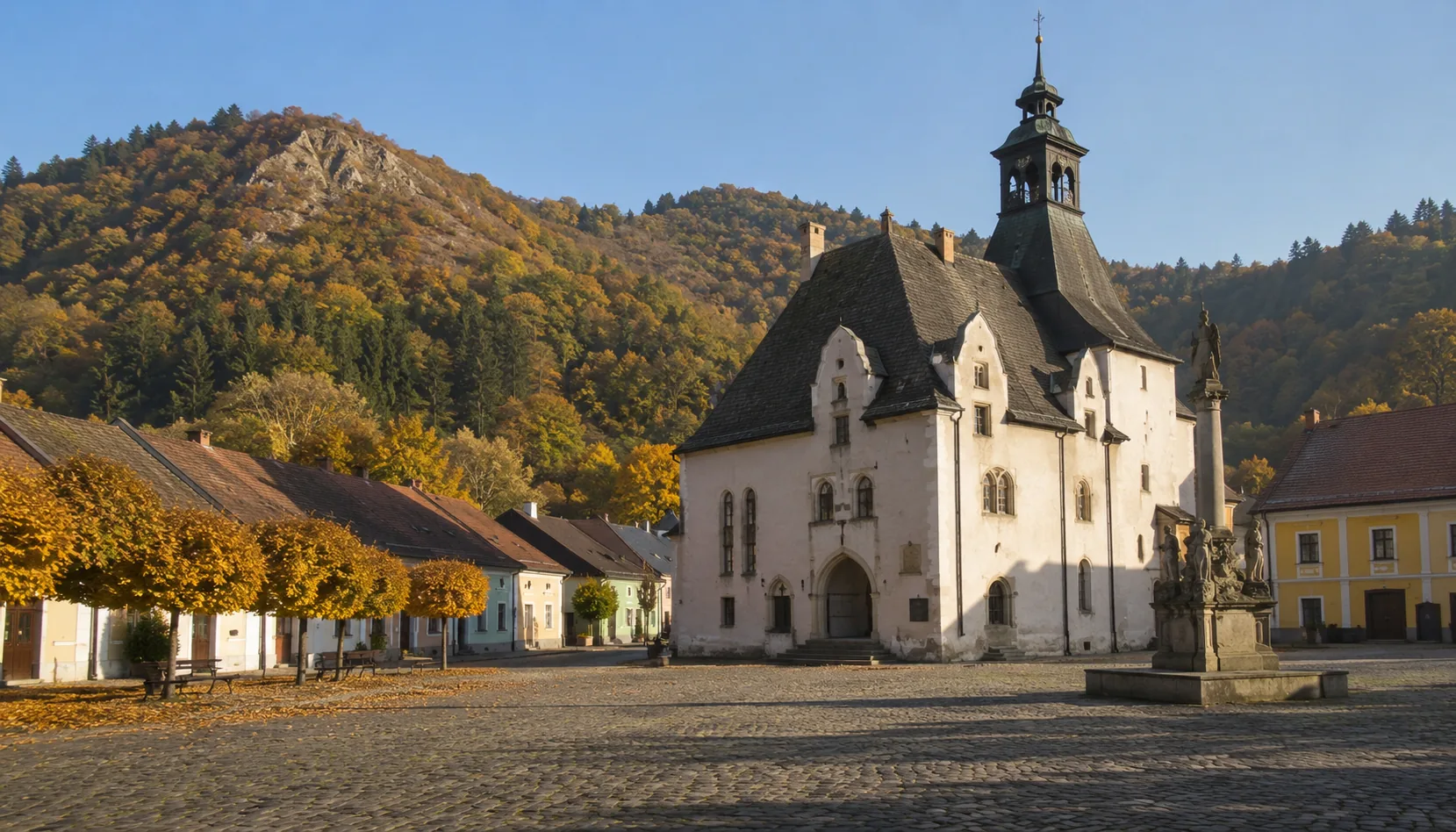
The old town hall on the square at Nová Baňa, now the Pohronie MuseumStará radnica na námestí v Novej Bani, dnes Pohronské múzeum
Where it standsKde leží
Nová Baňa stands on the Hron on the western edge of the Štiavnica Hills, where the mining country begins to give way to open valley. Žarnovica is the next town upstream and Žiar nad Hronom the one after that; Banská Štiavnica lies over the wooded ridges to the east.Nová Baňa leží na Hrone na západnom okraji Štiavnických vrchov, tam, kde banská krajina prechádza do otvorenej doliny. Najbližším mestom proti prúdu je Žarnovica, za ňou Žiar nad Hronom; za zalesnenými chrbtami na východe leží Banská Štiavnica.
The hills on both sides are volcanic and heavily wooded — the Štiavnica Hills behind the town, the Pohronský Inovec across the river — and the town itself climbs out of the valley onto the slopes, which is where the mines were.Kopce po oboch stranách sú sopečné a husto zalesnené — Štiavnické vrchy za mestom, Pohronský Inovec za riekou — a samotné mesto vystupuje z doliny do svahov, teda tam, kde boli bane.
The storyHistória
Gold and silver were dug here from the Middle Ages by miners brought in from the German lands, and in the fourteenth century the town was granted the privileges of a free royal mining town. It became one of the seven lower Hungarian mining towns, the association that also included Kremnica, Banská Štiavnica and Banská Bystrica. The Hungarian name Újbánya says the same thing as the Slovak one — the new mine; the German Königsberg says who owned it.Zlato a striebro sa tu dobývali od stredoveku baníkmi privedenými z nemeckých krajín a v štrnástom storočí získalo mesto výsady slobodného kráľovského banského mesta. Stalo sa jedným zo siedmich dolnouhorských banských miest — združenia, do ktorého patrili aj Kremnica, Banská Štiavnica a Banská Bystrica. Maďarský názov Újbánya hovorí to isté čo slovenský — nová baňa; nemecký Königsberg hovorí, komu patrila.
The mines flooded, as mines in these hills always did, and by the early eighteenth century the water stood deeper than horse-driven pumps could lift it. In 1722 an atmospheric steam engine of the kind Thomas Newcomen had built in England was erected over a shaft above the town, under the direction of the English engineer Isaac Potter, to pump it out. It was the first working steam engine anywhere on the European mainland — a machine of the industrial revolution set up in a Slovak mining town before there was an industrial revolution to speak of.Bane sa zatápali, ako sa v týchto kopcoch zatápali vždy, a začiatkom osemnásteho storočia už stála voda hlbšie, než ju konské čerpadlá dokázali vytiahnuť. V roku 1722 postavili nad jednou zo šácht nad mestom atmosférický parný stroj toho typu, aký v Anglicku staval Thomas Newcomen; práce viedol anglický inžinier Isaac Potter a stroj mal vodu odčerpávať. Bol to prvý fungujúci parný stroj na európskej pevnine — stroj priemyselnej revolúcie postavený v slovenskom banskom meste skôr, než sa o nejakej priemyselnej revolúcii dalo hovoriť.
The gold gave out in the centuries that followed, and Nová Baňa turned to what the valley offered instead: timber, orchards on the warm slopes, small workshops, and in the twentieth century industry placed here by the state. Mining is remembered in this town rather than practised.Zlato v ďalších storočiach došlo a Nová Baňa sa obrátila k tomu, čo dolina ponúkala inak: k drevu, sadom na teplých svahoch, malým dielňam a v dvadsiatom storočí k priemyslu, ktorý sem umiestnil štát. Baníctvo sa v tomto meste pripomína, neprevádzkuje.
What to seeČo vidieť
The old town hall on the square is the building to look for — Gothic in origin, remodelled over the centuries, and now the home of the Pohronie Museum, whose collections cover the mining of this stretch of the river and the story of the engine. The Gothic parish church stands above it on the slope.Budovou, ktorú treba hľadať, je stará radnica na námestí — pôvodom gotická, v priebehu storočí prestavaná a dnes sídlo Pohronského múzea, ktorého zbierky pokrývajú baníctvo tohto úseku rieky i príbeh parného stroja. Nad ňou stojí vo svahu gotický farský kostol.
A Baroque Calvary climbs the hill above the town, a line of chapels ending in a church, with the whole valley below it. The Tajch, a reservoir in the woods above the town of the kind the mining engineers built all over these hills to store water, is now the local swimming lake and a summer place in its own right.Nad mestom stúpa do kopca baroková kalvária — rad kaplniek zakončený kostolom, s celou dolinou pod sebou. Tajch, vodná nádrž v lesoch nad mestom, akú banskí inžinieri stavali po celých týchto kopcoch na zadržiavanie vody, je dnes miestnym kúpaliskom a letným miestom sám osebe.
About ten kilometres downstream, where the Hron cuts through a gap in the hills, stands the fortified Benedictine abbey of Hronský Beňadik — a Gothic church and cloister behind walls, founded in the eleventh century and rebuilt as a stronghold when the Ottoman frontier came close. It is the largest monument in this part of the valley.Asi desať kilometrov po prúde, tam, kde si Hron prerezáva cestu medzi kopcami, stojí opevnené benediktínske opátstvo v Hronskom Beňadiku — gotický kostol s kláštorom za múrmi, založené v jedenástom storočí a prestavané na pevnosť, keď sa priblížila osmanská hranica. Je to najväčšia pamiatka tejto časti doliny.
Work and industryPráca a priemysel
The town's largest employer is a mineral-wool plant run by Knauf Insulation on the industrial ground at the edge of the town. Woodworking and smaller engineering firms make up much of the rest, and a good number of people commute to the aluminium industry and the industrial park at Žiar nad Hronom.Najväčším zamestnávateľom mesta je závod na minerálnu vlnu spoločnosti Knauf Insulation na priemyselnej ploche na okraji mesta. Zvyšok tvoria najmä drevospracujúce a menšie strojárske firmy a nemálo ľudí dochádza za prácou do hlinikárskeho priemyslu a priemyselného parku v Žiari nad Hronom.
Forestry is the constant background, as it is everywhere in the Štiavnica Hills, and the towns of this stretch of the Hron — Žiar, Žarnovica, Nová Baňa — work as one labour market rather than three.Stálym pozadím je lesníctvo, ako všade v Štiavnických vrchoch, a mestá tohto úseku Pohronia — Žiar, Žarnovica, Nová Baňa — fungujú skôr ako jeden pracovný trh než ako tri.
Getting thereAko sa tam dostať
The railway down the Hron between Zvolen and the lowland at Levice and Nové Zámky calls at Nová Baňa, and the R1 expressway between Nitra and Banská Bystrica runs through the valley below the town, which makes the drive short from either direction. Buses connect it with Žarnovica and Žiar nad Hronom.Železnica popri Hrone medzi Zvolenom a nížinou pri Leviciach a Nových Zámkoch má v Novej Bani zastávku a dolinou pod mestom vedie rýchlostná cesta R1 z Nitry do Banskej Bystrice, takže cesta autom je z oboch strán krátka. Autobusy spájajú mesto so Žarnovicou a Žiarom nad Hronom.
Explore Nová BaňaObjavujte Nová Baňa
Every part of this place with a page of its own.Každá časť tohto miesta, ktorá má vlastnú stránku.