Kremnica · Kremnica MountainsKremnica · Kremnické vrchy

Culture in KremnicaKultúra v Kremnici

A walled mining town with a castle standing in the middle of its own square, a museum of coins run by the national bank, and a mint that has struck money without a break since 1328.Opevnené banské mesto s hradom uprostred vlastného námestia, s múzeom mincí a medailí národnej banky a s mincovňou, ktorá razí bez prerušenia od roku 1328.

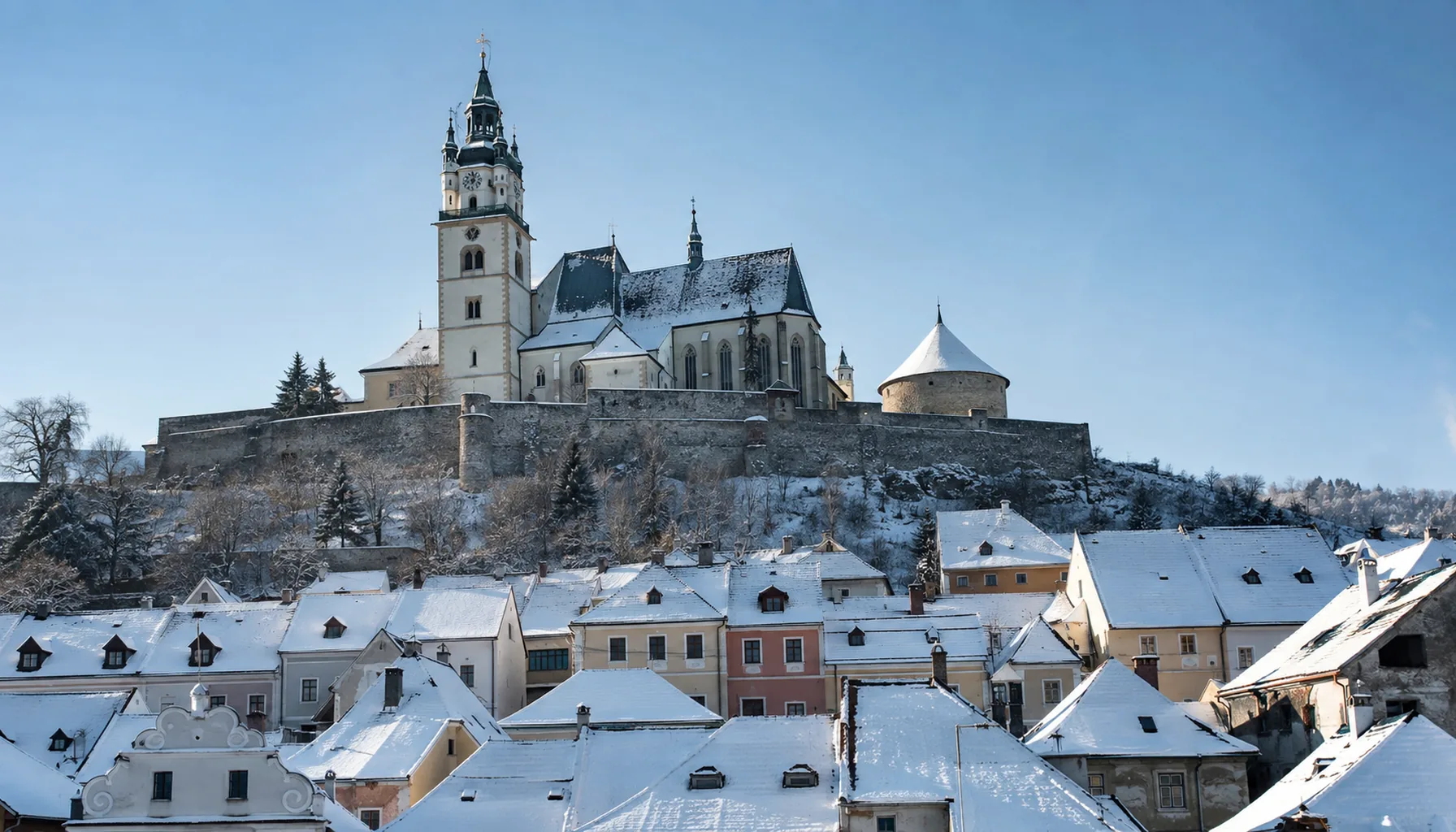
Kremnica's walled town castle above the square, with the Gothic Church of St Catherine and the round charnel chapel inside its precinct
Kremnica's walled town castle above the square, with the Gothic Church of St Catherine and the round charnel chapel inside its precinct.Opevnený mestský hrad v Kremnici nad námestím, s gotickým Kostolom svätej Kataríny a okrúhlou kostnicou vo vnútri areálu.

The year in KremnicaRok v Kremnici

For several days in late summer the square is taken over by the town's festival of humour and satire, which has run since the early 1980s and is the one week of the year when a town of a few thousand people has a national audience. It uses the square, the courtyards and the halls rather than a single venue.Na niekoľko dní v neskorom lete obsadí námestie mestský festival humoru a satiry, ktorý beží od začiatku osemdesiatych rokov a je tým jedným týždňom v roku, keď má niekoľkotisícové mesto celoslovenské publikum. Využíva námestie, dvory a sály namiesto jedného javiska.

The rest of the year belongs to the hills. Skalka, the saddle above the town, is a small ski area in winter and a walking centre otherwise, and a few kilometres up the road the church at Kremnické Bane carries a marker for the geographical centre of Europe — one of several such claims across the continent. Kremnica was granted weekly markets in 1425 and annual fairs in 1695, and the square has been where things happen ever since; what is on in a given season changes, so check the town's own listings.Zvyšok roka patrí kopcom. Skalka, sedlo nad mestom, je v zime malým lyžiarskym strediskom a inak miestom pre turistiku, a pár kilometrov po ceste hore nesie kostolík v Kremnických Baniach značku geografického stredu Európy — jeden z niekoľkých takých nárokov na kontinente. Kremnica dostala týždenné trhy v roku 1425 a výročné jarmoky v roku 1695 a námestie je odvtedy miestom, kde sa veci dejú; čo je práve v tej-ktorej sezóne, sa mení, takže si pozrite mestské oznamy.

Where culture livesKde žije kultúra

The Museum of Coins and Medals, run by the national bank, occupies several of the burgher houses on the square, and it is the natural place to see what the mint actually made. Guided visits to the mint's own historic rooms are sometimes possible but are not a standing public opening; check before counting on it. The castle precinct above the square is the other institution you can walk into: the two-naved Gothic Church of St Catherine, the round charnel chapel beside it, and a climbable tower.Múzeum mincí a medailí, ktoré vedie národná banka, sídli v niekoľkých meštianskych domoch na námestí a je prirodzeným miestom, kde uvidíte, čo mincovňa naozaj razila. Sprevádzané návštevy historických priestorov samotnej mincovne sú niekedy možné, nejde však o stále verejné otvorenie; radšej si to vopred overte. Hradný areál nad námestím je druhou inštitúciou, do ktorej sa dá vojsť: dvojloďový gotický Kostol svätej Kataríny, okrúhla karnerová kaplnka vedľa neho a veža, na ktorú sa dá vystúpiť.

The everyday side is the size of the town, not the size of its history. There is a cultural centre with a hall and a programme, a library and a school of art for children; we name none of them individually, because programmes and premises change faster than a page like this does. Kremnica had about ten thousand people in the 1840s and 4,586 at the end of 2025.Každodenná stránka má veľkosť mesta, nie veľkosť jeho dejín. Je tu kultúrne stredisko so sálou a programom, knižnica a základná umelecká škola; menovite neuvádzame ani jedno, lebo programy a priestory sa menia rýchlejšie než takáto stránka. Kremnica mala v štyridsiatych rokoch 19. storočia asi desaťtisíc obyvateľov a na konci roka 2025 ich mala 4 586.

The buildings that carry itBudovy, ktoré ju nesú

Who built this town is not a mystery. After a Mongol army rode across the kingdom in 1241, King Béla IV began inviting settlers from German-speaking lands, and among them came miners who knew how to follow a vein through hard rock. On 17 November 1328 Charles Robert of Anjou granted the place the rights of a free royal mining and minting town, answerable to the king and to nobody in between. The census of 1880 still counted 8,550 inhabitants, 72 per cent of them German-speaking. That six-hundred-year German town ended in the middle of the twentieth century; the houses it built did not.Kto toto mesto postavil, nie je záhada. Po tom, ako v roku 1241 prešlo kráľovstvom mongolské vojsko, začal kráľ Belo IV. pozývať osadníkov z nemecky hovoriacich krajín, a medzi nimi prišli baníci, ktorí vedeli sledovať žilu v tvrdej hornine. 17. novembra 1328 udelil Karol Róbert z Anjou tomuto miestu práva slobodného kráľovského banského a mincového mesta, podriadeného kráľovi a nikomu medzi tým. Sčítanie v roku 1880 tu ešte napočítalo 8 550 obyvateľov, z toho 72 percent nemecky hovoriacich. Toto šesťsto rokov staré nemecké mesto sa v polovici 20. storočia skončilo; domy, ktoré postavilo, nie.

The castle tells the same story from another angle. It is a walled precinct above the square, and it was not a lord's seat but the townspeople's own strongpoint, with the parish church inside the walls and the date 1488 on its presbytery vault. That is what a free royal mining town looks like when it builds for itself.Hrad rozpráva ten istý príbeh z inej strany. Je to opevnený areál nad námestím a nebol sídlom pána, ale vlastnou pevnosťou mešťanov, s farským kostolom vnútri hradieb a s letopočtom 1488 na klenbe presbytéria. Takto vyzerá slobodné kráľovské banské mesto, keď stavia samo pre seba.

Below it the square holds a run of burgher houses and the plague column raised between 1765 and 1772 — a vow in stone of the kind put up all over central Europe after an epidemic, and a reminder that this was also the town re-Catholicised in 1709 after two centuries as a Lutheran mining town. Walk it with the numbers in mind: the square was built for a place more than twice the size of the one that lives inside it now.Pod ním drží námestie rad meštianskych domov a morový stĺp postavený v rokoch 1765 – 1772 — sľub v kameni, aké sa po epidémiách stavali po celej strednej Európe, a pripomienka toho, že toto mesto bolo v roku 1709 po dvoch storočiach ako luteránske banské mesto rekatolizované. Prejdite ho s číslami v hlave: námestie bolo postavené pre mesto viac než dvakrát väčšie, než je to, ktoré v ňom dnes žije.

Seven centuries of strikingSedem storočí razby

The mint was founded in the same act that made the town, and in 1331 Kremnica became the seat of the chamber count, the royal official who ran mines, smelters and mint together. From 1335 it struck gold florins copied from the coins of Florence — the pieces later known as Kremnica ducats. Their gold was 0.990 pure, one grain better than the rest of Europe's mints managed, which is exactly why a merchant in Venice or Nuremberg would take one without weighing it.Mincovňa vznikla tým istým aktom, ktorý urobil mesto, a v roku 1331 sa Kremnica stala sídlom komorského grófa, kráľovského úradníka, ktorý riadil bane, huty aj mincovňu spolu. Od roku 1335 razila zlaté floreny podľa florentských mincí — kusy neskôr známe ako kremnické dukáty. Ich zlato malo rýdzosť 0,990, o jeden grán lepšie, než dokázali ostatné európske mincovne, a práve preto obchodník v Benátkach alebo Norimbergu prijal takú mincu bez váženia.

Kremnica introduced the screw press, which stamped a coin with one swing of a heavy weighted arm, and Prague and Vienna copied it afterwards. The mines ran out — the last gold was taken in 1970 — and the mint outlived them. From 1918 until the end of the common state it was the only mint Czechoslovakia had; it began striking coins for the new Slovak Republic on 23 January 1993 and was certified to strike euro coins in 2008. That is nearly seven centuries without a break, which is why it is called the oldest working mint in the world.Kremnica zaviedla vretenový lis, ktorý vyrazil mincu jediným švihom ťažkého závažného ramena, a Praha a Viedeň ho potom prevzali. Bane sa vyčerpali — posledné zlato vyviezli v roku 1970 — a mincovňa ich prežila. Od roku 1918 až do konca spoločného štátu bola jedinou mincovňou, akú Československo malo; mince novej Slovenskej republiky začala raziť 23. januára 1993 a v roku 2008 získala certifikáciu na razbu eurových mincí. Je to takmer sedemsto rokov bez prerušenia, a preto sa o nej hovorí ako o najstaršej fungujúcej mincovni na svete.

← Kremnica← Kremnica

WatchPozrite si

Sixteen videos for Culture in Kremnica.Šestnásť videí — Kultúra v Kremnici.