Banská Bystrica region · TownsBanskobystrický kraj · Mestá
FiľakovoFiľakovo
A Novohrad border town under a castle rock of volcanic basalt — the fortress that fell to the Ottomans in 1554 and was the seat of a sanjak for thirty-nine years, with a mostly Hungarian-speaking town below it.Novohradské pohraničné mesto pod hradnou skalou zo sopečného čadiča — pevnosť, ktorá v roku 1554 padla do osmanských rúk a tridsaťdeväť rokov bola sídlom sandžaku, s prevažne maďarsky hovoriacim mestom pod ňou.
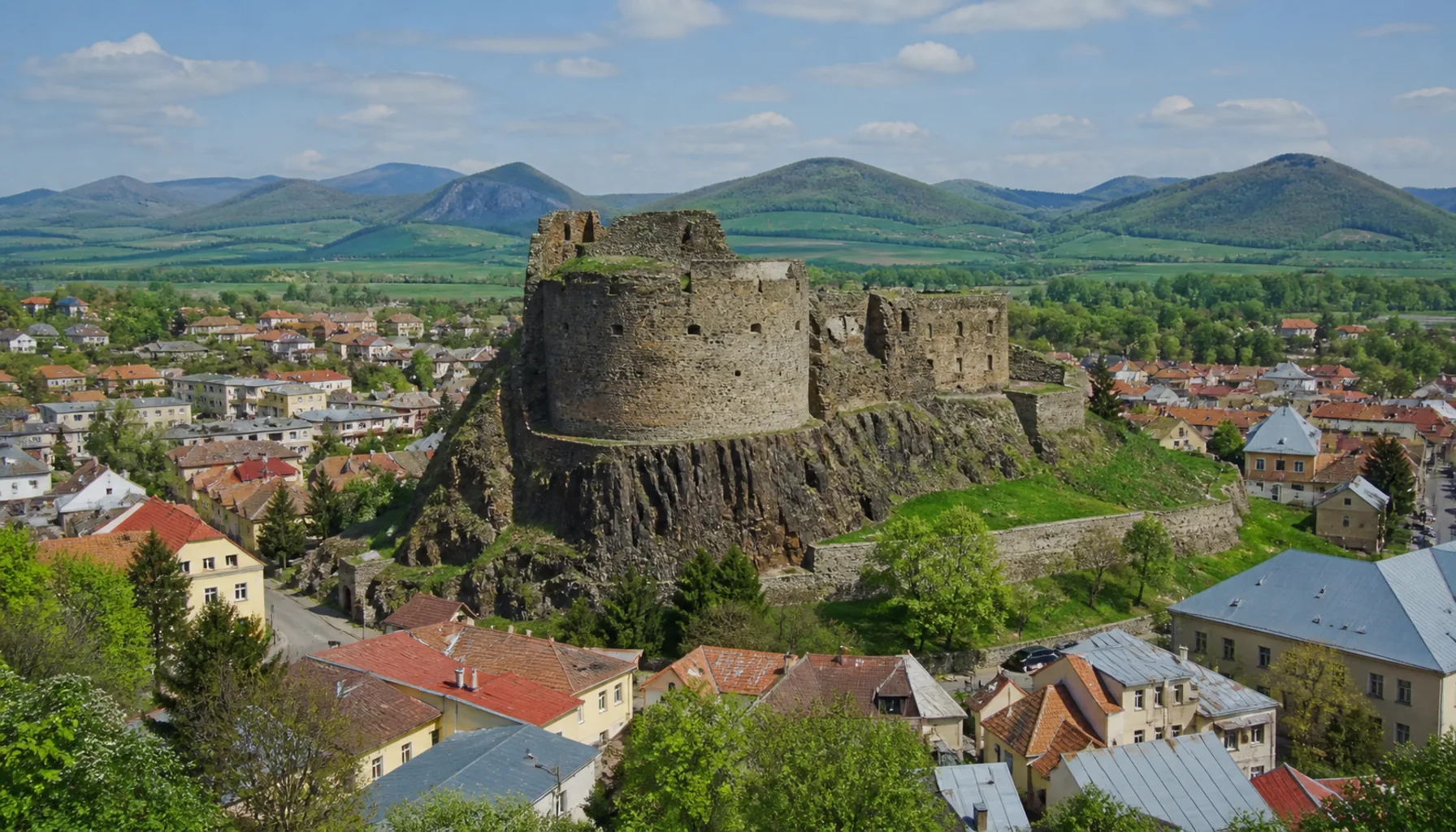
The castle rock of Fiľakovo standing in the middle of the town, its round bastion above the roofsHradná skala vo Fiľakove uprostred mesta, okrúhla bašta nad strechami
Where it standsKde leží
Fiľakovo lies in the south of Novohrad, close to the Hungarian border and about twenty kilometres east of Lučenec. The country is volcanic: basalt and tuff hills scattered across a warm, low landscape, and the castle rock in the middle of the town is one of those volcanic necks, standing above the roofs with cliffs on three sides.Fiľakovo leží na juhu Novohradu, blízko maďarskej hranice, asi dvadsať kilometrov východne od Lučenca. Krajina je sopečná: čadičové a tufové kopce roztrúsené v teplej nížinatej krajine — a hradná skala uprostred mesta je jedným z takých sopečných krkov, dvíha sa nad strechami a z troch strán ju uzatvárajú bralá.
The town has a Hungarian-speaking majority, and the border crossing towards Salgótarján and the Hungarian side of Nógrád is a few minutes away.Mesto má maďarsky hovoriacu väčšinu a hraničný prechod smerom na Salgótarján a na maďarskú stranu Novohradu je odtiaľto pár minút.
The storyHistória
The castle is recorded from the thirteenth century, but its importance came with the Ottoman conquest of central Hungary in the 1540s, which pushed a war frontier past its walls. It fell in 1554 and became the seat of an Ottoman sanjak — a province with a governor, a garrison and a tax administration — for thirty-nine years, until imperial forces took it back in 1593. The kuruc troops of Imrich Thököly took it a last time in 1682, and this time the walls were pulled down rather than repaired.Hrad je doložený od trinásteho storočia, no dôležitým sa stal až s osmanským dobytím stredu Uhorska v štyridsiatych rokoch šestnásteho storočia, ktoré posunulo vojnovú hranicu tesne popod jeho múry. V roku 1554 padol a na tridsaťdeväť rokov sa stal sídlom osmanského sandžaku — provincie s miestodržiteľom, posádkou a daňovou správou — kým ho v roku 1593 cisárske vojská nezískali späť. Naposledy ho v roku 1682 dobyli kurucké vojská Imricha Tökölyho a hradby vtedy neopravili, ale zbúrali.
The town beneath it recovered slowly. A Franciscan monastery was founded here after the wars, the county administration moved on to Lučenec, and Fiľakovo settled into being a market town — until the nineteenth and twentieth centuries turned it into a factory town instead.Mesto pod hradom sa spamätávalo pomaly. Po vojnách tu založili františkánsky kláštor, stoličná správa sa presťahovala do Lučenca a Fiľakovo sa ustálilo ako trhové mestečko — kým z neho devätnáste a dvadsiate storočie neurobilo mesto tovární.
What to seeČo vidieť
The castle is climbed from the middle of the town in a few minutes. What survives is the outline of the fortifications and one substantial piece: the great round Bebek bastion, which now holds the castle museum's collections. From the top the whole basin is visible, which is the point of the place and always was.Na hrad sa z centra mesta vyjde za pár minút. Zachoval sa obrys opevnenia a jeden výrazný kus: veľká okrúhla Bebekova bašta, v ktorej dnes sídlia zbierky hradného múzea. Zhora vidno celú kotlinu — a práve o to tu vždy išlo.
Below the rock the town is modest: the Franciscan church and monastery, a small centre and the museum's town collections. What makes a day of it is the country around — Šomoška on the border, with its fan of columnar basalt and the ruin above it, the volcanic hills of the Cerová vrchovina, and the castles of Divín and Modrý Kameň west along the old frontier.Pod skalou je mesto skromné: františkánsky kostol s kláštorom, malé centrum a mestské zbierky múzea. Celý deň z toho urobí až okolie — Šomoška na hranici s vejárom čadičových stĺpov a zrúcaninou nad ním, sopečné kopce Cerovej vrchoviny a hrady Divín a Modrý Kameň na západ pozdĺž starej hranice.
Work and industryPráca a priemysel
For most of the twentieth century Fiľakovo lived off a large metalworking and enamelware plant that made stoves and enamelled kitchen goods and employed much of the town. It did not come through the 1990s intact, and the town has been rebuilding since on smaller manufacturing, food processing and cross-border trade.Väčšinu dvadsiateho storočia žilo Fiľakovo z veľkého kovospracujúceho a smaltovníckeho závodu, ktorý vyrábal sporáky a smaltovaný kuchynský tovar a zamestnával podstatnú časť mesta. Deväťdesiate roky neprežil nepoškodený a mesto odvtedy stavia znovu na menšej výrobe, potravinárstve a cezhraničnom obchode.
Unemployment here is higher than the national average, and a good deal of the local workforce commutes to Lučenec or across the border.Nezamestnanosť je tu vyššia než celoštátny priemer a nemalá časť miestnych dochádza za prácou do Lučenca alebo cez hranicu.
Getting thereAko sa tam dostať
Fiľakovo is a railway junction on the Zvolen–Košice line, with a branch running south across the border towards Salgótarján; trains and buses both reach Lučenec in a few minutes. By car it is on the road east from Lučenec towards Rimavská Sobota.Fiľakovo je železničným uzlom na trati Zvolen – Košice, s odbočkou na juh cez hranicu smerom na Salgótarján; vlaky aj autobusy sú v Lučenci za pár minút. Autom leží na ceste z Lučenca na východ smerom na Rimavskú Sobotu.
Explore FiľakovoObjavujte Fiľakovo
Every part of this place with a page of its own.Každá časť tohto miesta, ktorá má vlastnú stránku.