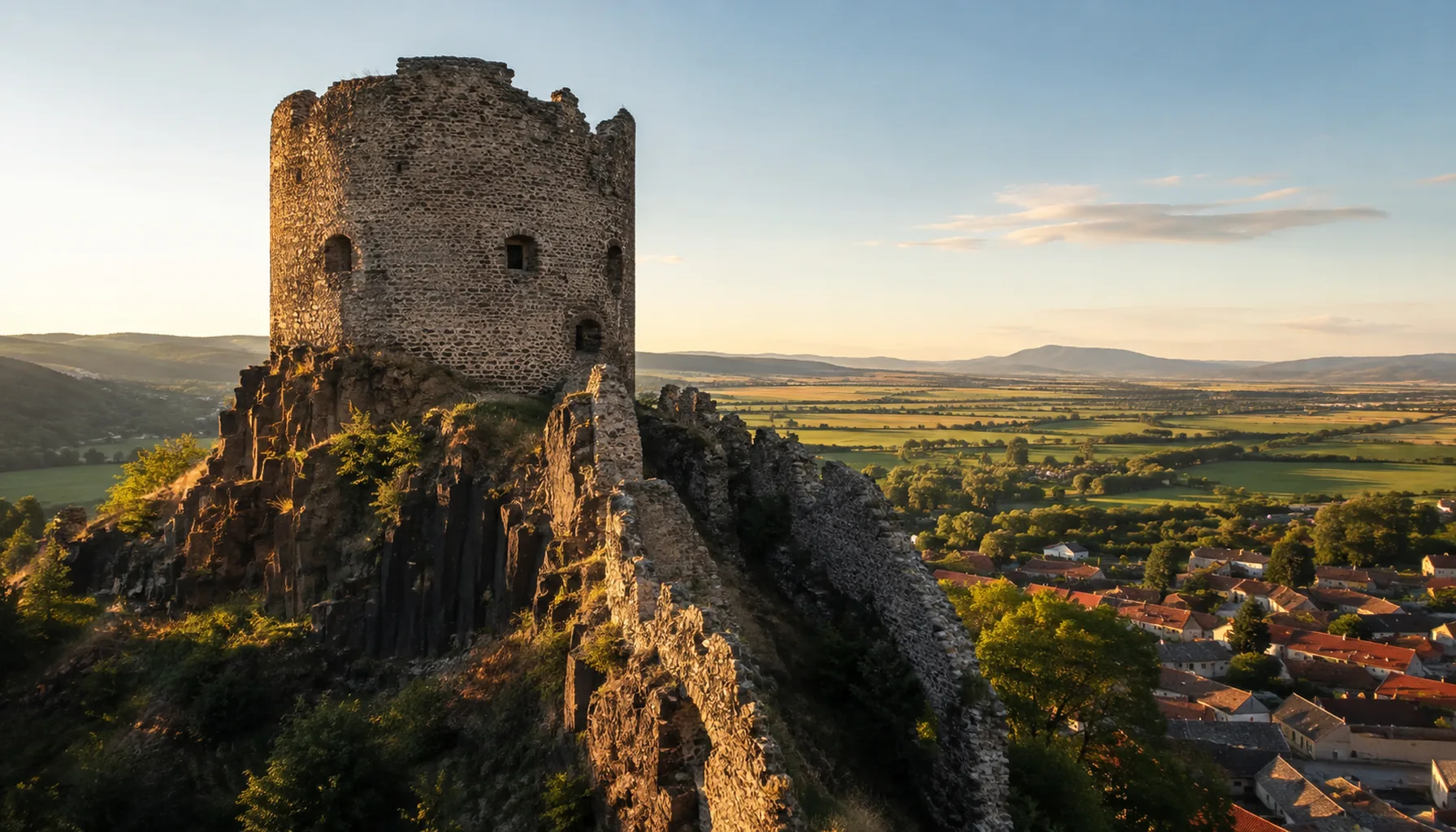
A museum in the one surviving bastion, a Franciscan church rebuilt after the wars, and a market town that has held its fairs since 1423.Múzeum v jedinej zachovanej bašte, františkánsky kostol obnovený po vojnách a trhové mesto, ktoré má jarmočné právo od roku 1423.
The round Bebek bastion on Fiľakovo's basalt castle rock, the largest surviving piece of the fortress, standing over the roofs of the town.Okrúhla Bebekova bašta na fiľakovskej čadičovej hradnej skale — najväčší zachovaný kus pevnosti — sa dvíha nad strechami mesta.
The year in FiľakovoRok vo Fiľakove
Fiľakovo was granted municipal privileges in 1423 — the right to hold markets and to run its own affairs — and the market outlasted everything else that happened here. What the town keeps now is the ordinary calendar of a Slovak district town: market days, church feasts, school events and a summer programme built around the castle. We name no individual event, because a page like this outlives them; the town hall and the castle museum both publish what is on.Fiľakovo získalo mestské výsady v roku 1423 — právo držať trhy a spravovať si vlastné veci — a trh prežil všetko ostatné, čo sa tu odohralo. Dnes si mesto drží obvyklý kalendár slovenského okresného mesta: trhové dni, cirkevné sviatky, školské podujatia a letný program postavený okolo hradu. Jednotlivé akcie tu nemenujeme, lebo takáto stránka ich prežije; mestský úrad aj hradné múzeum zverejňujú, čo sa chystá.
The castle rock is the town's stage as much as its monument. It is climbed from the middle of the town in a few minutes, the ground inside the fortifications is open, and the view from the top takes in the whole basin. Most of what the town puts on out of doors in summer ends up here.Hradné bralo je pre mesto javiskom rovnako ako pamiatkou. Vystúpi sa naň zo stredu mesta za pár minút, plocha vo vnútri opevnenia je prístupná a výhľad z vrchu obsiahne celú kotlinu. Väčšina toho, čo mesto v lete usporiada vonku, skončí tu.
The border is minutes away, and since Slovakia and Hungary both joined the European Union in 2004 and the Schengen area in 2007 it has been a road sign rather than a frontier. Salgótarján, the industrial town Fiľakovo traded with for centuries before the border of 1920 was drawn between them, is close enough that audiences and performers move both ways.Hranica je odtiaľto pár minút a odkedy Slovensko aj Maďarsko vstúpili v roku 2004 do Európskej únie a v roku 2007 do schengenského priestoru, je z nej dopravná značka. Salgótarján, priemyselné mesto, s ktorým Fiľakovo obchodovalo stáročia predtým, než medzi ne v roku 1920 padla hranica, je dosť blízko na to, aby publikum aj účinkujúci chodili sem i tam.
Where culture livesKde žije kultúra
The castle museum is the institution that carries Fiľakovo. Its collections sit in the great round Bebek bastion — the one substantial piece of the fortress still standing, where a museum opened in 2008 — and its town collections are shown below the rock. It works in both of the languages spoken in the town, which is simply what a museum here has to do to be understood.Inštitúciou, ktorá Fiľakovo nesie, je hradné múzeum. Zbierky má vo veľkej okrúhlej Bebekovej bašte — jedinom väčšom zachovanom kuse pevnosti, kde múzeum otvorili v roku 2008 — a mestské zbierky vystavuje dole pod bralom. Pracuje v oboch jazykoch, ktorými sa v meste hovorí; inak by mu tu jednoducho nerozumeli.
Beyond it the town has what a district town of this size has: a cultural centre with a hall and a programme, a library, amateur choirs and folk groups, and a school of art for children. We name none of them individually, because programmes and premises change faster than a page like this does. There is no resident theatre company and no gallery of national standing; for a bigger programme the town looks to Lučenec, twenty kilometres west.Okrem neho má mesto to, čo mávajú okresné mestá jeho veľkosti: kultúrny dom so sálou a programom, knižnicu, amatérske spevácke zbory a folklórne skupiny a základnú umeleckú školu. Menovite tu neuvádzame ani jedno, lebo programy a priestory sa menia rýchlejšie než takáto stránka. Stále divadlo ani galéria celoštátneho významu tu nie sú; za väčším programom sa chodí do Lučenca dvadsať kilometrov na západ.
The buildings that carry itBudovy, ktoré ju nesú
The castle is named in a document of 1242 and the town below it four years later, in 1246, as Filek — and that order explains the place. Nobody chose this spot for its fields; the basalt neck standing alone in the plain was the reason. The fortress fell to the Ottomans on 16 June 1554 and was the seat of a sanjak for thirty-nine years, until imperial forces retook it on 27 November 1593. In September 1682 Thököly's kuruc troops and their Ottoman allies took it a last time, and the walls were then pulled down rather than repaired.Hrad sa spomína v listine z roku 1242 a mesto pod ním o štyri roky neskôr, v roku 1246, ako Filek — a toto poradie vysvetľuje celé miesto. Nikto si tento bod nevybral pre polia; dôvodom bol čadičový suk stojaci osamote v rovine. Pevnosť padla Osmanom 16. júna 1554 a tridsaťdeväť rokov bola sídlom sandžaku, kým ju cisárske vojská 27. novembra 1593 nezískali späť. V septembri 1682 ju naposledy dobyli Thökölyho kuruci so svojimi osmanskými spojencami a múry potom namiesto opravy zbúrali.
The main building of the lower town is the Franciscan church and monastery. The Franciscans had a house here from the early sixteenth century and began rebuilding after the wars in 1694; the church was finished and given its baroque tower in the 1720s. In 1722 Count Štefan Koháry II granted the town a new seal and coat of arms — a small administrative act, and the clearest sign there is that the place was working again.Hlavnou stavbou dolného mesta je františkánsky kostol s kláštorom. Františkáni tu mali dom už od začiatku 16. storočia a po vojnách začali v roku 1694 s obnovou; kostol dokončili a barokovú vežu dostal v dvadsiatych rokoch 18. storočia. V roku 1722 udelil mestu gróf Štefan Koháry II. novú pečať a erb — drobný správny úkon a zároveň najjasnejší doklad toho, že mesto opäť fungovalo.
Two manor houses followed, the Berchtold house in 1830 and the Cebrián house in 1847, and they tell you who owned the land: noble families with estates, and villages of tenants who owed them labour until 1848 ended the obligation. The last set piece is the Art Nouveau town hall of 1911–12, built when the railway junction and the new factory had made the town prosperous.Nasledovali dva kaštiele, Berchtoldovský z roku 1830 a Cebriánovský z roku 1847, a povedia vám, komu patrila pôda: šľachtickým rodinám s majetkami a dedinám poddaných, ktorí im boli povinní robotou, kým to rok 1848 nezrušil. Posledným výrazným kusom je secesná radnica z rokov 1911 – 1912, postavená v čase, keď železničný uzol a nová fabrika priniesli mestu blahobyt.
Enamel, and the town a factory madeSmalt a mesto, ktoré urobila fabrika
In 1908, once the line up from Salgótarján met the Zvolen–Košice route and made Fiľakovo a junction, an enamelware and stove works was founded here. It made stoves and enamelled kitchen goods, and for most of the next century it was the town's living. Under communism it was nationalised and enlarged until it employed a large part of the town.V roku 1908, keď sa trať od Salgótarjánu stretla s traťou Zvolen – Košice a z Fiľakova sa stal uzol, tu založili smaltovňu a továreň na sporáky. Vyrábala kachle, sporáky a smaltovaný kuchynský riad a väčšinu nasledujúceho storočia bola obživou mesta. Za socializmu podnik znárodnili a rozšírili, až zamestnával veľkú časť mesta.
Fiľakovo in those decades was a factory with a town attached — one big employer, one pay day, one set of prospects for a school-leaver — and that shapes how the place looks more than all of its baroque does. The plant did not come through the change to a market economy intact, and the town has been rebuilding since on smaller manufacturing, food processing and cross-border trade. An account of Fiľakovo that stops in 1682 has missed half of it.Fiľakovo bolo v tých desaťročiach fabrikou s pripojeným mestom — jeden veľký zamestnávateľ, jedna výplata, jedna perspektíva pre absolventa školy — a formuje to podobu mesta viac než všetok jeho barok. Zmenu na trhovú ekonomiku podnik neprežil v celku a mesto odvtedy stavia na menšej výrobe, potravinárstve a cezhraničnom obchode. Rozprávanie o Fiľakove, ktoré sa končí rokom 1682, vynechalo polovicu.