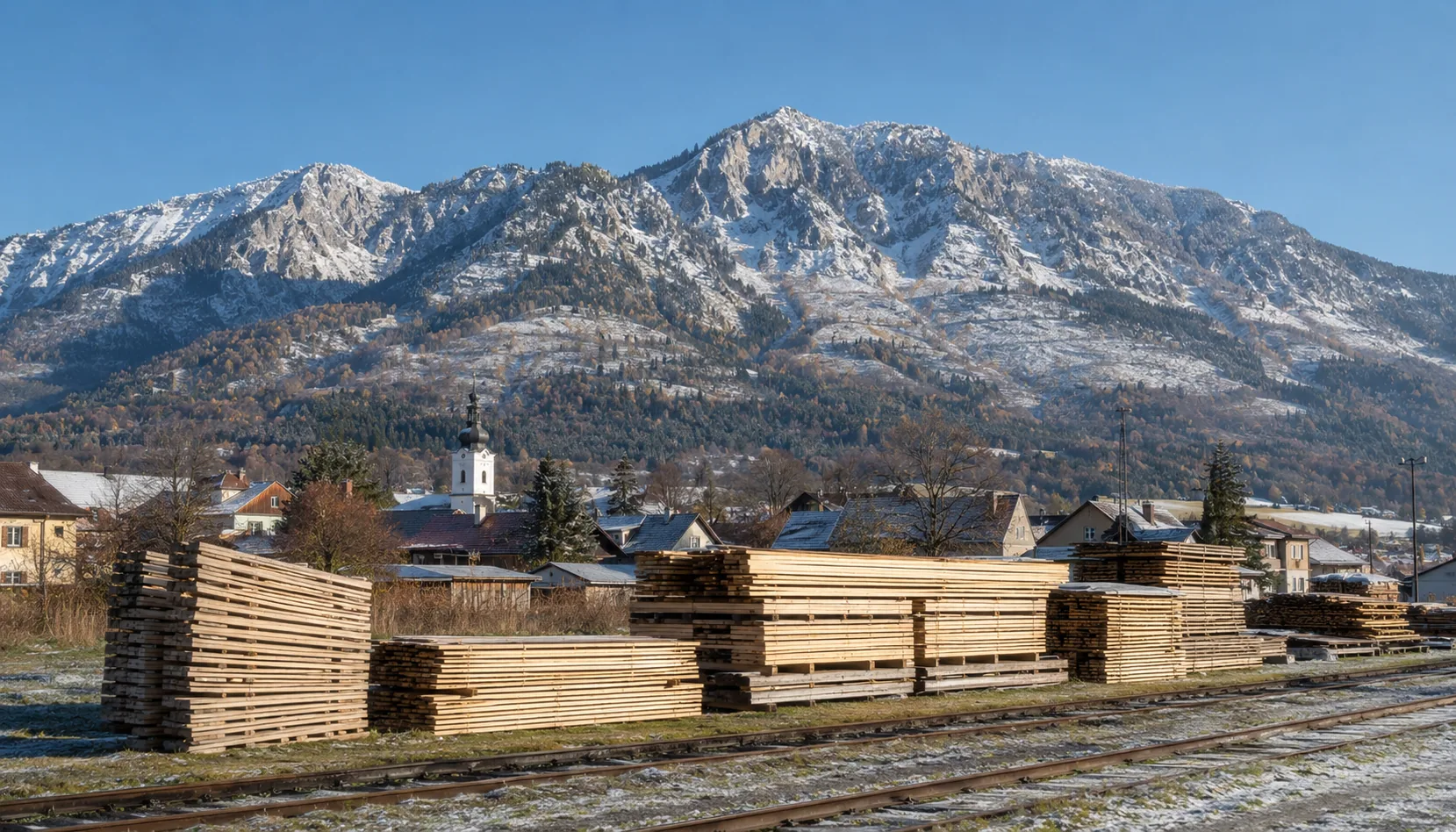
A timber town at the north-eastern corner of the Turiec basin, where the Váh comes in under the rock ridge of the Malá Fatra — sawmills on the valley floor, and one of the eastern ways onto the range's main ridge.Drevárske mesto v severovýchodnom kúte Turčianskej kotliny, tam, kde Váh vteká pod skalný hrebeň Malej Fatry — píly na dne doliny a jedna z východných ciest na hlavný hrebeň pohoria.
Timber yards at Turany under the ridge of the Krivánska Malá FatraSklady reziva v Turanoch pod hrebeňom Krivánskej Malej Fatry
Where it standsKde leží
Turany lies on the Váh at the north-eastern corner of the Turiec basin, about fifteen kilometres up the river from Martin. The Krivánska group of the Malá Fatra rises directly north of the town — the rockier half of that range, its main ridge running just above seventeen hundred metres at Veľký Kriváň — while the Veľká Fatra closes the basin to the south and east.Turany ležia na Váhu v severovýchodnom kúte Turčianskej kotliny, asi pätnásť kilometrov proti prúdu od Martina. Priamo na sever od mesta sa dvíha Krivánska Malá Fatra — skalnatejšia polovica pohoria, ktorej hlavný hrebeň vystupuje na Veľkom Kriváni tesne nad 1 700 metrov — a na juhu a východe kotlinu uzatvára Veľká Fatra.
A few kilometres upstream the Orava comes down out of its own country to join the Váh at Kraľovany; a few kilometres downstream the river reaches Sučany and Vrútky and then turns north-west into the Strečno gorge. Turany sits in the open stretch between the two.Pár kilometrov proti prúdu sa pri Kraľovanoch vlieva do Váhu Orava, ktorá sem prichádza z vlastného kraja; pár kilometrov po prúde rieka dosiahne Sučany a Vrútky a potom sa stáča na severozápad do Strečnianskej tiesňavy. Turany ležia v otvorenom úseku medzi nimi.
The storyHistória
Turany is an old settlement of the Turiec, recorded in the Middle Ages and holding market privileges for much of its history — the status Slovak calls a mestečko, a market town rather than a royal free city. The basin around it was county country, administered from Sklabiňa Castle on the western side, and unusually thick with petty nobility: whole villages here belonged to families of minor gentry rather than to magnates.Turany sú starým sídlom Turca, doloženým v stredoveku a po väčšinu svojich dejín s trhovými výsadami — teda mestečkom, nie slobodným kráľovským mestom. Kotlina okolo nich bola stoličným krajom spravovaným z hradu Sklabiňa na západnej strane a nezvyčajne husto osídleným drobnou šľachtou: celé dediny tu patrili zemianskym rodinám, nie veľmožom.
Wood made the town. The forests of the Malá Fatra come down to the valley here and the Váh was the road out: timber was floated downstream to the mills and on towards the lowland, and rafting on this stretch of the river was a trade of its own until the railway and then the dams ended it. Sawmilling replaced floating and stayed.Mesto vyrástlo na dreve. Lesy Malej Fatry tu zostupujú až do doliny a Váh bol cestou von: drevo sa splavovalo k pílam a ďalej do nížiny a pltníctvo bolo na tomto úseku rieky samostatným remeslom, kým ho neukončila železnica a potom priehrady. Píliarstvo vystriedalo splavovanie a zostalo tu.
The Košice–Bohumín railway came through in the early 1870s, putting the town on the trunk line between Žilina and the east and giving the timber trade a way to move in quantity. In the autumn of 1944 the Turiec was insurgent territory during the Slovak National Uprising, and the fighting for the basin came up this stretch of the Váh.Košicko-bohumínska železnica sem prišla začiatkom 70. rokov 19. storočia, položila mesto na hlavnú trať medzi Žilinou a východom a dala obchodu s drevom možnosť voziť vo veľkom. Na jeseň 1944 bol Turiec povstaleckým územím Slovenského národného povstania a boje o kotlinu prišli aj sem, proti prúdu Váhu.
What to seeČo vidieť
Turany is a working town rather than a monument town, and the honest answer is that the reason to stop is the mountain behind it. Marked paths climb north out of the town into the Krivánska Malá Fatra and up to the main ridge — the eastern approach to a range most walkers enter from the Vrátna valley on the far side. It is longer, quieter and steeper, and best begun early.Turany sú pracovným, nie pamiatkovým mestom, a poctivá odpoveď znie, že dôvodom zastaviť sa tu je hora za nimi. Značené chodníky stúpajú z mesta na sever do Krivánskej Malej Fatry až na hlavný hrebeň — je to východný prístup do pohoria, do ktorého väčšina turistov vchádza z Vrátnej doliny na druhej strane. Je dlhší, tichší a strmší a najlepšie je začať zavčasu.
The next valley upstream, at Šútovo, holds the tallest waterfall in the Malá Fatra and a gorge path up to it; Kraľovany, where the Orava joins, is the way into Orava itself. In the other direction the basin opens towards Martin, its National Cemetery and the Museum of the Slovak Village, and towards the ruined castle at Sklabiňa.Najbližšia dolina proti prúdu, pri Šútove, ukrýva najvyšší vodopád Malej Fatry a tiesňavu s chodníkom k nemu; Kraľovany, kde sa vlieva Orava, sú vstupom do samotnej Oravy. Na druhú stranu sa kotlina otvára k Martinu s Národným cintorínom a Múzeom slovenskej dediny a k zrúcanine hradu Sklabiňa.
In the town itself there is the long main street, the parish church and the older log outbuildings that survive behind newer houses. The Turiec building tradition was a wooden one, and here it survives in fragments rather than as a preserved ensemble — which is worth knowing before you go looking for one.V samotnom meste je to dlhá hlavná ulica, farský kostol a staršie zrubové hospodárske stavby, ktoré prežili za novšími domami. Stavebná tradícia Turca bola drevená a zachovala sa tu skôr v útržkoch než ako súvislý pamiatkový celok — čo je dobré vedieť skôr, než ho začnete hľadať.
Work and industryPráca a priemysel
Wood is still the trade. Sawmilling and wood processing have been the town's largest industry for well over a century, working timber cut in the Malá Fatra and the Veľká Fatra, and the timber yards beside the railway are the first thing a passing train shows of the place. Joinery, pallet and building-timber firms sit around the main plant.Drevo je tu remeslom stále. Píliarstvo a drevospracovanie sú najväčším priemyslom mesta už vyše storočia a spracúvajú drevo vyťažené v Malej i Veľkej Fatre; sklady reziva pri železnici sú prvé, čo z mesta uvidí prechádzajúci vlak. Okolo hlavného závodu pôsobia stolárske firmy a výrobcovia paliet a stavebného reziva.
Otherwise Turany works the way the whole Turiec does: people commute the short distance to Martin and Vrútky — to the engineering plants, the railway works and the hospital — and forestry and small-scale farming fill in around the edges.Inak Turany fungujú ako celý Turiec: ľudia dochádzajú na krátku vzdialenosť do Martina a Vrútok — do strojární, železničných opravovní a nemocnice — a okraje dopĺňa lesníctvo a drobné hospodárenie.
Getting thereAko sa tam dostať
Turany has a station on the main Žilina–Košice line, though the fast trains run through; local services and buses connect it with Sučany, Vrútky and Martin. By road the D1 comes down the basin from Martin and ends near the town, and the old trunk road up the Váh through Kraľovany carries the traffic on towards Ružomberok — the unbuilt section between them is one of the longest-running gaps in the Slovak motorway network.Turany majú stanicu na hlavnej trati Žilina – Košice, hoci rýchliky cez ne prechádzajú bez zastavenia; osobné vlaky a autobusy ich spájajú so Sučanmi, Vrútkami a Martinom. Diaľnica D1 prichádza kotlinou od Martina a pri meste sa končí; ďalej vedie dopravu stará cesta hore Váhom cez Kraľovany na Ružomberok — nepostavený úsek medzi nimi patrí k najdlhšie otvoreným medzerám slovenskej diaľničnej siete.
Explore TuranyObjavujte Turany
Every part of this place with a page of its own.Každá časť tohto miesta, ktorá má vlastnú stránku.