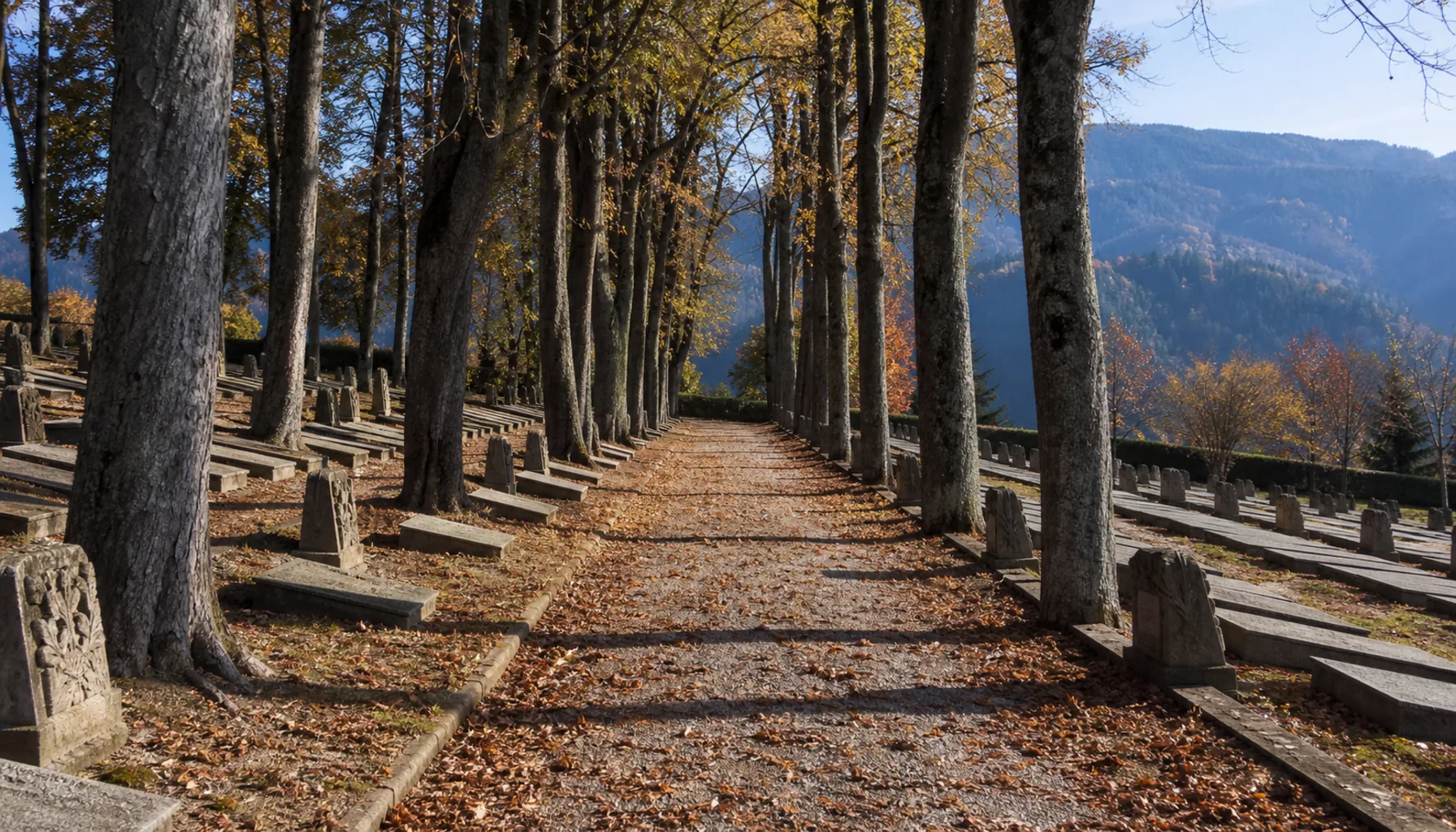
The chief town of the Turiec basin and the address Slovak national culture chose for itself: Matica slovenská, the Slovak National Library, the National Cemetery, and the country's largest open-air museum on the wooded edge of town.Hlavné mesto Turčianskej kotliny a adresa, ktorú si zvolila slovenská národná kultúra: Matica slovenská, Slovenská národná knižnica, Národný cintorín a najväčší skanzen v krajine na zalesnenom okraji mesta.
The tree-lined avenue of the National Cemetery in MartinStromoradie na Národnom cintoríne v Martine
Where it standsKde leží
Martin lies in the Turiec basin with a mountain range on either side — the Malá Fatra to the west, the Veľká Fatra to the east — on the river Turiec a short way above its confluence with the Váh. Directly above the town rise the Martinské hole, bare grassy ridges reaching about 1,400 metres, which serve as the town's own ski slopes and explain how quickly the weather here can turn.Martin leží v Turčianskej kotline s pohorím na oboch stranách — Malou Fatrou na západe a Veľkou Fatrou na východe — na rieke Turiec kúsok nad jej sútokom s Váhom. Priamo nad mestom sa dvíhajú Martinské hole, holé trávnaté hrebene dosahujúce približne 1 400 metrov, ktoré slúžia ako mestské lyžiarske svahy a vysvetľujú, ako rýchlo sa tu vie obrátiť počasie.
Vrútky, the railway town at the northern end of the basin, is effectively Martin's neighbour and its junction. Until the middle of the twentieth century the town was called Turčiansky Svätý Martin, and that longer name is the one on every nineteenth-century document about it.Vrútky, železničiarske mesto na severnom konci kotliny, sú v podstate susedom Martina a jeho uzlom. Do polovice dvadsiateho storočia sa mesto volalo Turčiansky Svätý Martin a práve tento dlhší názov nesie každý dokument o ňom z devätnásteho storočia.
The storyHistória
Martin grew as the market town of a basin unusually full of small noble families: Turiec had one of the largest populations of petty gentry in the kingdom, and the county's own seat was the castle at Sklabiňa in the hills to the north-east. The town took over the county's administrative business as the castle declined.Martin rástol ako trhové mesto kotliny nezvyčajne plnej drobných šľachtických rodín: Turiec mal jednu z najpočetnejších vrstiev zemianstva v krajine a sídlom stolice bol hrad Sklabiňa v kopcoch na severovýchode. Ako hrad upadal, správnu agendu stolice prevzalo mesto.
Two nineteenth-century meetings decided what the town would become. The Memorandum of the Slovak Nation was adopted here on 6 and 7 June 1861, demanding recognition of the Slovaks as a nation and Slovak schools and administration; Matica slovenská, the national cultural institution, followed on 4 August 1863, financed partly by public collections. The Hungarian government banned it in 1875 and confiscated its property, and it could not reopen until after the First World War.O tom, čím sa mesto stane, rozhodli dve zhromaždenia z devätnásteho storočia. 6. a 7. júna 1861 tu prijali Memorandum národa slovenského, ktoré žiadalo uznanie Slovákov za národ a slovenské školy i úrady; 4. augusta 1863 nasledovala Matica slovenská, národná kultúrna ustanovizeň, sčasti financovaná z verejných zbierok. Uhorská vláda ju v roku 1875 zakázala a majetok jej zhabala; obnoviť sa mohla až po prvej svetovej vojne.
On 30 October 1918, before news of the proclamation in Prague had reached them, delegates meeting in Martin adopted the Declaration of the Slovak Nation, committing the Slovaks to the new Czechoslovak state. A law of 1994 formally named the town the centre of national culture of the Slovaks — a title no other Slovak town holds.30. októbra 1918, skôr než k nim dorazila správa o vyhlásení v Prahe, prijali delegáti zhromaždení v Martine Deklaráciu slovenského národa, ktorou sa Slováci prihlásili k novému česko-slovenskému štátu. Zákon z roku 1994 mesto formálne označil za centrum národnej kultúry Slovákov — titul, aký nemá nijaké iné slovenské mesto.
What to seeČo vidieť
The Slovak National Library, which holds the national written heritage, and the buildings of Matica slovenská are the institutional core. So is the National Cemetery, a protected national cultural monument where a very large share of the country's writers, scholars and public figures lie under a single avenue of trees; it is a quieter and more affecting place than its reputation suggests.Inštitucionálnym jadrom sú Slovenská národná knižnica, ktorá spravuje národné písomné dedičstvo, a budovy Matice slovenskej. Patrí sem aj Národný cintorín, chránená národná kultúrna pamiatka, kde pod jedinou alejou stromov leží veľmi veľká časť spisovateľov, vedcov a verejných osobností krajiny; je to tichšie a silnejšie miesto, než by sa podľa jeho povesti čakalo.
On the edge of town at Jahodnícke háje stands the Museum of the Slovak Village, the largest open-air museum in Slovakia — whole log farmsteads carried here from Turiec, Orava, Liptov and the Kysuce and rebuilt on a wooded hillside. The ethnographic collections of the Slovak National Museum are in the town itself, and the Slovak Chamber Theatre keeps a professional stage here.Na okraji mesta v Jahodníckych hájoch stojí Múzeum slovenskej dediny, najväčší skanzen na Slovensku — celé zrubové usadlosti prenesené sem z Turca, Oravy, Liptova a Kysúc a znovu poskladané na zalesnenom svahu. V samotnom meste sídlia národopisné zbierky Slovenského národného múzea a Slovenské komorné divadlo tu udržiava profesionálnu scénu.
Outside the town the walking is immediate. The Martinské hole are reached on foot from the last streets; the Gaderská and Blatnická valleys cut back into Veľká Fatra limestone within half an hour; and the ruin of Sklabiňa, the old county seat, stands in the hills to the north-east.Za mestom sa začína turistika prakticky hneď. Na Martinské hole sa dá vyjsť pešo z posledných ulíc, Gaderská a Blatnická dolina sa do vápenca Veľkej Fatry zarezávajú do polhodiny a v kopcoch na severovýchode stojí zrúcanina Sklabine, niekdajšieho sídla stolice.
Work and industryPráca a priemysel
Engineering is the industrial base. The town's great socialist-era works built heavy machinery and, for two decades, armoured vehicles for the Warsaw Pact; the collapse of that trade after 1989 hit Martin harder than almost any other Slovak town. The site has since become an industrial park shared by engineering firms and automotive suppliers, at a fraction of the old headcount.Priemyselným základom je strojárstvo. Veľký závod zo socialistických čias staval ťažké stroje a dve desaťročia aj obrnenú techniku pre Varšavskú zmluvu; pád tejto výroby po roku 1989 zasiahol Martin tvrdšie než takmer ktorékoľvek iné slovenské mesto. Z areálu sa medzitým stal priemyselný park strojárskych firiem a dodávateľov pre automobilový priemysel, so zlomkom niekdajšieho počtu zamestnancov.
Medicine and the national institutions carry much of the rest. The Jessenius Faculty of Medicine of Comenius University and the university hospital make Martin a training centre for doctors, and the library, the museums and Matica employ a permanent staff of librarians, archivists and curators. Mountain tourism fills in around them.Zvyšok nesie najmä medicína a národné inštitúcie. Jesseniova lekárska fakulta Univerzity Komenského a univerzitná nemocnica robia z Martina vzdelávacie stredisko lekárov a knižnica, múzeá i Matica zamestnávajú stály zbor knihovníkov, archivárov a kurátorov. Okolo toho dopĺňa obraz horský cestovný ruch.
Getting thereAko sa tam dostať
Trains run south from Vrútky through Martin towards Turčianske Teplice and Zvolen; Vrútky itself sits on the main Žilina to Košice line, so most long-distance arrivals change there. By road the town is reached from Žilina through the Strečno gorge, and from the south over the pass from Kremnica.Vlaky idú z Vrútok cez Martin na juh smerom na Turčianske Teplice a Zvolen; samotné Vrútky ležia na hlavnej trati Žilina – Košice, takže väčšina diaľkových spojov vyžaduje prestup práve tam. Autom sa do mesta príde od Žiliny cez strečniansku tiesňavu a z juhu cez sedlo od Kremnice.
Explore MartinObjavujte Martin
Every part of this place with a page of its own.Každá časť tohto miesta, ktorá má vlastnú stránku.