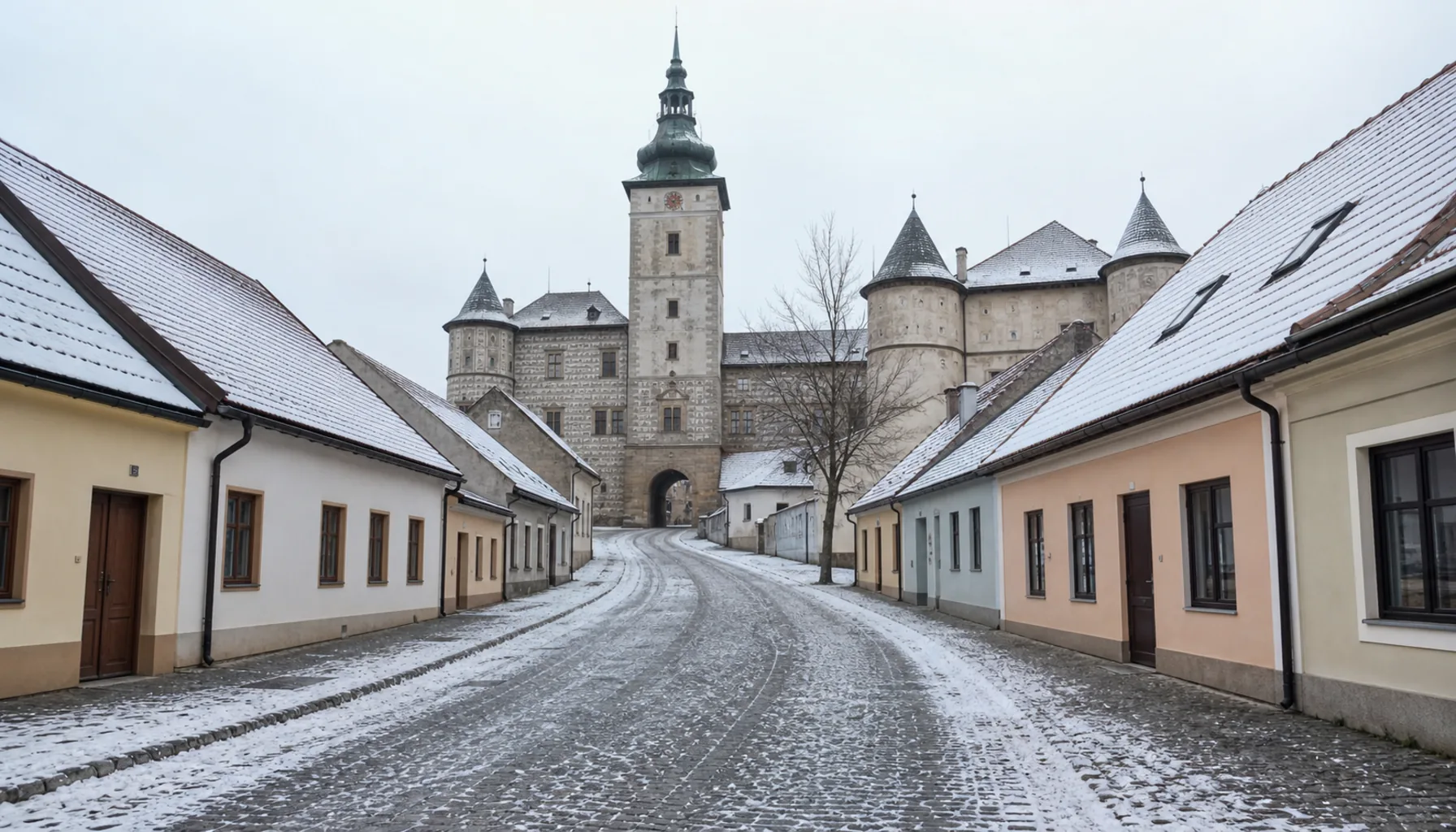
A small town on the Váh built around one of the most complete Renaissance chateaux in Slovakia, and around the free-standing hall of 1601 that the Palatine Juraj Thurzó raised for no other purpose than marrying off his daughters.Malé mesto na Váhu postavené okolo jedného z najucelenejších renesančných sídel na Slovensku a okolo samostatnej sály z roku 1601, ktorú dal palatín Juraj Turzo postaviť s jediným cieľom — vydávať svoje dcéry.
The street front of Bytča with the chateau's gate tower closing the viewUličný front Bytče s vežou zámockej brány uzatvárajúcou pohľad
Where it standsKde leží
Bytča stands on the Váh about twenty kilometres down the valley from Žilina, where the river runs between the Javorníky to the north and the Súľov hills to the south. The valley is narrow enough here that river, road and railway share the floor between them.Bytča leží na Váhu asi dvadsať kilometrov po prúde od Žiliny, kde rieka tečie medzi Javorníkmi na severe a Súľovskými vrchmi na juhu. Dolina je tu taká úzka, že rieka, cesta a železnica si dno delia medzi sebou.
A few kilometres south-east rise the Súľov rocks, a maze of conglomerate towers and gates with a castle ruin standing among them — the best walking within reach of the town, and busy on any fine weekend.Pár kilometrov na juhovýchod sa dvíhajú Súľovské skaly, bludisko zlepencových veží a brán so zrúcaninou hradu medzi nimi — najlepšia turistika na dosah mesta a v každý pekný víkend plná ľudí.
The storyHistória
The town belonged to the estate of its chateau. The Thurzó family acquired Bytča in the sixteenth century and rebuilt the fortified manor into a four-winged Renaissance residence with a tower at each corner and two tiers of arcades running round the inner courtyard — an Italian idea imported wholesale into the upper Váh valley.Mesto patrilo k panstvu svojho zámku. Rod Turzovcov získal Bytču v šestnástom storočí a opevnené sídlo prestaval na štvorkrídlovú renesančnú rezidenciu s vežou na každom nároží a s dvoma poschodiami arkád okolo vnútorného nádvoria — s talianskou myšlienkou prenesenou naraz do hornej doliny Váhu.
Juraj Thurzó, Palatine of Hungary from 1609 until his death in 1616, ran a large part of the kingdom's business from Bytča. It was he who ordered the investigation of Elizabeth Báthory at Čachtice in 1610; the depositions were taken and kept here, and his decision to confine her in her own castle rather than try her publicly is usually read as protecting a great family's name.Juraj Turzo, uhorský palatín od roku 1609 až do svojej smrti v roku 1616, riadil z Bytče veľkú časť agendy kráľovstva. Práve on dal v roku 1610 vyšetriť Alžbetu Bátoriovú na Čachticiach; výpovede svedkov sa zbierali a uchovávali tu a jeho rozhodnutie zavrieť ju na vlastnom hrade namiesto verejného súdu sa zvyčajne vykladá ako ochrana mena veľkého rodu.
For much of the twentieth century the chateau housed the state archive holding the records of the old counties of the upper Váh, which is why generations of Slovak historians knew Bytča as an address long before they knew it as a town.Veľkú časť dvadsiateho storočia sídlil v zámku štátny archív s písomnosťami starých stolíc horného Považia — preto generácie slovenských historikov poznali Bytču ako adresu skôr než ako mesto.
What to seeČo vidieť
The chateau is the reason to stop. From the street it reads as a solid block, and only when you pass under the gate tower does the building explain itself: the courtyard opens and the round-headed arcades run round all four sides, one storey above the other. It is used for exhibitions and events, and access varies — confirm before you travel.Zámok je dôvodom, prečo tu zastaviť. Z ulice pôsobí ako pevný blok a až keď prejdete popod vežu brány, stavba sa vysvetlí sama: otvorí sa nádvorie a polkruhové arkády obiehajú všetky štyri strany, jedno podlažie nad druhým. Slúži na výstavy a podujatia a prístup sa mení — pred cestou si ho overte.
Beside it stands the Wedding Palace, a separate building of 1601: essentially one great hall over a lower storey, its walls once carrying a painted gallery of the family, so that ancestors looked down on each wedding party. Buildings raised for a single family ceremony almost nowhere survive, and this is why Bytča appears in architectural histories at all.Vedľa neho stojí Sobášny palác, samostatná stavba z roku 1601: v podstate jedna veľká sála nad nižším podlažím, na ktorej stenách bola kedysi maľovaná galéria rodu, takže na každú svadobnú spoločnosť hľadeli predkovia. Stavby postavené pre jediný rodinný obrad sa takmer nikde nezachovali — a práve preto sa Bytča vôbec objavuje v dejinách architektúry.
The older streets around the two buildings and the parish church make up the rest of the centre, and the ruin of Hričov castle stands on its rock between Bytča and Žilina.Zvyšok centra tvoria staršie ulice okolo oboch budov a farský kostol a medzi Bytčou a Žilinou stojí na svojej skale zrúcanina Hričovského hradu.
Work and industryPráca a priemysel
Metalworking is the town's industry, and specifically bearings: rolling bearings have been made in Bytča for decades, Kinex Bearings being the best-known name, and the trade belongs to the same Váh valley bearing cluster as Kysucké Nové Mesto and Považská Bystrica.Priemyslom mesta je kovospracovanie, a to konkrétne ložiská: valivé ložiská sa v Bytči vyrábajú už desaťročia, najznámejším menom je Kinex Bearings, a toto remeslo patrí do toho istého považského ložiskového zoskupenia ako Kysucké Nové Mesto a Považská Bystrica.
Woodworking, food processing and construction fill in around it, and a good part of the town commutes — west to Považská Bystrica, east to Žilina and its car plant.Okolo neho stojí drevospracovanie, potravinárstvo a stavebníctvo a značná časť mesta dochádza — na západ do Považskej Bystrice, na východ do Žiliny a jej automobilky.
Getting thereAko sa tam dostať
Bytča is on the main railway and the road along the Váh between Žilina and Považská Bystrica, with the motorway passing just outside the town; local trains from Žilina take about twenty minutes.Bytča leží na hlavnej trati a ceste popri Váhu medzi Žilinou a Považskou Bystricou, diaľnica prechádza tesne za mestom; osobné vlaky zo Žiliny idú približne dvadsať minút.
Explore BytčaObjavujte Bytča
Every part of this place with a page of its own.Každá časť tohto miesta, ktorá má vlastnú stránku.