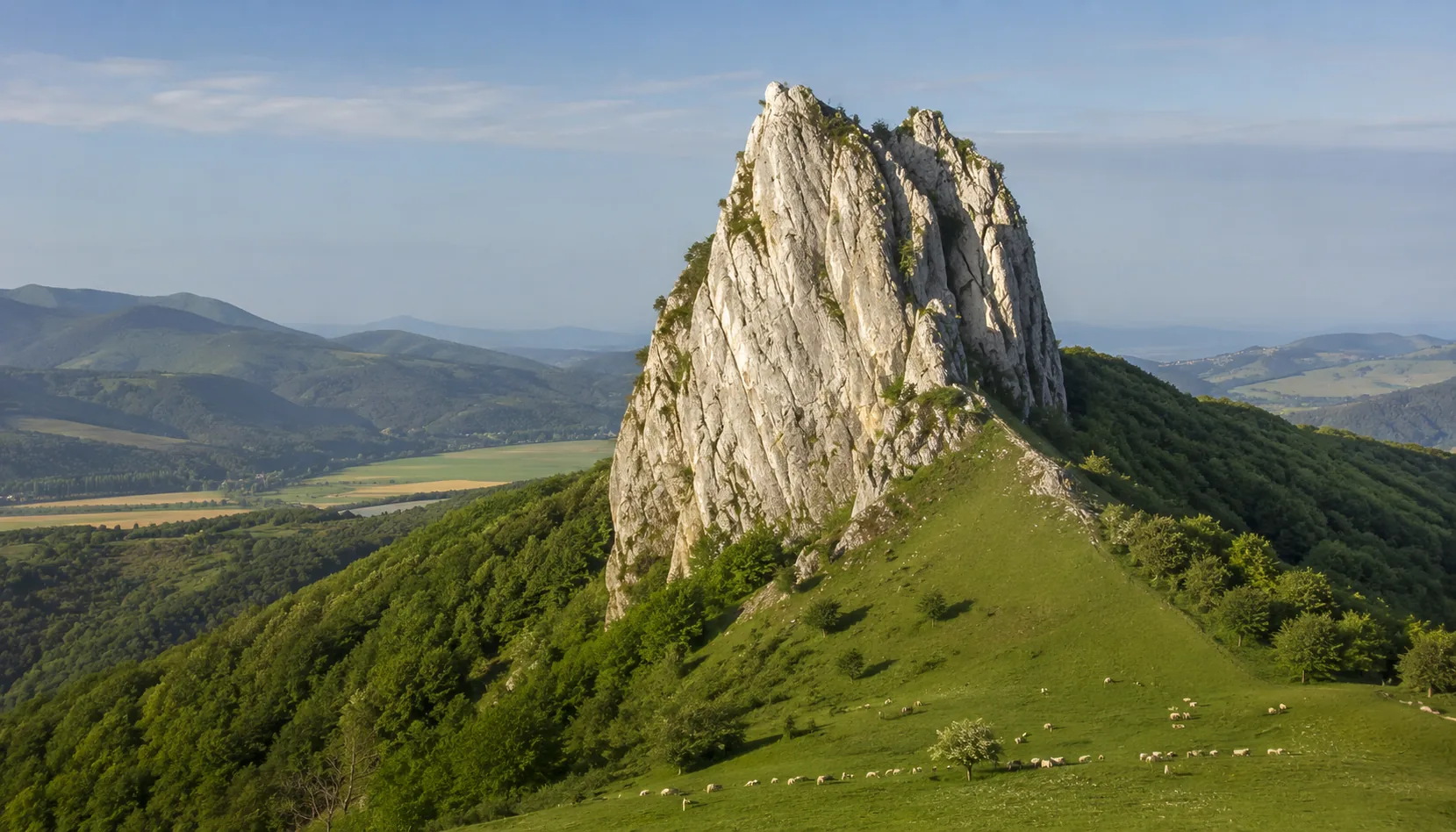
A granite core carved by glaciers, a belt of limestone cliffs running diagonally across the whole country, and a soft sandstone north that slides whenever it rains hard.Žulové jadro vybrúsené ľadovcami, pás vápencových brál tiahnuci sa šikmo celou krajinou a mäkký pieskovcový sever, ktorý sa zosúva vždy, keď poriadne prší.
A limestone klippe crag standing out of soft wooded hillsVápencové bradlo vyčnievajúce z mäkkých zalesnených kopcov
Granite and glaciersŽula a ľadovce
The High Tatras are the only genuinely alpine ground in the country: a block of granite pushed up and then cut by Ice Age glaciers into the shapes that make them look far bigger than they are — steep-walled cirques, knife ridges, hanging valleys and, in the bottom of each cirque, a tarn.Vysoké Tatry sú jediným skutočne vysokohorským terénom v krajine: blok žuly vyzdvihnutý nahor a potom rozrezaný ľadovcami doby ľadovej do tvarov, vďaka ktorým pôsobia oveľa väčšie, než sú — kotly so strmými stenami, ostré hrebene, visuté doliny a na dne každého kotla pleso.
The Belianske Tatry at the eastern end are a different rock entirely — limestone and dolomite lying on top of the same core — which is why they are grey and rounded where the High Tatras are grey and sharp, and why the Belianska cave is where it is.Belianske Tatry na východnom konci sú úplne iná hornina — vápenec a dolomit ležiace na tom istom jadre — a preto sú sivé a oblé tam, kde sú Vysoké Tatry sivé a ostré, a preto je Belianska jaskyňa práve tam.
The Low Tatras, the Malá and Veľká Fatra and the Tribeč are the same idea at lower altitude: a crystalline core with a sedimentary cover, the cover eroded off the ridges and left on the flanks. Where the cover survives you get cliffs, gorges and caves; where it has gone you get grass.Nízke Tatry, Malá a Veľká Fatra či Tribeč sú tá istá myšlienka v nižšej nadmorskej výške: kryštalické jadro so sedimentárnym obalom, ktorý sa z hrebeňov zmyl a zostal na úbočiach. Kde sa obal zachoval, sú brala, tiesňavy a jaskyne; kde zmizol, je tráva.
The klippen belt, and why the castles are on itBradlové pásmo a prečo sú na ňom hrady
Running diagonally across the country from the Little Carpathians to the Pieniny is a narrow, discontinuous strip of hard limestone blocks set in soft rock — the klippen belt. Because the blocks are hard and the matrix around them is not, they stand up as isolated crags, and almost every one of them has a castle on it.Šikmo cez krajinu od Malých Karpát po Pieniny sa tiahne úzky, prerušovaný pás tvrdých vápencových blokov uložených v mäkkej hornine — bradlové pásmo. Keďže bloky sú tvrdé a okolie mäkké, vyčnievajú ako osamelé brala — a takmer na každom z nich stojí hrad.
That is not a coincidence and it is one of the most useful things to know about Slovak landscape: Beckov, Vršatec, Čachtice, Lednica and the Pieniny crags above the Dunajec are the same geological feature, and so is the reason the road has to go round them.Nie je to náhoda a patrí to k najužitočnejším veciam, ktoré sa dajú o slovenskej krajine vedieť: Beckov, Vršatec, Čachtice, Lednica aj pieninské brala nad Dunajcom sú tým istým geologickým útvarom — a je to aj dôvod, prečo ich cesta musí obchádzať.
Flysch, and what it doesFlyš a čo robí
North and east of all that is the flysch: alternating layers of sandstone and shale laid down in a deep sea and then folded. It makes rounded, forested, unspectacular hills — the Kysuce, the Beskydy, most of Šariš and Zemplín — and it is unstable. Landslides after heavy rain are a normal hazard there, and a lot of the road maintenance in the north-east is landslide repair.Severne a východne od toho všetkého je flyš: striedajúce sa vrstvy pieskovca a ílovca uložené v hlbokom mori a potom zvrásnené. Tvorí oblé, zalesnené, nenápadné kopce — Kysuce, Beskydy, väčšinu Šariša a Zemplína — a je nestabilný. Zosuvy po výdatných dažďoch sú tam bežným rizikom a veľká časť údržby ciest na severovýchode je oprava zosuvov.
Súľovské skaly near Bytča are the local oddity: towers and gates of conglomerate — cemented ancient gravel — weathered into shapes that look artificial and are not.Súľovské skaly pri Bytči sú miestnou zvláštnosťou: veže a brány z konglomerátu — spevneného dávneho štrku — zvetrané do tvarov, ktoré vyzerajú umelo a nie sú.