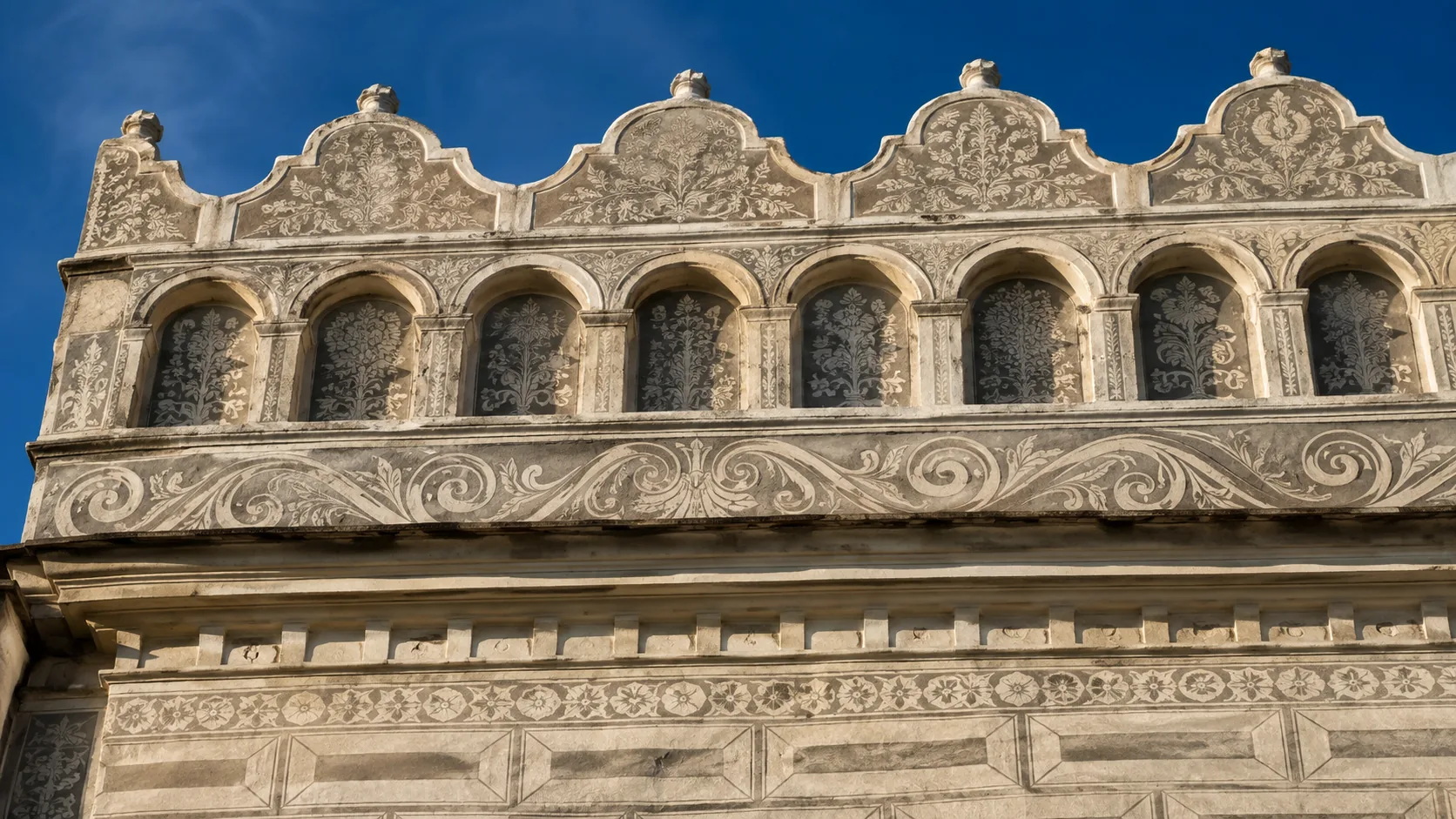
The one thing Slovak Renaissance architecture invented for itself: a decorated parapet wall hiding the roof, in sgraffito, along the whole top of a burgher house.Jediná vec, ktorú si slovenská renesančná architektúra vymyslela sama: zdobená atika, ktorá skrýva strechu, v sgrafite, po celej hornej hrane meštianskeho domu.
A sgraffito Renaissance attic above a burgher house frontSgrafitová renesančná atika nad priečelím meštianskeho domu
Where the money came fromOdkiaľ prišli peniaze
Sixteenth-century money came from mining and from the trade in copper, and it arrived at the same time as Italian masons fleeing north and Italian military engineers being hired south. The result on a Spiš or Šariš square is a house that is medieval underneath and Renaissance on the outside.Peniaze 16. storočia prichádzali z baníctva a z obchodu s meďou — a prišli v tom istom čase ako talianski murári smerujúci na sever a talianski vojenskí inžinieri najímaní na juh. Výsledkom na spišskom či šarišskom námestí je dom, ktorý je vnútri stredoveký a zvonku renesančný.
The attic — atika — is the signature. Instead of letting the roof show, the front wall is carried up past it as a decorated screen: blind arcading, merlons, volutes, and sgraffito scratched through pale plaster to the dark layer beneath. Levoča, Kežmarok, Spišská Sobota, Podolínec, Prešov and Bardejov all have it, and so does the Thurzo house on Levoča's square.Poznávacím znakom je atika. Namiesto toho, aby bolo vidieť strechu, priečelie pokračuje nad ňu ako zdobená clona: slepé arkády, cimburie, volúty a sgrafito vyškrabané cez svetlú omietku do tmavej vrstvy pod ňou. Má ju Levoča, Kežmarok, Spišská Sobota, Podolínec, Prešov aj Bardejov — a má ju aj Turzov dom na levočskom námestí.
Bell towers and BytčaZvonice a Bytča
The free-standing Renaissance bell towers of Spiš are the other local speciality: square, tall, sgraffitoed, standing beside the church rather than on it, at Kežmarok, Spišská Sobota, Strážky, Vrbov, Poprad and Spišská Belá. They are as close as this region gets to a signature skyline.Druhou miestnou špecialitou sú voľne stojace renesančné zvonice Spiša: hranaté, vysoké, sgrafitované, stojace pri kostole, nie na ňom — v Kežmarku, Spišskej Sobote, Strážkach, Vrbove, Poprade a Spišskej Belej. Sú tým najbližším k charakteristickej siluete, čo tento región má.
Bytča on the Váh has the best surviving Renaissance chateau, with an arcaded courtyard and, beside it, the Wedding Palace — a hall built by the Thurzós for the marriages of their daughters and for nothing else, which is a very sixteenth-century thing to build.Bytča na Váhu má najlepšie zachovaný renesančný zámok s arkádovým nádvorím a vedľa neho Sobášny palác — sálu, ktorú dali Turzovci postaviť na svadby svojich dcér a na nič iné, čo je veľmi v duchu 16. storočia.
Bastions, and what came nextBastióny a čo prišlo potom
The military side of the same century is the Italian bastion. Nové Zámky was a textbook six-pointed star; Komárno grew into the largest fortress complex in the region; Leopoldov was built to replace Nové Zámky when it fell. Only Komárno survives in quantity; the other two were demolished by the state that built them, once a fortress in the wrong hands looked more dangerous than useful.Vojenskou stranou toho istého storočia je taliansky bastión. Nové Zámky boli učebnicovou šesťcípou hviezdou, Komárno vyrástlo na najväčší pevnostný komplex v regióne a Leopoldov postavili ako náhradu za padnuté Nové Zámky. Vo väčšom rozsahu sa zachovalo len Komárno; ďalšie dve zbúral ten istý štát, ktorý ich postavil, keď sa pevnosť v nesprávnych rukách začala javiť nebezpečnejšia než užitočná.
Baroque follows and is everywhere, but it is largely imported: church interiors, monastery ranges, the Trinity columns on the squares and the manor houses of the eighteenth century. The Renaissance attic is the thing that is local.Nasleduje barok a je všade, no je väčšinou dovezený: interiéry kostolov, kláštorné krídla, morové stĺpy na námestiach a kaštiele 18. storočia. Miestna je práve renesančná atika.