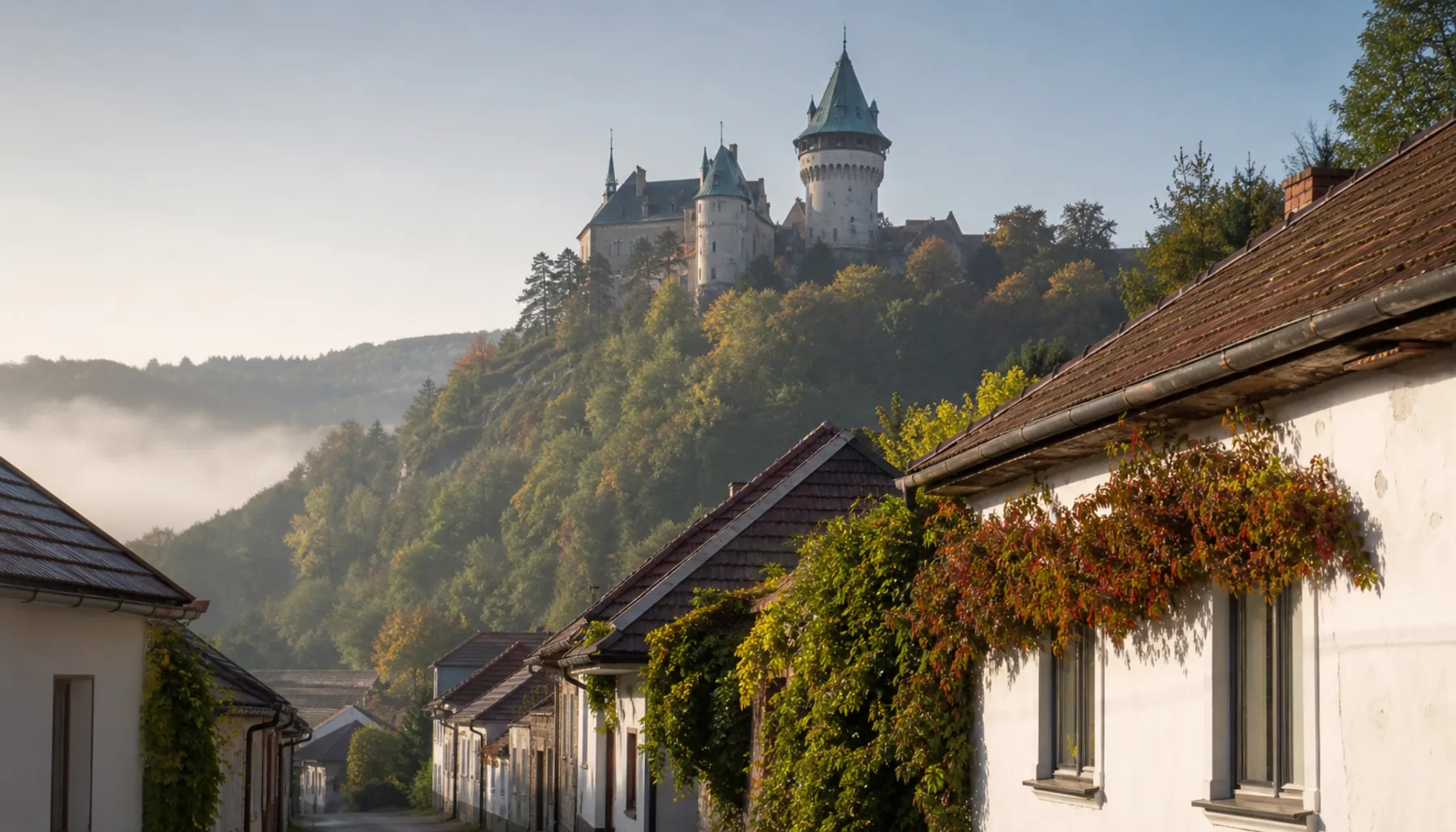
Three separate things stand above one village at the foot of the Little Carpathians: an Iron Age hillfort, a neo-Gothic chateau used as a scientific congress centre, and the only show cave in western Slovakia.Nad jednou obcou na úpätí Malých Karpát stoja tri samostatné veci: hradisko z doby železnej, neogotický zámok slúžiaci ako vedecké kongresové centrum a jediná sprístupnená jaskyňa na západnom Slovensku.
Smolenice under its chateau at the foot of the Little CarpathiansSmolenice pod zámkom na úpätí Malých Karpát
Where it standsKde leží
Smolenice lie where the Trnava plain runs into the eastern wall of the Little Carpathians, about half an hour north-west of Trnava. Behind the village the range goes up abruptly and a valley leads back towards the Jahodník recreation area and the karst.Smolenice ležia tam, kde trnavská rovina naráža na východnú stenu Malých Karpát, asi pol hodiny severozápadne od Trnavy. Za obcou sa pohorie prudko dvíha a dolina vedie späť k rekreačnej oblasti Jahodník a ku krasu.
The chateau stands on a wooded spur above the houses, and Molpír faces it across the mouth of that valley. Those two high points and the gap between them explain the place.Zámok stojí na zalesnenom výbežku nad domami a oproti nemu, cez ústie tej doliny, leží Molpír. Tieto dva vyvýšené body a brána medzi nimi vysvetľujú celú obec.
Why it is herePrečo práve tu
The hill came first, by a very long way. Molpír carried a fortified settlement of the Hallstatt period, in the Early Iron Age, with terraces and ramparts over some twelve hectares of hilltop; Celts and later Slavs occupied it again. The position is the point: this is where a route through the range meets the open plain.Prvý bol kopec, a to o veľmi veľa. Na Molpíre stálo opevnené sídlisko halštatského obdobia zo staršej doby železnej, s terasami a valmi na približne dvanástich hektároch temena; neskôr ho znovu osídlili Kelti a po nich Slovania. Podstatou je poloha: práve tu ústi cesta cez pohorie do otvorenej roviny.
The medieval castle held the same gap, one of a line of strongholds along the crest of the Little Carpathians, and it fell into ruin like the rest. What stands there now is barely a century old: the Pálffy family rebuilt it as a romantic neo-Gothic chateau, the work was interrupted, and it was finished after the Second World War for the Slovak Academy of Sciences, which uses it still.Stredoveký hrad držal tú istú bránu ako jeden z reťaze pevností na hrebeni Malých Karpát a spolu s ostatnými spustol. To, čo tam stojí dnes, má sotva storočie: Pálfiovci ho prestavali na romantický neogotický zámok, práce sa prerušili a dokončili sa po druhej svetovej vojne pre Slovenskú akadémiu vied, ktorá ho používa dodnes.
The third thing was found in 1929, when cavers broke into the fissures of Driny above the village; it opened to visitors a few years later. Štefan Banič, born in Smolenice in 1870, took part in the discovery. Slovak tradition credits him with inventing the parachute; what is documented is an American patent of 1914 for his design.Tretiu vec objavili v roku 1929, keď sa jaskyniari prekopali do puklín Driny nad obcou; pre návštevníkov ju sprístupnili o pár rokov neskôr. Objavu sa zúčastnil Štefan Banič, narodený v Smoleniciach v roku 1870. Slovenská tradícia mu pripisuje vynález padáka; doložený je americký patent z roku 1914 na jeho konštrukciu.
What you actually seeČo naozaj uvidíte
The chateau is the picture everybody takes: round towers, steep dark roofs and a crenellated terrace wall above the trees. Because it belongs to the Academy and works as a congress centre, public access is limited and seasonal — the castle pages here set out what that means. Do not build a day around getting inside.Zámok je záberom, ktorý si odnesie každý: okrúhle veže, strmé tmavé strechy a terasový múr s cimburím nad korunami stromov. Keďže patrí akadémii a slúži ako kongresové centrum, prístup verejnosti je obmedzený a sezónny — čo to znamená v praxi, opisujú stránky o zámku na tomto webe. Deň si okolo vstupu dnu neplánujte.
Driny is about twenty-five minutes on foot up from the car park at Jahodník, and the cave is unlike the big Slovak systems: narrow fissure passages rather than halls, with fine flowstone and curtain formations close beside the path. Tours are guided and the cave has a season.K jaskyni Driny je to od parkoviska na Jahodníku asi dvadsaťpäť minút pešo a jaskyňa sa nepodobá veľkým slovenským systémom: sú to úzke puklinové chodby, nie siene, so sintrovými a záclonovými útvarmi tesne pri chodníku. Prehliadky sú so sprievodcom a jaskyňa má sezónu.
Molpír is reached on foot from the village church by the Smolenice karst nature trail. There is little to see as architecture — banks, terraces and information panels — but the ridge gives the view over the plain that explains why anyone fortified it.Na Molpír sa ide pešo od kostola v obci po náučnom chodníku Smolenický kras. Ako architektúra sa tam veľa nevidí — valy, terasy a informačné panely — no z hrebeňa je výhľad na rovinu, ktorý vysvetľuje, prečo ho vôbec niekto opevnil.
Living village, not a museumŽivá obec, nie skanzen
Smolenice is a working village at the foot of the hills, and all three of the things above it are run by somebody else: the Academy has the chateau, the cave has a season and a guide, and the hillfort is an archaeological site on open hillside. None is open continuously through the year.Smolenice sú fungujúcou obcou na úpätí kopcov a všetky tri veci nad nimi spravuje niekto iný: zámok akadémia, jaskyňa má sezónu a sprievodcu a hradisko je archeologickou lokalitou na otvorenom svahu. Ani jedna z nich nie je otvorená nepretržite po celý rok.
The Jahodník valley is busy on summer weekends and quiet the rest of the time. The forest above is a protected landscape area and the vineyards below it are worked ground — keep to the marked paths, particularly on Molpír, where what looks like rough ground is the site.Dolina Jahodník je cez letné víkendy rušná a po zvyšok času tichá. Les nad ňou je chránenou krajinnou oblasťou a vinice pod ním obrábanou pôdou — držte sa značených chodníkov, najmä na Molpíre, kde to, čo vyzerá ako neupravený terén, je samotná lokalita.
Getting thereAko sa tam dostať
Buses run from Trnava, and by car it is a signposted turn off the road between Trnava and Senica; the cave car park is up the valley beyond the village, and the last stretch to any of the three is on foot.Autobusy chodia z Trnavy a autom ide o značenú odbočku z cesty medzi Trnavou a Senicou; parkovisko k jaskyni je vyššie v doline za obcou a posledný úsek ku ktorejkoľvek z tých troch vecí sa ide pešo.
Explore SmoleniceObjavujte Smolenice
Every part of this place with a page of its own.Každá časť tohto miesta, ktorá má vlastnú stránku.