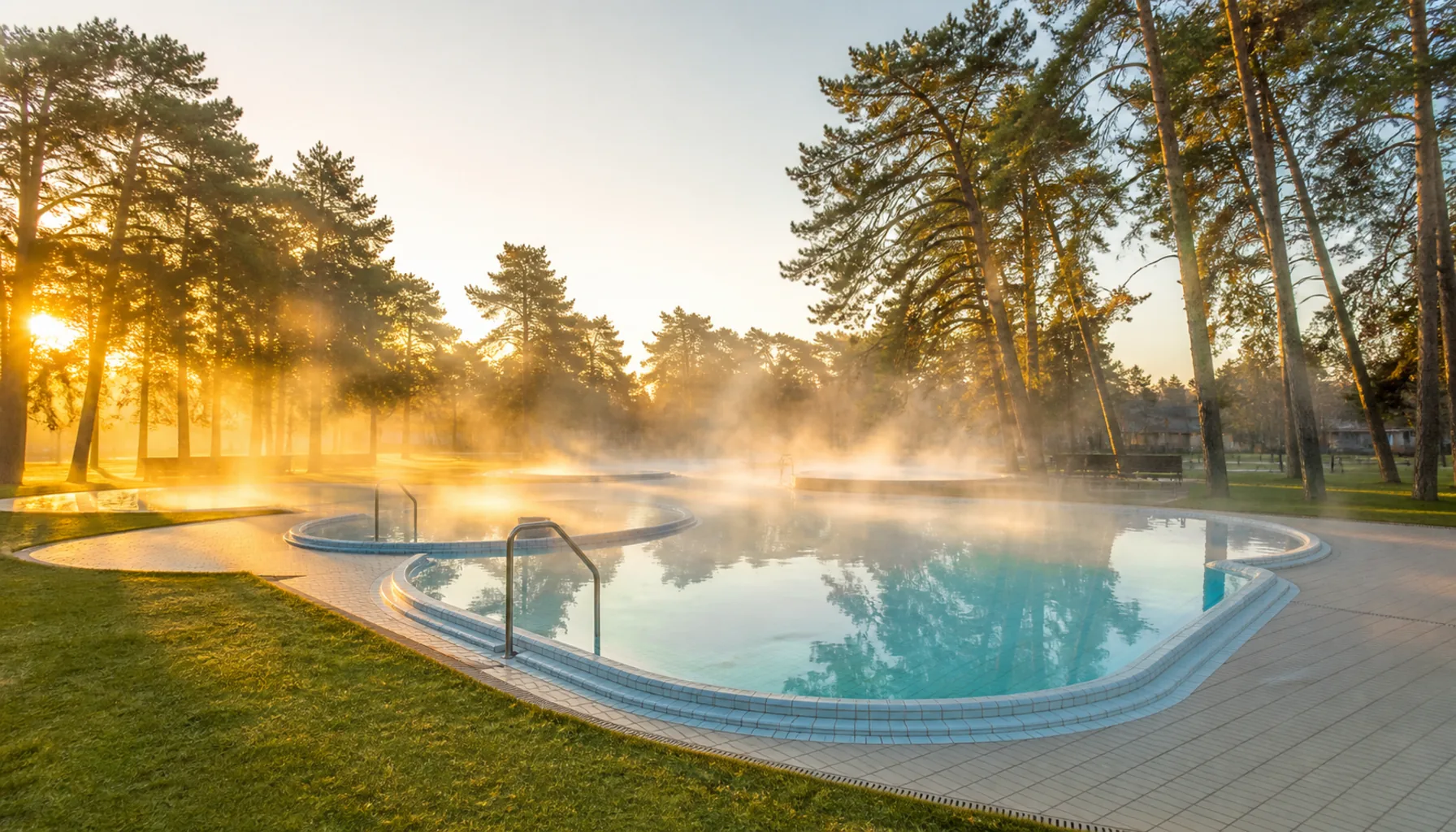
A Hungarian-speaking market town in the eastern half of the Žitný ostrov, known across Slovakia for one thing: a large thermal swimming park laid out among pine trees and fed by hot water from deep beneath the island.Maďarsky hovoriace trhové mesto vo východnej polovici Žitného ostrova, známe po celom Slovensku jednou vecou: veľkým termálnym areálom rozloženým medzi borovicami, ktorý napája horúca voda z hĺbky pod ostrovom.
Steam over the outdoor thermal pools among the pines at Veľký MederPara nad vonkajšími termálnymi bazénmi medzi borovicami v meste Veľký Meder
Where it standsKde leží
Veľký Meder lies in the eastern half of the Žitný ostrov, on the road between Dunajská Streda and Komárno, on the flat plain of gravel and silt between the Danube and the Little Danube. Nothing on it rises: fields, rows of poplars, drainage canals, and the Danube embankment some kilometres to the south.Veľký Meder leží vo východnej polovici Žitného ostrova, na ceste medzi Dunajskou Stredou a Komárnom, na rovine štrku a naplavenín medzi Dunajom a Malým Dunajom. Nič sa tu nedvíha: polia, rady topoľov, odvodňovacie kanály a dunajská hrádza niekoľko kilometrov na juh.
Hungarian is the everyday language of the town and of most villages around it, and the Hungarian name, Nagymegyer, is the older one. Between 1948 and 1990 the town was officially called Čalovo; older maps and timetables still carry that name, and it turns up in the speech of older people.Bežnou rečou mesta aj väčšiny okolitých obcí je maďarčina a maďarský názov Nagymegyer je ten starší. V rokoch 1948 až 1990 sa mesto úradne volalo Čalovo; staršie mapy a cestovné poriadky ten názov stále nesú a v reči starších ľudí zaznie dodnes.
The storyHistória
The settlement is medieval and grew as a market village on the island, living off grain, cattle and the water around it. It never had a castle: there is no stone and no high ground on the Žitný ostrov, and whatever its lords built, they built on the flat.Osada je stredoveká a rástla ako trhová dedina na ostrove, ktorá žila z obilia, dobytka a z vody okolo seba. Hrad tu nikdy nestál: na Žitnom ostrove niet kameňa ani vyvýšeniny, a čokoľvek tunajší páni postavili, postavili na rovine.
The island's history is really a history of water. Before the Danube was regulated in the nineteenth century the river moved its arms across the whole plain, and villages were flooded, abandoned and rebuilt. Embankment and drainage turned the island into the most productive farmland in the country and made the modern town possible.Dejiny ostrova sú v skutočnosti dejinami vody. Kým Dunaj v 19. storočí neregulovali, rieka presúvala svoje ramená po celej rovine a obce zaplavovalo, opúšťali sa a stavali nanovo. Hrádze a odvodnenie premenili ostrov na najúrodnejšiu pôdu v krajine a umožnili vznik dnešného mesta.
The twentieth century is written into the name. Southern Slovakia was annexed to Hungary between 1938 and 1945; the town was renamed Čalovo in 1948 and took its own name back in 1990. Two changes of name in fifty years is the shortest description of what happened along this border.Dvadsiate storočie je zapísané v samotnom názve. Južné Slovensko bolo v rokoch 1938 až 1945 pripojené k Maďarsku, mesto v roku 1948 premenovali na Čalovo a svoje meno dostalo späť v roku 1990. Dve zmeny názvu za päťdesiat rokov sú najkratším opisom toho, čo sa na tejto hranici dialo.
What to seeČo vidieť
The thermal park is why most visitors come. Warm mineral water from a deep borehole feeds a large complex of outdoor and indoor pools laid out among mature pines, which is unusual in itself: most lowland thermal baths sit on open ground with no shade at all. It runs through the year, the outdoor pools busiest in high summer, so confirm the season and the opening hours before planning a day around it.Väčšina návštevníkov prichádza pre termálny areál. Teplá minerálna voda z hlbokého vrtu napája veľký komplex vonkajších aj krytých bazénov rozložený medzi vzrastlými borovicami, čo je samo osebe nezvyčajné: väčšina nížinných termálnych kúpalísk stojí na otvorenej ploche úplne bez tieňa. Funguje po celý rok, vonkajšie bazény sú najplnšie vo vrcholnom lete — sezónu a otváracie hodiny si pred plánovaním dňa overte.
The town itself is a working market town rather than a monument: one long main street, a church, a park, and shops that serve the villages around. What repays a longer stay is the country. The flat lanes make some of the easiest cycling in Slovakia, the backwaters of the Little Danube north of the town are canoeing and fishing water, and the Danube embankment to the south carries the long-distance riverside cycle route.Samotné mesto je skôr fungujúcim trhovým mestom než pamiatkou: jedna dlhá hlavná ulica, kostol, park a obchody, ktoré obsluhujú okolité obce. Za dlhší pobyt sa odmení skôr okolie. Rovné cesty ponúkajú jedny z najpohodlnejších podmienok na bicyklovanie na Slovensku, ramená Malého Dunaja severne od mesta sú vodou na kanoe a rybárčenie a dunajská hrádza na juhu nesie diaľkovú cyklotrasu popri rieke.
Work and industryPráca a priemysel
Arable farming carries the district. The island's soil is as good as any in the country, and the fields around the town grow grain, maize and vegetables on a large scale, with the processing, storage and machinery businesses that follow from it.Okres drží orná pôda. Ostrovná pôda je taká dobrá ako ktorákoľvek v krajine a polia okolo mesta rodia obilie, kukuricu a zeleninu vo veľkom, a s tým prichádza aj spracovanie, skladovanie a strojárske služby, ktoré k tomu patria.
The thermal park is the other economy. Hotels, guesthouses, campsites and restaurants have grown up around it, and a good share of local work is seasonal because of it. Many people of working age commute — to Dunajská Streda, to Bratislava, or across the border into Hungary.Druhou ekonomikou je termálny areál. Okolo neho vyrástli hotely, penzióny, kempingy a reštaurácie a značná časť miestnej práce je preto sezónna. Mnohí ľudia v produktívnom veku dochádzajú — do Dunajskej Stredy, do Bratislavy alebo cez hranicu do Maďarska.
Getting thereAko sa tam dostať
Trains on the Bratislava to Komárno line call here through the day, and the main road along the island connects the town with Dunajská Streda in one direction and Komárno in the other; buses serve the surrounding villages.Vlaky na trati Bratislava – Komárno tu zastavujú počas celého dňa a hlavná cesta po ostrove spája mesto na jednu stranu s Dunajskou Stredou a na druhú s Komárnom; autobusy obsluhujú okolité obce.
Explore Veľký MederObjavujte Veľký Meder
Every part of this place with a page of its own.Každá časť tohto miesta, ktorá má vlastnú stránku.