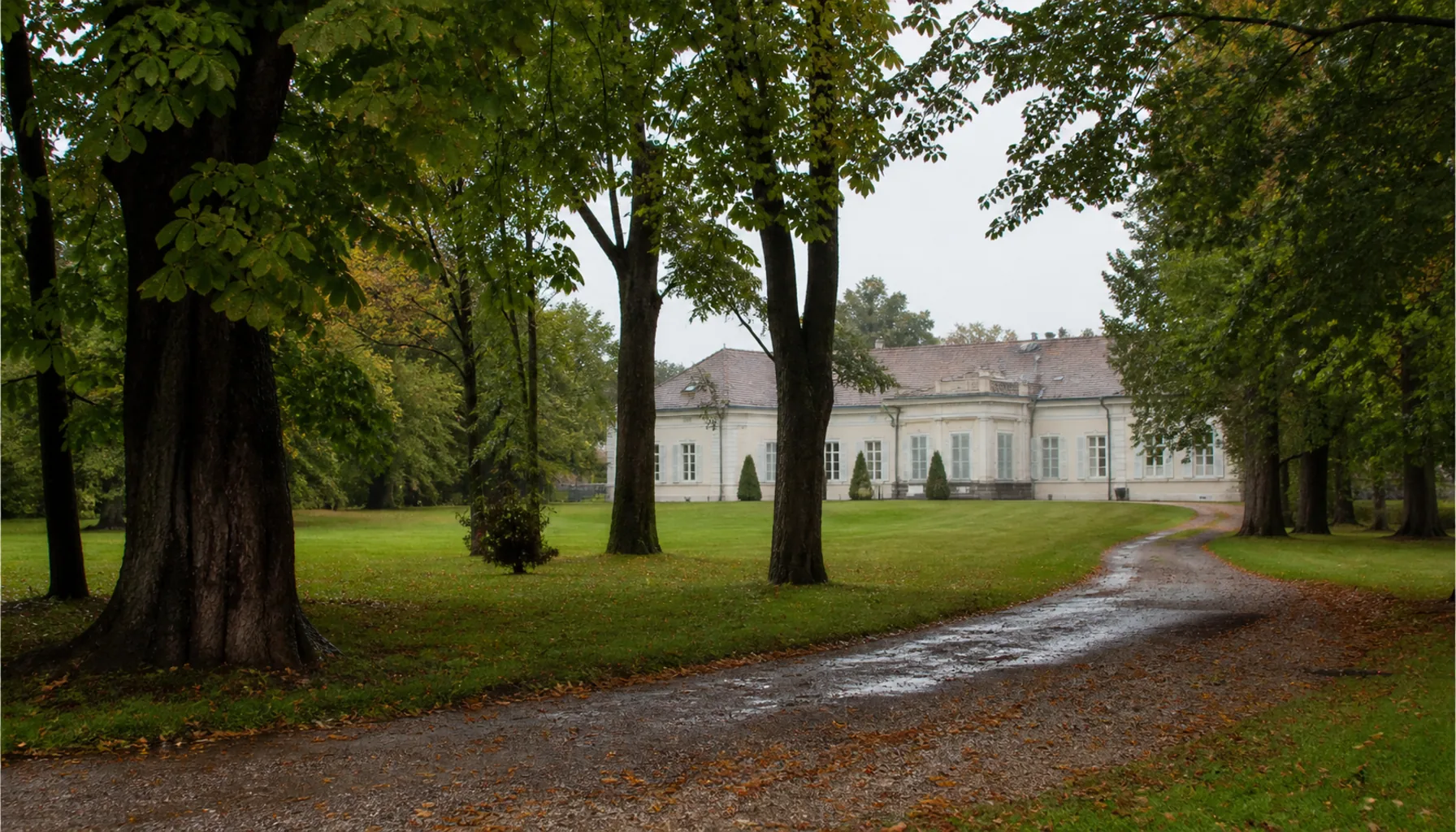
A sugar town on the plain between Senec and Galanta, called Diószeg until 1948 and then renamed after a poet who never set foot in it, with an industrialist family's manor house in the centre and thermal water in the woods on its edge.Cukrovarnícke mesto na rovine medzi Sencom a Galantou, ktoré sa do roku 1948 volalo Diószeg a potom dostalo meno po básnikovi, ktorý v ňom nikdy nebol — s kaštieľom priemyselníckeho rodu v centre a termálnou vodou v lese na okraji.
The Kuffner manor house and its park at SládkovičovoKuffnerovský kaštieľ a jeho park v Sládkovičove
Where it standsKde leží
Sládkovičovo stands on the flat Danubian Lowland roughly midway between Senec and Galanta, on the main road and railway running south-east out of Bratislava. There is no relief in the landscape at all: wheat, maize and beet fields, drainage ditches, poplar windbreaks, and the woods of Vincov les on the edge of the town.Sládkovičovo leží na rovine Podunajskej nížiny zhruba na polceste medzi Sencom a Galantou, pri hlavnej ceste a železnici, ktoré vedú z Bratislavy na juhovýchod. Krajina tu nemá nijaké prevýšenie: polia pšenice, kukurice a repy, odvodňovacie kanály, topoľové vetrolamy a Vincov les na okraji mesta.
It belongs to the Galanta district and to the bilingual belt of southern Slovakia. Slovak and Hungarian are both everyday languages, and the older Hungarian name, Diószeg, is still what a good many people in the district call the place.Patrí do okresu Galanta a do dvojjazyčného pásu južného Slovenska. Slovenčina aj maďarčina sú tu bežnou rečou a starší maďarský názov Diószeg dodnes používa v okrese veľa ľudí.
The storyHistória
The town grew out of two neighbouring villages, Magyardiószeg and Németdiószeg — the Hungarian and the German Diószeg — whose shared name comes from the Hungarian word for walnut. They sat on good soil beside a road, and for centuries they lived on grain, cattle and the market.Mesto vyrástlo z dvoch susedných obcí, z Magyardiószegu a Németdiószegu — maďarského a nemeckého Dioseku —, ktorých spoločný názov pochádza z maďarského slova pre orech. Ležali na dobrej pôde pri ceste a po stáročia žili z obilia, dobytka a trhu.
What changed the place was sugar. A beet refinery founded here in the nineteenth century became one of the largest in this part of the Kingdom of Hungary, and the Kuffner family, industrialists who took the town's name into their noble title, ran it for generations and built the manor house that still stands in the centre. With the refinery came a railway station, workers' housing and a working year organised around the autumn campaign.Miesto zmenil cukor. Cukrovar založený tu v 19. storočí patril k najväčším v tejto časti Uhorska a rod Kuffnerovcov, priemyselníci, ktorí si meno mesta vzali do šľachtického predikátu, ho viedol po generácie a postavil kaštieľ, ktorý dodnes stojí v centre. S cukrovarom prišla železničná stanica, robotnícke domy a pracovný rok usporiadaný okolo jesennej kampane.
The present name dates from 1948, when a wave of renaming replaced Hungarian place names across the south. Diószeg became Sládkovičovo after Andrej Sládkovič, the Krupina-born poet of Marína and Detvan, who had no connection with the town whatever. It is worth saying plainly, because the same is true of several of its neighbours.Dnešný názov je z roku 1948, keď vlna premenovaní nahradila maďarské názvy po celom juhu. Z Diószegu sa stalo Sládkovičovo po Andrejovi Sládkovičovi, krupinskom rodákovi a autorovi Maríny a Detvana, ktorý s mestom nemal nič spoločné. Treba to povedať na rovinu, lebo to isté platí aj o viacerých susedných mestách.
What to seeČo vidieť
The Kuffner manor house and its park are the one piece of architecture here with any ambition — a nineteenth-century industrialist's residence with mature trees around it. It has been adapted to other uses rather than kept as a museum, so what most visitors see is the outside and the park.Kuffnerovský kaštieľ a jeho park sú jedinou stavbou v meste s väčšími ambíciami — sídlo priemyselníka z 19. storočia so vzrastlými stromami okolo. Slúži iným účelom, než je múzeum, takže väčšina návštevníkov vidí najmä jeho vonkajšok a park.
Vincov les, the thermal swimming complex in the woods on the edge of town, is what most Slovaks associate with the name. It draws on the same hot aquifer that supplies the pools at Galanta and Štúrovo, and it is a summer place: grass, warm outdoor basins and shade from the trees. Seasons and opening hours change, so check before planning a day around it.Vincov les, termálny areál v lese na okraji mesta, je to, čo si so Sládkovičovom spája väčšina Slovákov. Čerpá z tej istej horúcej zvodne ako bazény v Galante či v Štúrove a je to letné miesto: tráva, teplé vonkajšie bazény a tieň stromov. Sezóna a otváracie hodiny sa menia, preto si ich pred plánovaním overte.
Otherwise the town is a starting point rather than a destination. The lanes south towards the Žitný ostrov are flat and quiet enough to make good cycling, and Galanta, with its two Esterházy houses, is a short run down the road.Inak je mesto skôr východiskom než cieľom. Cesty na juh smerom k Žitnému ostrovu sú rovné a dosť tiché na pohodlnú cyklistiku a Galanta s dvoma kaštieľmi Esterházyovcov je kúsok po ceste.
Work and industryPráca a priemysel
Sugar is no longer made here. Slovak refining consolidated onto a couple of large plants elsewhere, and the works that built the town closed; food processing, engineering and warehousing along the Bratislava road took over the employment. The proximity of the capital matters more every year, and a large share of working-age people commute west.Cukor sa tu už nevyrába. Slovenské cukrovarníctvo sa sústredilo do niekoľkých veľkých závodov inde a podnik, ktorý mesto postavil, zanikol; zamestnanosť prevzalo potravinárstvo, strojárstvo a sklady pri ceste na Bratislavu. Blízkosť hlavného mesta znamená každým rokom viac a veľká časť ľudí v produktívnom veku dochádza na západ.
The town also has a private university, unusual in a place this size, which keeps a small student population in it. Agriculture is the constant underneath everything else: this is some of the best arable land in the country, farmed in large blocks.V meste sídli aj súkromná vysoká škola, čo je na mesto tejto veľkosti nezvyčajné a čo tu udržiava malú komunitu študentov. Pod všetkým ostatným je stálicou poľnohospodárstvo: ide o jednu z najúrodnejších pôd v krajine, obrábanú vo veľkých blokoch.
Getting thereAko sa tam dostať
Sládkovičovo is on the main line from Bratislava through Galanta towards Nové Zámky and Štúrovo, so stopping trains call through the day; buses run to Galanta, Senec and Sereď. By car it sits on the old road between Senec and Galanta, with the motorway corridor towards Trnava a short way north.Sládkovičovo leží na hlavnej trati z Bratislavy cez Galantu smerom na Nové Zámky a Štúrovo, takže osobné vlaky tu zastavujú počas celého dňa; autobusy premávajú do Galanty, Senca a Serede. Autom sa tam ide po starej ceste medzi Sencom a Galantou a diaľničný koridor smerom na Trnavu je kúsok na sever.
Explore SládkovičovoObjavujte Sládkovičovo
Every part of this place with a page of its own.Každá časť tohto miesta, ktorá má vlastnú stránku.