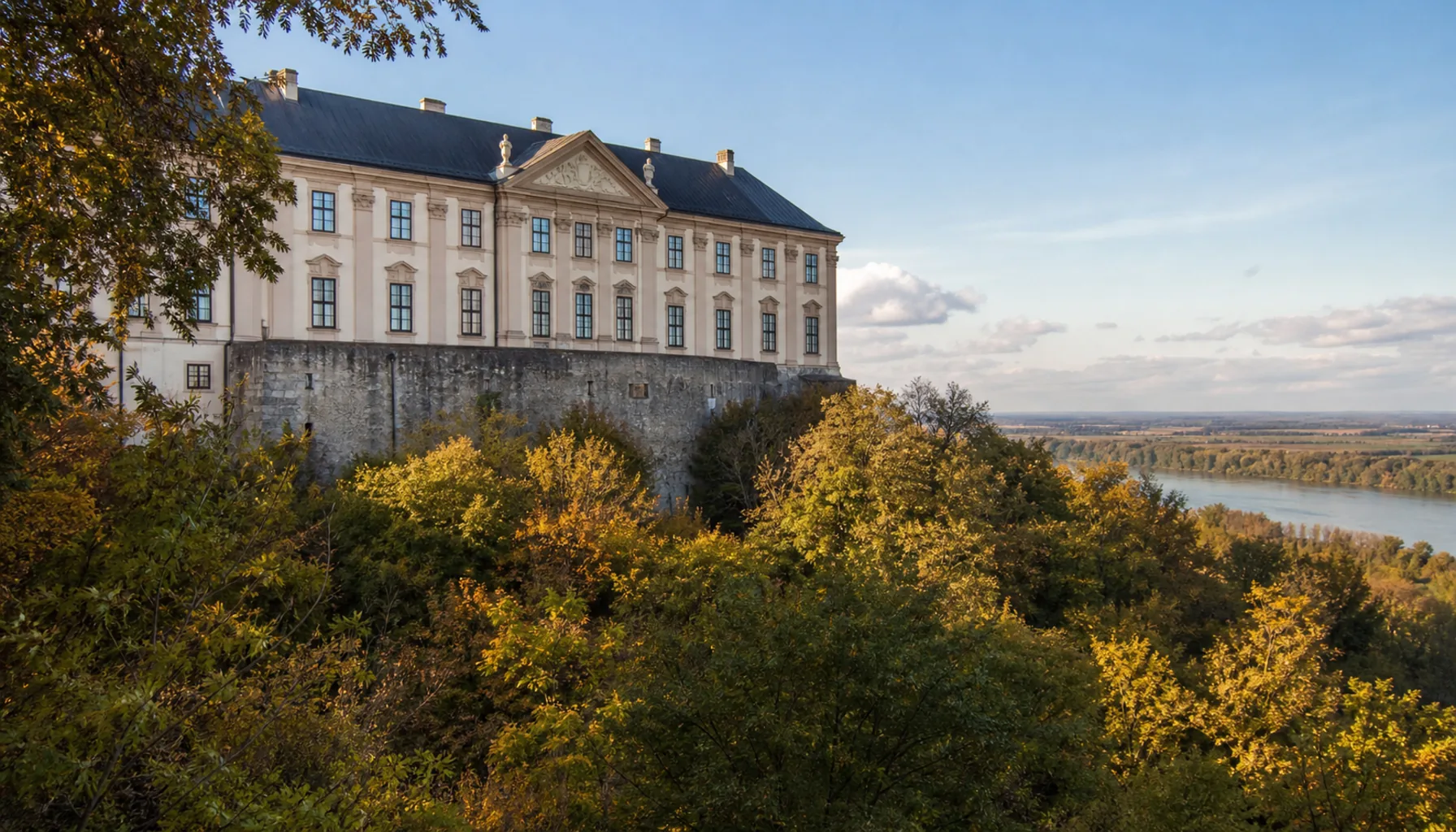
A Váh town under a château: the Erdődy residence and its park stand on the terrace above the old market centre, with one of the oldest theatre buildings in Slovakia among the trees and the fortress town of Leopoldov across the river.Mesto na Váhu pod zámkom: sídlo Erdődyovcov s parkom stojí na terase nad starým trhovým jadrom, medzi stromami je jedna z najstarších divadelných budov na Slovensku a za riekou leží pevnostné mesto Leopoldov.
The château at Hlohovec on its terrace above the Váh valleyHlohovský zámok na terase nad údolím Váhu
Where it standsKde leží
Hlohovec sits on the Váh where the river leaves the hills of the Považie and spreads into the lowland, about twenty kilometres north-east of Trnava and a short way downstream from Piešťany. The town works on two levels: the market centre down by the water and the château terrace on the escarpment above it.Hlohovec leží na Váhu tam, kde rieka opúšťa považské kopce a rozlieva sa do nížiny, asi dvadsať kilometrov severovýchodne od Trnavy a kúsok po prúde od Piešťan. Mesto funguje na dvoch úrovniach: trhové jadro dole pri vode a zámocká terasa na svahu nad ním.
Vineyards and orchards work the warm slopes above the valley, and the wooded ridge of the Považský Inovec closes the eastern horizon.Na teplých svahoch nad údolím sú vinohrady a sady a východný horizont uzatvára zalesnený hrebeň Považského Inovca.
The storyHistória
A royal castle guarded the Váh crossing here from the early Middle Ages, and the town beneath it grew on the traffic over the ford. For centuries it was known as Frašták, a name that stayed in local speech long after the official one had settled as Hlohovec.Prechod cez Váh tu od včasného stredoveku strážil kráľovský hrad a mesto pod ním rástlo z ruchu pri brode. Po stáročia sa volalo Frašták a tento názov zostal v miestnej reči ešte dlho po tom, čo sa úradne ustálil Hlohovec.
From the eighteenth century the estate belonged to the Erdődy family, who turned the castle into a residence, laid out an English park around it and built a theatre in the grounds at the turn of the nineteenth century — a private house theatre, and one of the oldest surviving theatre buildings in Slovakia.Od 18. storočia patrilo panstvo Erdődyovcom, ktorí hrad premenili na sídlo, rozvrhli okolo neho anglický park a na prelome 18. a 19. storočia v areáli postavili divadlo — súkromné panské divadlo a jednu z najstarších zachovaných divadelných budov na Slovensku.
The château left private hands in the twentieth century, spent decades in institutional use and then in decline, and has been under long, staged restoration for years. What a visitor can actually enter changes from season to season, so confirm before planning a day around the interior.V 20. storočí zámok opustil súkromné ruky, desaťročia slúžil inštitúciám a potom chátral; už roky prechádza dlhou etapovitou obnovou. To, čo si návštevník naozaj môže pozrieť, sa mení zo sezóny na sezónu, preto si to pred plánovaním dňa v interiéri overte.
What to seeČo vidieť
The château terrace and its park are the town's set piece — a large landscaped park along the edge of the escarpment, open as public ground, with the theatre standing among the trees and long views down the Váh from the balustrade.Zámocká terasa s parkom je vizitkou mesta — rozsiahly krajinársky park pozdĺž hrany svahu, prístupný ako verejný priestor, s divadlom medzi stromami a s ďalekými výhľadmi do doliny Váhu spod balustrády.
In the centre the Franciscan church and monastery and the parish church make a short circuit through streets that still follow the medieval market plan.V centre tvoria františkánsky kostol s kláštorom a farský kostol krátky okruh ulicami, ktoré dodnes sledujú stredoveký trhový pôdorys.
Across the Váh is Leopoldov, a small town built around a bastioned fortress raised in the 1660s after the Ottomans took Nové Zámky. The fortress was converted into a prison in the nineteenth century and still serves as one, so it cannot be visited; but the earthworks and the town's grid plan are plain from the road, and together with the castle terrace they explain the whole geography of this crossing.Za Váhom leží Leopoldov, mestečko vyrastené okolo bastiónovej pevnosti postavenej v šesťdesiatych rokoch 17. storočia po tom, čo Osmani dobyli Nové Zámky. V 19. storočí pevnosť premenili na väznicu a slúži tak dodnes, navštíviť sa teda nedá; valy aj pravouhlý pôdorys mesta však vidno z cesty a spolu so zámockou terasou vysvetľujú geografiu celého tohto prechodu.
Work and industryPráca a priemysel
Pharmaceutical manufacturing has been the town's industry since the middle of the twentieth century: the works that traded for decades as Slovakofarma is still the largest plant in Hlohovec and one of the bigger drug factories in Slovakia. Engineering, plastics and food processing fill in around it.Od polovice 20. storočia je priemyslom mesta farmaceutická výroba: závod, ktorý desaťročia niesol meno Slovakofarma, je stále najväčšou fabrikou v Hlohovci a jednou z väčších liekových výrobní na Slovensku. Okolo neho stojí strojárstvo, spracovanie plastov a potravinárstvo.
The land is the other employer — orchards, vineyards and arable farming on the terraces above the Váh — and a good number of people commute to Trnava or to the plants along the motorway.Druhým zamestnávateľom je pôda — sady, vinohrady a orná pôda na terasách nad Váhom — a nemálo ľudí dochádza do Trnavy alebo do závodov pri diaľnici.
Getting thereAko sa tam dostať
The main line from Bratislava to Žilina passes on the far bank, and Leopoldov is the junction station for Hlohovec, a few minutes away by bus or on foot over the bridge; a branch line from Leopoldov towards Nitra has a station in the town itself. By road it is a short drive from Trnava and from the D1 motorway.Hlavná trať z Bratislavy do Žiliny vedie po druhom brehu a prestupnou stanicou pre Hlohovec je Leopoldov, pár minút autobusom alebo pešo cez most; odbočná trať z Leopoldova smerom na Nitru má stanicu priamo v meste. Autom je to kúsok z Trnavy aj z diaľnice D1.
Explore HlohovecObjavujte Hlohovec
Every part of this place with a page of its own.Každá časť tohto miesta, ktorá má vlastnú stránku.