A working town on the Záhorie sand whose heritage is industrial: the country's first commercial oil field, the stubble field where an instrument first found petroleum, and gas now stored in the rock the oil came out of.Pracovné mesto na záhorskom piesku, ktorého dedičstvo je priemyselné: prvé komerčne ťažené naftové pole na Slovensku, strnisko, na ktorom prístroj po prvý raz našiel ropu, a plyn uskladnený v hornine, z ktorej sa ropa kedysi ťažila.
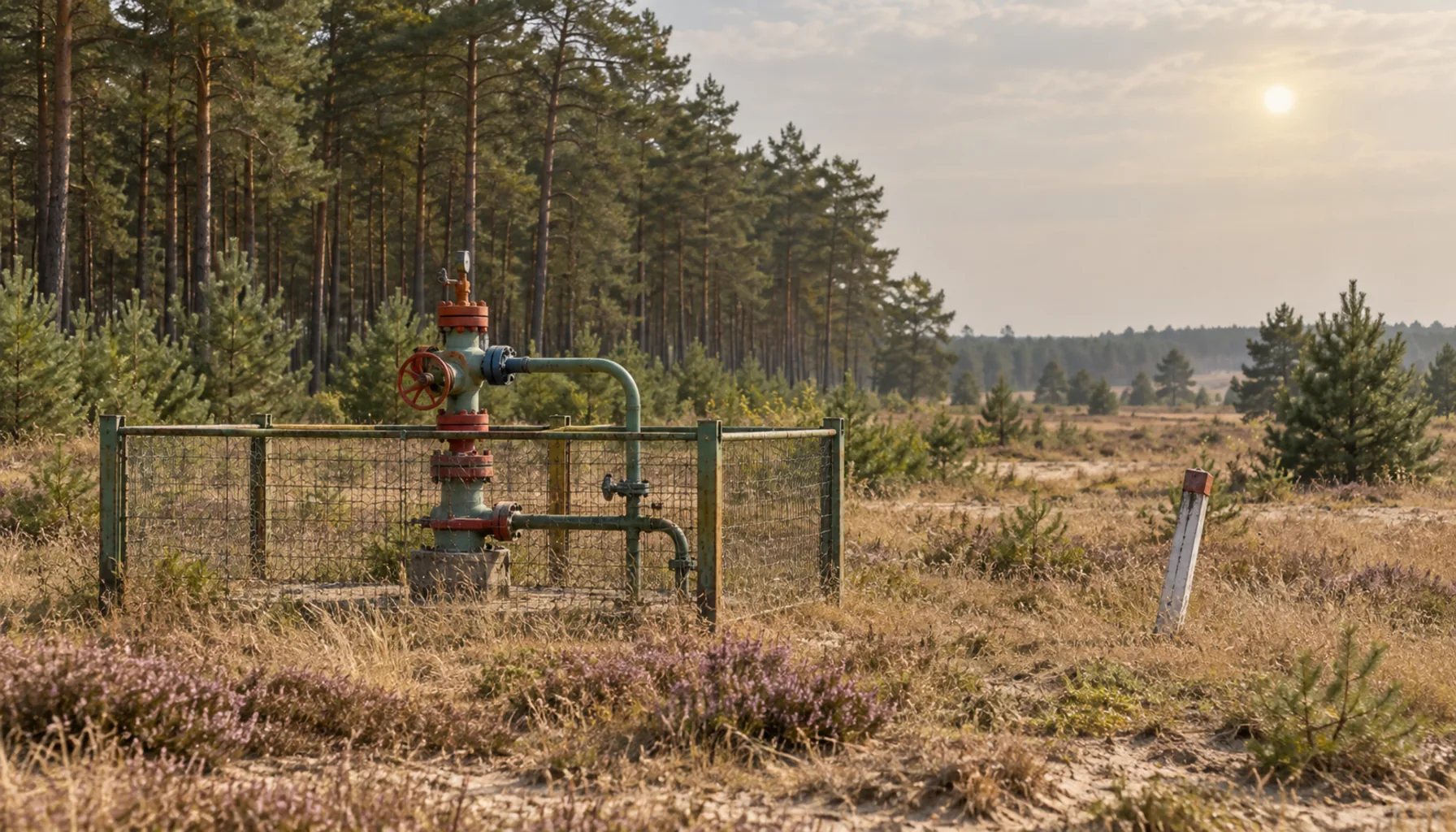
A gas wellhead in the stubble at the edge of the pine woods outside Gbely, where oil and gas were struck around 1913 and gas is now stored underground.Plynová sonda v strnisku na okraji borovicového lesa pri Gbeloch, kde okolo roku 1913 našli plyn a ropu a kde sa dnes plyn skladuje pod zemou.
The year in GbelyRok v Gbeloch
Gbely keep the calendar of a small working town and do not pretend to keep any other. There are church feasts, a town day in the warm months, markets, and the school and cultural-centre concerts that fill the winter; and the fishing and swimming season at Adamovské jazerá, the flooded workings on the edge of town, is what most people here mean by summer. We name no festival and give no dates, because programmes of this kind are set year by year and change faster than a page like this does — the town's own listings are the reliable source.Gbely držia kalendár malého pracovného mesta a netvária sa, že by držali iný. Sú tu hody, dni mesta v teplých mesiacoch, trhy a zimné koncerty školy a kultúrneho domu; a sezóna rybárčenia a kúpania na Adamovských jazerách, zatopených ťažobných jamách na okraji mesta, je to, čo tu väčšina ľudí myslí pod slovom leto. Konkrétne názvy ani dátumy tu neuvádzame — programy tohto druhu sa určujú rok po roku a menia sa rýchlejšie než takáto stránka; spoľahlivým zdrojom sú mestské vývesky a webová stránka.
Two things about the year here are worth knowing anyway. The first is that this is a company town's calendar as much as a village one: an oil field brought engineers, trained workers, wages and shift patterns to a district that had known none of them, and that has shaped what people do with their free time for a century. The second is the country west of the town. The Morava floodplain and the long-distance cycle route along the line of the old frontier put the best days out within a few kilometres, and they belong to spring and autumn as much as to summer, because the birds do.Dve veci o tunajšom roku predsa len stoja za zmienku. Prvá: je to kalendár závodného mesta aspoň tak ako dedinský. Naftové pole prinieslo do okresu inžinierov, vyučených robotníkov, mzdy a zmenový režim, aké tu dovtedy nikto nepoznal, a to už storočie určuje aj to, čo ľudia robia vo voľnom čase. Druhá: krajina západne od mesta. Niva Moravy a diaľková cyklotrasa po línii bývalej hranice majú najlepšie výlety pár kilometrov od domu a patria jari a jeseni rovnako ako letu — pretože vtákom to tak vyhovuje.
Where culture livesKde žije kultúra
The institutions are the ordinary ones for a town of this size: a cultural centre with a hall and a programme, a library, amateur groups and choirs, and a school of art for children. We name none of them individually, because premises and programmes change faster than a page like this does. There is no gallery and no theatre, and it would be dishonest to invent either.Inštitúcie sú tie obvyklé pre mesto tejto veľkosti: kultúrny dom so sálou a programom, knižnica, amatérske súbory a zbory a základná umelecká škola pre deti. Menovite ich neuvádzame, lebo priestory aj programy sa menia rýchlejšie než takáto stránka. Galéria ani divadlo tu nie sú a bolo by nečestné si ich vymýšľať.
The town's real subject is its own industry, and the honest place to meet it is outdoors rather than in a room. Wellheads, pipelines and compressor plant stand among pine woods and stubble fields, fenced, quiet and entirely ordinary to the people who live with them; it is an industrial landscape of a kind found in few other places in Slovakia. If you want that history told indoors, with photographs of the wooden derricks and of the colony that went up beside them, ask locally what is open before you travel — this is a small town, and collections of that sort keep small-town hours.Skutočnou témou mesta je jeho vlastný priemysel a čestné miesto na stretnutie s ním je vonku, nie v miestnosti. Sondy, potrubia a kompresorová stanica stoja medzi borovicovými lesmi a strniskami — oplotené, tiché a pre miestnych úplne samozrejmé; taká priemyselná krajina sa na Slovensku nájde na málo miestach. Ak chcete tento príbeh vidieť aj vnútri, s fotografiami drevených vrtných veží a kolónie, ktorá pri nich vyrástla, opýtajte sa vopred, čo je otvorené — je to malé mesto a takéto zbierky majú malomestské otváracie časy.
The buildings that carry itBudovy, ktoré ju nesú
Gbely have almost no lordly architecture, and there is a reason for it. The village first appears in writing in 1392 as part of the Holíč estate — the fortress that guarded a crossing of the Morava — so its lord always lived somewhere else. A survey of that estate in 1452 counted forty holdings here, which made Gbely the third-largest settlement on the whole estate and still only a village of forty farms on sand. In 1736 the estate was bought by Francis Stephen of Lorraine, the husband of Maria Theresa; Holíč got the baroque residence and the model farm, and Gbely got a better-managed obligation to work for them. Serfdom lasted until 1848.Panská architektúra tu takmer nie je a má to svoj dôvod. Obec sa prvý raz spomína roku 1392 ako súčasť holíčskeho panstva — pevnosti, ktorá strážila prechod cez Moravu — takže jej pán vždy býval inde. Súpis panstva z roku 1452 tu napočítal štyridsať usadlostí, čím boli Gbely tretím najväčším sídlom celého panstva a stále len dedinou štyridsiatich gazdovstiev na piesku. Roku 1736 kúpil panstvo František Štefan Lotrinský, manžel Márie Terézie; Holíč dostal barokovú rezidenciu a vzorný majer, Gbely dostali lepšie spravovanú povinnosť pracovať pre ne. Poddanstvo trvalo do roku 1848.
What stands here instead is younger and industrial. The workers' colony built beside the derricks after 1914 is the town's real monument: company housing put up in a hurry for men who had been farmers a year before. The parish church and the plain village core carry the older half of the story. One earlier community left almost nothing to see but is worth naming — the Habáns, an Anabaptist group who settled here in 1547, held their property in common and lived by skilled craft, growing hemp and pressing oil until their walled yard was burned in 1602.To, čo tu stojí namiesto toho, je mladšie a priemyselné. Robotnícka kolónia postavená po roku 1914 pri vrtných vežiach je skutočnou pamiatkou mesta: závodné bývanie postavené narýchlo pre mužov, ktorí boli rok predtým roľníkmi. Farský kostol a nenápadné jadro obce nesú staršiu polovicu príbehu. Jedno staršie spoločenstvo po sebe nenechalo takmer nič viditeľné, no stojí za to ho pomenovať — habáni, novokrstenci, ktorí sa tu usadili roku 1547, mali majetok spoločný a žili z remesla; pestovali konope a lisovali olej, kým ich ohradený dvor roku 1602 nezhorel.
The field that taught the world to lookPole, ktoré naučilo svet hľadať
In 1912 a Gbely man, Ján Medlen, noticed gas escaping from the ground on his own land. In 1913 it exploded, which is what finally brought the authorities and the geologists; drilling found gas and then crude oil, and extraction began in 1914. By the end of the First World War about four hundred men worked the oil mines here. A farming village had turned into an industrial town in roughly a decade, and the old name of the place, Egbell, went into the scientific literature and stayed there.Roku 1912 si Gbelan Ján Medlen všimol, že na jeho vlastnom poli uniká zo zeme plyn. Roku 1913 vybuchol, a to napokon privolalo úrady a geológov; vrty našli plyn a potom aj ropu a ťažba sa začala roku 1914. Do konca prvej svetovej vojny pracovalo na tunajších naftových baniach asi štyristo mužov. Z poľnohospodárskej dediny sa za necelé desaťročie stalo priemyselné mesto a staré meno miesta, Egbell, sa dostalo do odbornej literatúry a ostalo v nej.
The part worth telling twice happened in 1915. The Hungarian physicist Loránd Eötvös had built a torsion balance delicate enough to measure the tiny differences in gravity caused by heavier or lighter rock deep underground. That summer it was carried out into the stubble fields here and used to map the buried structure holding the oil — the first time anywhere in the world that a geophysical instrument successfully found petroleum. Every seismic survey since descends from that work. Eötvös died in 1919, before the method went round the world; the field he mapped ran dry, was refilled with imported gas, and now serves as one of the larger underground stores in Central Europe. A town of this size can rarely point at anything of the kind.To, čo stojí za to povedať dvakrát, sa stalo roku 1915. Maďarský fyzik Loránd Eötvös zostrojil torzné kyvadlo dosť citlivé na to, aby zmeralo nepatrné rozdiely v tiaži spôsobené ťažšou či ľahšou horninou hlboko pod zemou. To leto ho vyniesli do tunajších strnísk a zmapovali ním podzemnú štruktúru, v ktorej ležala ropa — prvý raz na svete, čo geofyzikálny prístroj úspešne našiel ropu. Každý seizmický prieskum odvtedy vychádza z tejto práce. Eötvös zomrel roku 1919, skôr než metóda obišla svet; pole, ktoré zmapoval, sa vyčerpalo, znova sa naplnilo dovezeným plynom a dnes slúži ako jeden z väčších podzemných zásobníkov v strednej Európe. Na niečo také sa mesto tejto veľkosti môže odvolávať len zriedka.