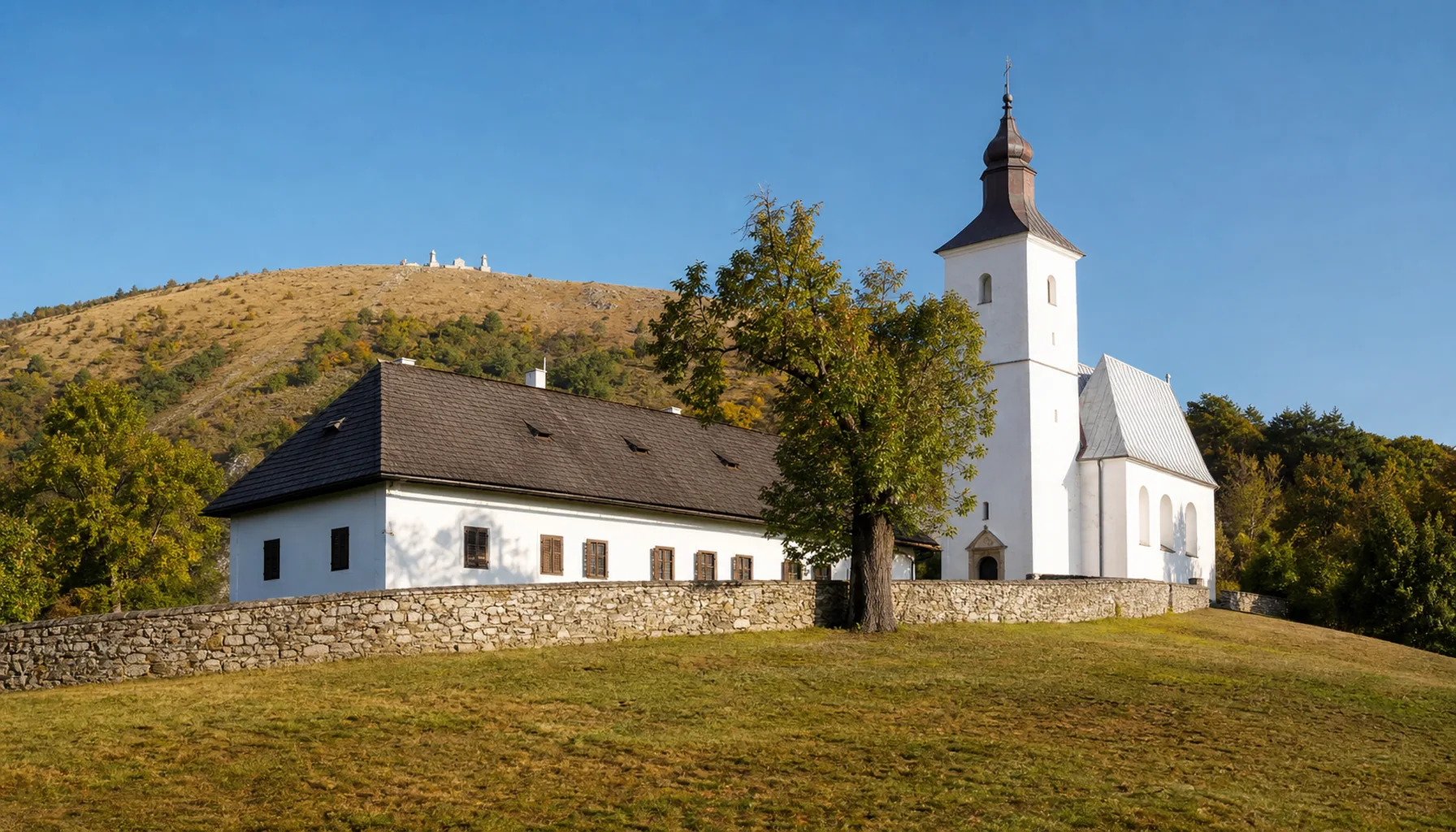
A Lutheran parish village on the Kopanice ridges under Bradlo. Milan Rastislav Štefánik was born in the pastor's house here in 1880; the house is a museum, and the mound that holds his grave stands a few kilometres up the road.Kopaničiarska obec na chrbtoch pod Bradlom s evanjelickou farou. Práve v nej sa v roku 1880 narodil Milan Rastislav Štefánik; dom je dnes múzeom a mohyla s jeho hrobom stojí pár kilometrov cestou hore.
The Lutheran parish house at Košariská, the church beside it and Bradlo behindEvanjelická fara v Košariskách, vedľa nej kostol a v pozadí Bradlo
Where it standsKde leží
Košariská lie in the Myjava uplands, the Kopanice country under the White Carpathians, on the road that leaves Brezová pod Bradlom for Priepasné and Myjava. The village proper is one line of houses along the valley floor; the farmsteads belonging to it are spread over the grassy ridges above.Košariská ležia na Myjavskej pahorkatine, v kopaničiarskom kraji pod Bielymi Karpatmi, pri ceste, ktorá vedie z Brezovej pod Bradlom na Priepasné a Myjavu. Samotná obec je jedným radom domov na dne doliny; usadlosti, ktoré k nej patria, sú rozsypané po trávnatých chrbtoch nad ňou.
The bare ridge of Bradlo rises directly above the village, and the terraced stone mound on its crown — Štefánik's tomb, and one of the best-known pieces of commemorative architecture in the country — has its own account elsewhere on this site. Košariská is where he was born, not where he lies.Priamo nad obcou sa dvíha holý hrebeň Bradla a terasovitá kamenná mohyla na jeho temene — Štefánikov hrob a jedno z najznámejších diel pamätníkovej architektúry v krajine — má na tomto webe vlastný text. Košariská sú miestom, kde sa narodil, nie kde leží.
Why it is herePrečo práve tu
The name records what the place was for. A košiar is a sheepfold, and these ridges were cleared and grazed during the settlement of the White Carpathians in the sixteenth and seventeenth centuries. Good arable land there never was; the living came from sheep, plums, timber and going away to work.Meno hovorí, načo miesto slúžilo. Košiar je ohrada pre ovce a tieto chrbty vyklčovali a spásali pri osídľovaní Bielych Karpát v 16. a 17. storočí. Dobrá orná pôda tu nikdy nebola; živili sa ovcami, slivkami, drevom a odchodom za prácou.
The Kopanice were Lutheran, and in a settlement with no square the congregation held the place together: church, school and parsonage did the work a town centre does elsewhere. Košariská had its own parish, serving farms scattered over several kilometres of ridge.Kopanice boli evanjelické a v sídle bez námestia a bez centra držal veci pokope cirkevný zbor: kostol, škola a fara robili to, čo inde robí mestské centrum. Košariská mali vlastný zbor, ktorý slúžil usadlostiam roztrateným po niekoľkých kilometroch chrbtov.
Pavol Štefánik was pastor here, and his son Milan Rastislav was born in the parish house in 1880, one of a large family of children. What he did afterwards — astronomy, a French general's uniform, the founding of Czechoslovakia — is told on this site's page about the men who made the state. What belongs to Košariská is the building.Farárom tu bol Pavol Štefánik a jeho syn Milan Rastislav sa na fare narodil v roku 1880 ako jedno z mnohých detí. Čo bolo potom — astronómia, uniforma francúzskeho generála, vznik Československa — rozpráva na tomto webe stránka o tvorcoch štátu. Košariskám patrí ten dom.
What you actually seeČo naozaj uvidíte
The parish house is a long, low, whitewashed building with the church beside it, and it has been a museum for decades. The room he was born in is part of it; the rest sets out the family, the parish it served and material from his own life. It keeps fixed hours and a closed day; check before travelling.Fara je dlhá nízka obielená stavba s kostolom vedľa nej a už desaťročia je múzeom. Izba, v ktorej sa narodil, je jeho súčasťou; zvyšok predstavuje rodinu, zbor, ktorému slúžila, a materiál z jeho vlastného života. Má pevné otváracie hodiny aj deň zatvorenia — pred cestou si to overte.
The church next door is the plain wide hall the Kopanice built once Protestants were allowed to build again after 1781, with a gallery inside and a tower added later. It is the working church of a small congregation and is normally locked between services.Kostol vedľa je jednoduchá široká sieň, akú si kopanice postavili, keď evanjelici po roku 1781 znova smeli stavať — s emporou vnútri a s vežou pridanou neskôr. Je to fungujúci kostol malého zboru a medzi bohoslužbami býva zamknutý.
From the village both a road and a marked path go up to Bradlo. The mound stands alone on open grass at the top; there is no gate, no ticket and no shelter, and the wind is the first thing anyone notices. Half a day covers the house, the church and the climb without hurrying.Z obce vedie na Bradlo cesta aj značený chodník. Mohyla stojí na vrchole sama na otvorenej tráve; nie je tam brána, vstupenka ani prístrešok a prvé, čo si tam každý všimne, je vietor. Pol dňa stačí na dom, kostol aj výstup bez zhonu.
Living village, not a museumŽivá obec, nie skanzen
Košariská is a small working village, not a memorial site with a village attached. The museum is one building on the street, the church is used by the people around it, and the kopanice on the ridges are private farms and weekend houses. Gates stay shut and yards are not thoroughfares.Košariská sú malou fungujúcou obcou, nie pamätným miestom s obcou navyše. Múzeum je jeden dom pri ceste, kostol používajú ľudia, ktorí bývajú okolo, a kopanice na chrbtoch sú súkromné gazdovstvá a chalupy. Brány zostávajú zavreté a dvory nie sú prechodom.
Two dates fill the place: the anniversaries of Štefánik's death in May and his birth in July bring ceremonies and coaches to Bradlo and to the house below it. On an ordinary weekday the village is quiet and the ridge is empty.Dva dátumy miesto zapĺňajú: výročia Štefánikovej smrti v máji a jeho narodenia v júli privádzajú na Bradlo aj k domu pod ním pietne slávnosti a autobusy. V bežný všedný deň je obec tichá a hrebeň prázdny.
Getting thereAko sa tam dostať
There is no railway. Buses run from Myjava and Brezová pod Bradlom, thinly at weekends, and the nearest station is Myjava on the branch line from Nové Mesto nad Váhom to Vrbovce. By car it is the hill road out of Brezová pod Bradlom.Železnica sem nevedie. Autobusy premávajú z Myjavy a z Brezovej pod Bradlom, cez víkend riedko, a najbližšia stanica je Myjava na odbočnej trati z Nového Mesta nad Váhom do Vrboviec. Autom sa ide kopcovitou cestou z Brezovej pod Bradlom.
Explore KošariskáObjavujte Košariská
Every part of this place with a page of its own.Každá časť tohto miesta, ktorá má vlastnú stránku.